The post Ultimate Guide to Japanese Etiquette appeared first on Japan Switch.
]]>Ultimate Guide to Japanese Etiquette
By Astri Elvarita | Feb 24th, 2026
If you're planning to visit Japan, you've probably already noticed that daily life in Japan follows many unwritten rules, especially in public places and at temples or shrines. Small details often surprise first-time visitors and can make Japanese etiquette seem intimidating. To make things easier, this article outlines essential Japanese etiquette that travelers are likely to encounter in everyday situations, from using public transportation and dining to visiting temples, helping you avoid common mistakes and feel more confident while traveling.
This article is a part of our extensive series on Learning about Japan through Online Japanese Lessons at Japan Switch.


Learn Japanese. Make friends. Enjoy Japan.
Save up to 30 - 60% on your Japanese lessons while learning online or in the heart of Tokyo
with Japan Switch!
What Tourists Commonly Worry About
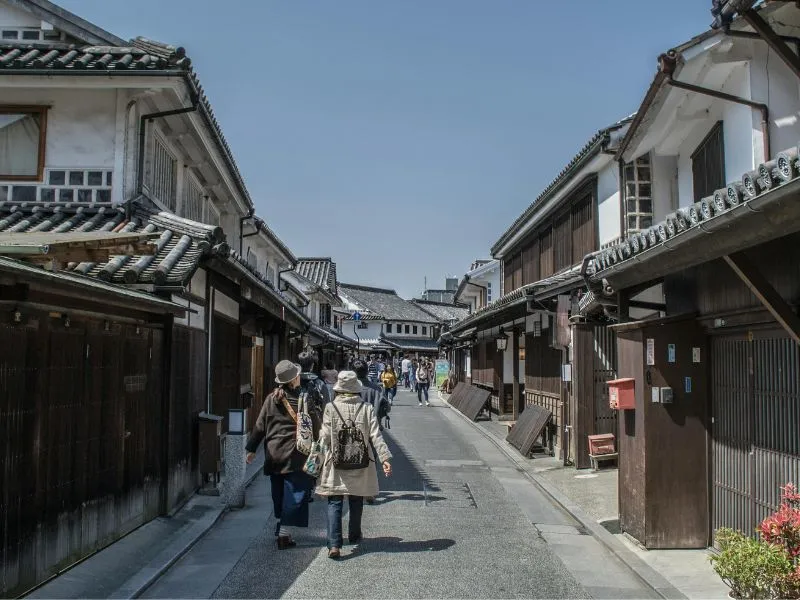
Japanese etiquette is not a random set of rules; it reflects deep cultural values that have developed over centuries. Have you ever wondered why social etiquette is so strict in Japan? These rules did not appear overnight. It’s got deep roots in the country’s history and culture.
In recent years, Japanese etiquette has become a popular topic on social media, but much of this content lacks proper context or exaggerates how strict the rules actually are. While Japan values politeness and consideration, most Japanese people do not expect visitors to behave perfectly. As long as travelers show basic respect and awareness of their surroundings, small mistakes are usually understood, and many rules are frequently easy to apply.
Still, many tourists worry about unintentionally breaking social rules or causing inconvenience without realizing it. Some may talk loudly on the phone on trains instead, or try to tip even though tipping isn’t common in Japan. Below are some basic Japanese etiquette tips to keep in mind before visiting.
Japanese Street Etiquette
Japanese streets are often busy, and we are expected to stay aware of our surroundings. Stopping suddenly, walking in large groups across narrow sidewalks, or checking phones while standing in busy areas can disrupt pedestrian flow. While these basic rules are easy to understand, there are other important points of street etiquette that visitors should be aware of.
Confused between Yukata and Kimono?
Learn about the differences in our Ultimate Guide to Yukata and Kimono.
Busy Streets in Shibuya
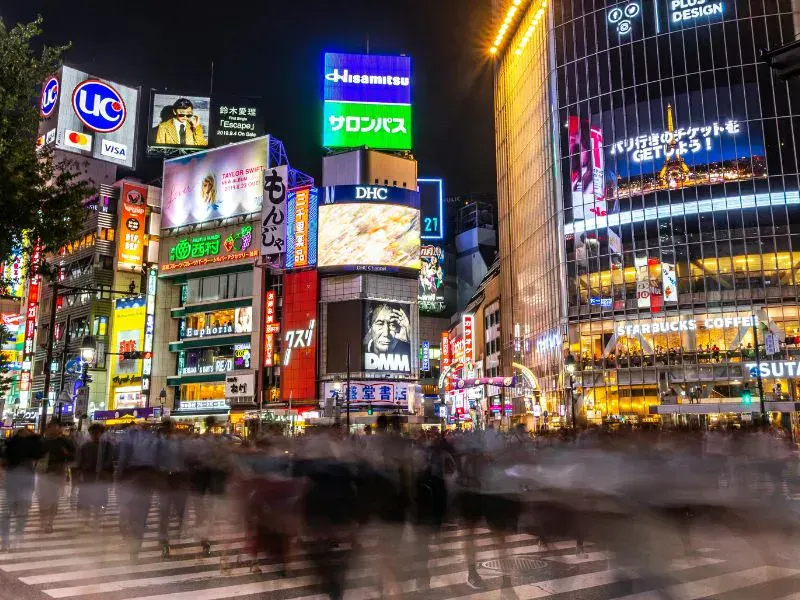
Shibuya is one of Tokyo’s busiest districts. Areas such as Shibuya Crossing experience extremely heavy foot traffic, particularly on weekday evenings between 5:00 p.m. and 8:00 p.m., as well as on weekends and public holidays. During these peak times, pedestrians tend to move quickly and with purpose, and stopping abruptly can increase the risk of accidents.
There is an extra consideration required in crowded areas like Shibuya for photography. If you wish to take pictures, it is polite to step aside to a less crowded area where you are not blocking others. Additionally, photographing strangers without permission is discouraged.
Eating and Drinking on the Street
Eating or drinking while walking is generally discouraged in Japan. Although it is not strictly forbidden, this helps maintain cleanliness and prevents litter in public spaces. Exceptions may be seen during festivals or in certain street food areas, where eating while standing nearby is considered acceptable.
Smoking on the Street
Many urban areas in Japan restrict smoking in public spaces, allowing it only in designated smoking areas. These measures are intended to maintain hygiene, so visitors need to pay attention to the signs before smoking.
Japanese Etiquette on Public Transportation
Trains and buses are the most common modes of transportation in Japan. Many tourists say Japan's transportation system, especially in Tokyo, is on another level compared to that of other countries.
It’s important to know the proper manners when using public transportation. Misbehavior can result in unpleasant glances and even a warning from other passengers or train staff. To maintain comfort, all passengers are expected to follow Japanese etiquette on trains or buses.
Before Getting on the Train at the Station
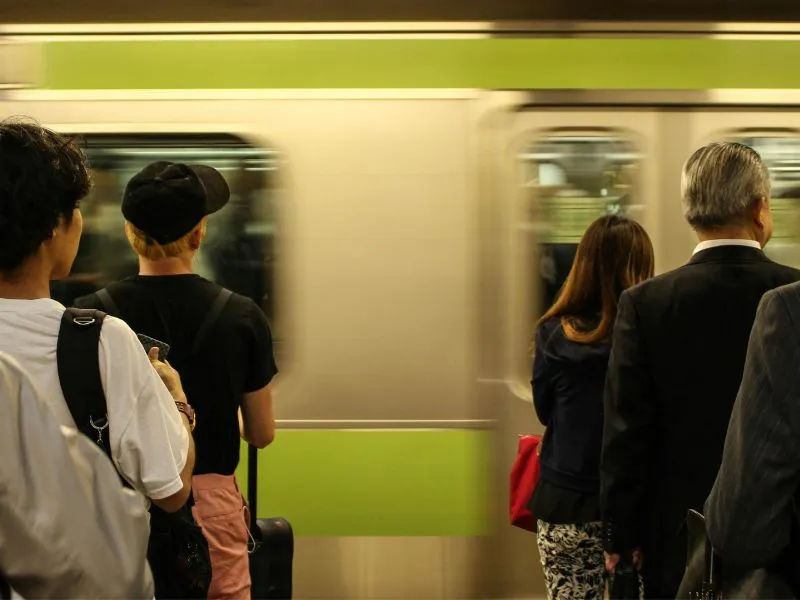
Once you enter the station, pay attention to which side you're walking on. Although station staircases are usually wide, passengers are expected to keep to the designated sides. Once you enter a station, pay attention to the signs and floor markings. In many smaller or less crowded stations, people may walk freely without strict lane separation. However, in major stations such as Shibuya, clearly marked paths often indicate which side to walk on. One side is used by passengers entering the platform, while the opposite side is used to exit the train. Following these signs helps avoid blocking other passengers, and always pay attention to station signs, as walking rules may differ.
When waiting for a train, line up behind those already waiting and remain behind the yellow safety line. If the train stops, don't rush to board as soon as the doors open; let people get off the train first.
No Loud Noise
Trains, especially in Japan’s main cities, are a primary mode of transportation, and many people commute while feeling tired. Therefore, maintaining a quiet atmosphere is essential when traveling by train.
Avoid talking on the phone; if it is really necessary, keep your voice low. The same goes when chatting with friends, and keep your headphone volume low. On the Shinkansen only, move to the area between the train cars to take a phone call.
No More Cookie-Cutter Japanese Lessons!
At Japan Switch, we teach the Japanese you’ll actually hear, actually use, and actually need and not just textbook sentences you’ll never say.
Backpacks and Personal Belongings
When standing on a crowded train, backpacks should be worn on the front to avoid bothering other passengers. This will make it easier for others to get on and off the train. If you're carrying large items, such as suitcases, keep them close to you and hold them tightly so they don't get separated from you.
Seating Etiquette
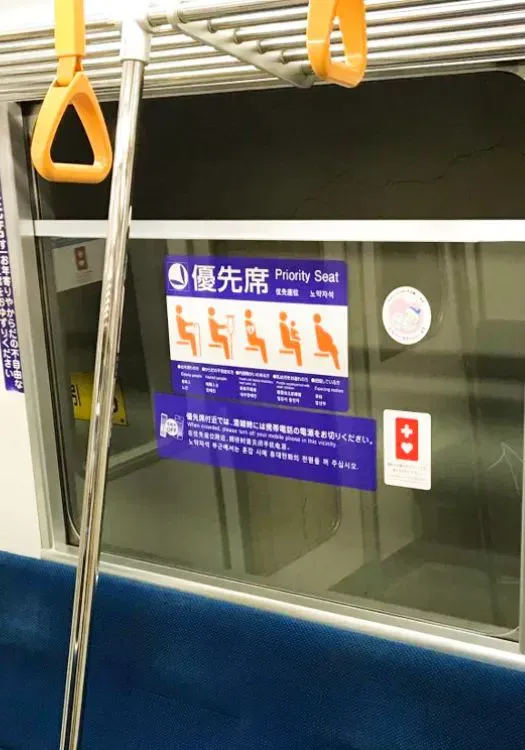
Japanese trains provide priority seating to pregnant women, elderly people, people with disabilities, and others who need extra support. These seats are usually clearly marked and should be given up immediately when someone in need joins the train. Even when the train is not full, passengers are usually expected to use available seats in the main seating section rather than selecting priority seats for more personal space.
Cell phones should be set to silent in these areas, as some passengers may be using medical devices that are sensitive to electronic signals.
Offering your seat to someone in need is considered proper train etiquette in Japan. Additionally, during certain times, some trains have women-only cars, so be sure to check the signs before boarding.
Philosophy: Natural, minimalistic, skin-first approach
General Behaviours
Some general behaviours to be aware of include avoiding eating or snacking outside restaurants. However, eating and drinking are generally permitted on long-distance or limited-express trains, such as the Shinkansen. Also, never throw away or leave trash, even if it's small. Keep everything in your bag. Sometimes you'll find trash bins on train platforms.
For women, applying makeup while the train is moving is considered impolite, as cosmetics may spill and stain other passengers’ clothing or the seats, and many people find this behavior unpleasant. It is best to finish getting ready before boarding the train.
In Japan, smoking is generally prohibited outdoors, except in designated areas. However, there are strict no-smoking rules on trains, except in designated smoking areas on Shinkansen trains.
Japanese Dining Etiquette
Dining in Japan is quite easy, although the experience may be differ from what you're used to. That's why it's important to learn proper dining etiquette and how to eat when dining in Japan. There are some important dos and don'ts to keep in mind when dining in Japan. While minor mistakes can happen, understanding the customs and etiquette will help you make a good impression wherever you are.
Before Eating
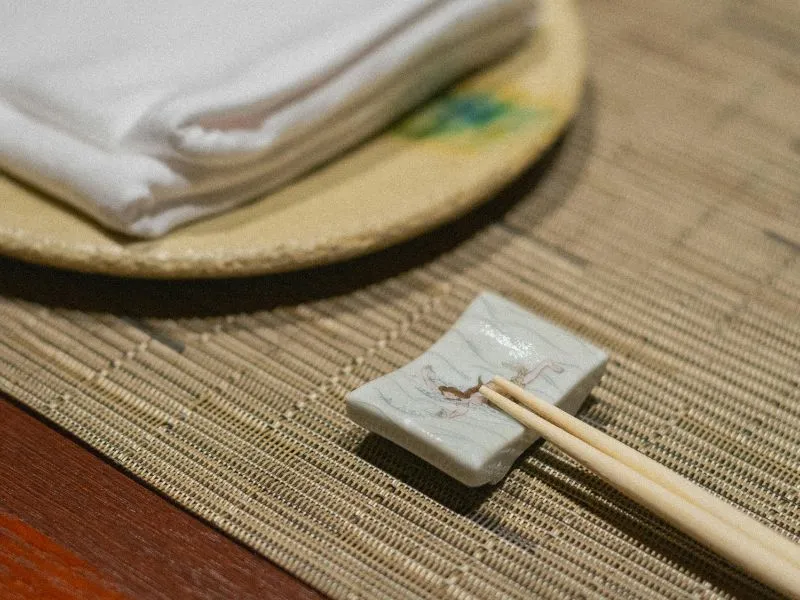
Before starting a meal in Japan, wet towels (oshibori) are provided at most restaurants to clean your hands before eating, and it is polite to say “itadakimasu” before eating to express gratitude for the food and everyone involved in preparing it. “Itadakimasu” literally means “I humbly receive” and reflects appreciation not only for the person who cooked the meal but also for everyone and everything involved in making it.
Timing matters in Japan,
Learn more in our Ultimate Guide to Seasons in Japan to get the best experience when visiting Japan.
Using Chopsticks
Place them in the holder when not in use and handle them carefully. Sticking chopsticks upright in a bowl of rice, transferring food directly from one pair of chopsticks to another, or pointing with chopsticks is considered taboo due to its association with funerals. If you have difficulty holding chopsticks, you can ask for a fork or spoon. You can also place them on the rim of your bowl or plate if there is no holder.
Eating Sushi
Sushi can be eaten with chopsticks or your hands, depending on your preference. Three common seasonings can be served with sushi: shoyuu (Japanese-style soy sauce), wasabi (Japanese horseradish), or shoga (pickled ginger). When dipping sushi in shoyuu, dip only the fish side, not the rice side, to prevent the sushi from absorbing too much sauce and then falling apart. Now that you’ve learned the basics of sushi etiquette, let’s dive deeper into our Ultimate Guide to Japanese Sushi: How Much Do You Know?
Eating Noodles
Slurping noodles like ramen or udon is acceptable and even considered a sign of enjoyment, especially when they're still hot. However, other loud eating sounds, such as chewing with your mouth open or burping, should be avoided.
After Eating
After finishing a meal, saying "Gochisousama Deshita" is a polite way to give thanks for the food. Placing your palms together and a slight bow can also be added to show extra respect, especially when dining with others.
Eating in Convenience Stores
Japanese convenience stores, commonly known as konbini, such as 7-Eleven, Lawson, and FamilyMart, are an essential part of daily life in Japan. Most are open 24 hours a day, making them very popular for late-night dining or a quick stop after a long journey.
You'll often encounter freshly brewed coffee, canned iced coffee priced at about ¥120, hot steamed buns, such as pork-filled nikuman, for around ¥130, and even single-serving alcoholic beverages like beer or sake. Numerous shops also offer hot water stations for instant noodles, machines for smoothies, and complimentary plastic utensils.
Since food at konbini is intended for immediate consumption, some stores provide small dining areas with tables or counters for customers to eat in. If they do not offer those, it is best to take the food elsewhere rather than eating inside the store. Eating while walking away from the store is generally discouraged in Japan. Rather, people usually finish their food near the place of purchase before continuing on their way.
Visiting Japan on holiday?
We offer short-term Japanese classes so that you can make the most of your trip! Learn honest-to-kami-sama Japanese that you actually need from our native Japanese teachers!
Book a free consultation with us and inquire about our Short-Term Classes!
After understanding basic table manners, it is also important to be aware of specific dining etiquette in Japan. Some key points to keep in mind include how to pay and the tipping system. In many restaurants, except for high-end ones, payment is taken at the counter, not at the table. Outside of major cities, many restaurants and shops still prefer cash, so it's best to always carry cash. This is gradually changing, and more stores are also offering mobile payments like Apple Pay or PayPay.
Japanese Drinking Etiquette
Drinking alcohol is a significant part of social life in Japan, whether with friends, at a workplace gathering, or at a celebration at an izakaya (Japanese pub). You can legally consume alcohol if you are 20 years old or above. Foreigners who attempt to break the law in Japan may end up in jail or face deportation without a chance to return. The last thing you want in Japan is to visit a police station where they don't understand English, and end up waiting in a holding cell while they decide your fate. If you're under 20, avoid drinking alcohol in Japan.
Sake and Japan go hand in hand
Don’t stop at just knowing it, explore more in our Ultimate Guide to Sake Brewery.
Nommunication (Nomikai)? After-Work Drinking Culture
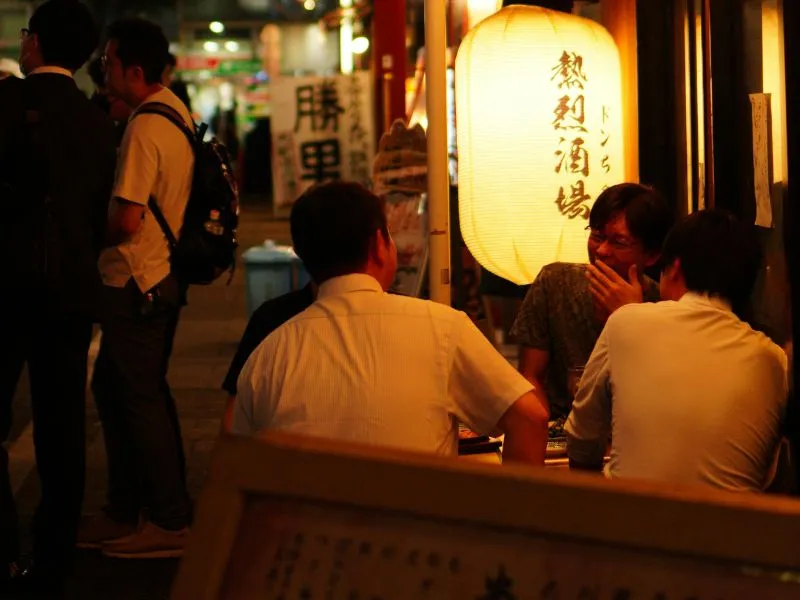
Nommunication, also known as nomikai or nominication, refers to the practice of drinking alcohol as a way to encourage communication and strengthen relationships among colleagues.
The term combines the Japanese verb nomu (飲む), meaning “to drink,” with the English word “communication.” Together, it reflects the idea that drinking can help facilitate open conversation in social and professional settings. In Japan, nomikai often take place after work and typically involve coworkers, supervisors, or business partners gathering.
Nommunication is well-liked for several reasons. In Japan, the societal hierarchy is rigid. Individuals typically prefer to appear serious, disciplined, and reserved, which can limit open expression during working hours. Organizations view social drinking as advantageous since it allows colleagues to relax their inhibitions and foster stronger connections with one another and with clients.
When workers feel less stressed, they are more likely to share concerns and express their views with each other and their managers. This transparency is seen as beneficial, and many believe it helps the organization's growth. There are a few etiquette points worth keeping in mind.
Pouring for Others and Group Drinking
One of the most important aspects of Japanese drinking etiquette is the custom of oshaku, pouring drinks for others rather than for yourself. In group settings, it is considered polite to watch your companions’ glasses and offer to refill them when they are low, rather than pouring your own drink. When someone offers you a drink, it is respectful to receive it with both hands as a sign of gratitude.
Have Food with Your Drinks
In Japan, drinking is rarely done on its own. It is customary to enjoy alcohol alongside a meal or small dishes, especially in social settings such as izakayas or group gatherings. These accompanying dishes are often referred to as otsumami, which are light snacks similar to Western bar food. Common otsumami include items such as edamame, shredded dried squid, and rice crackers.
Public Drinking and Legal Norms
Open consumption of alcohol in public places such as parks or on the streets is not strictly prohibited, and many people enjoy drinking during festivals or during hanami (cherry blossom viewing). However, it is still important to behave respectfully and avoid causing a disturbance.
Besides sake, it's one of Japan’s most loved drinks
Find out more in our Ultimate Guide to Umeshu (Japanese Plum Wine) for a sweet and refreshing Japanese wine.
Solo Drinking Culture in Japan
While traditional nomikai focuses on group socializing, solo drinking (hitori-nomi) has grown in popularity, especially in urban areas. Japan even has a Solo Drinking Association called Soroyoi (そろよい) with tens of thousands of members that welcome individual drinkers. It even uses
“Let’s protect solo drinking culture and move toward a society without loneliness or isolation.”
as its membership recruitment slogan. Bars such as Bar Hitori (which means alone in Japanese) in Tokyo are designed specifically for people who want to drink alone, and many izakaya naturally accommodate solo customers. In this context, enjoying a drink by yourself is socially acceptable.
Overall, drinking in Japan is about respect and balance. Joining a nomikai can be a great way to bond, but it’s totally okay to say no if you don’t feel like drinking. With solo drinking becoming more common, people are more understanding of personal preferences than ever. As long as you’re polite and considerate, you’ll fit in just fine, whether you choose to raise a glass or give it a miss.
Japanese Etiquette While Visiting a Temple and Shrine
Praying at a shrine in Japan is referred to as "omairi", and when it is done during the New Year, it is called "hatsumoude". Some people believe that visiting multiple shrines may result in bad luck, as it is associated with greed. In reality, this idea is only a myth, since each shrine offers different spiritual meanings and blessings. Visitors may pray at one shrine or several without concern.
Before visiting temples and shrines, certain actions are considered disrespectful. Visitors should avoid touching sacred objects or taking photographs in prohibited areas, especially inside prayer halls or during religious ceremonies.
Photography etiquette is taken seriously in Japan, and ignoring “No Photography” signs (particularly in temple halls, museums, or during rituals) is considered a serious matter. Appropriate attire is also important. Overly revealing or inappropriate clothing may result in visitors being warned, asked to cover up, or denied entry.
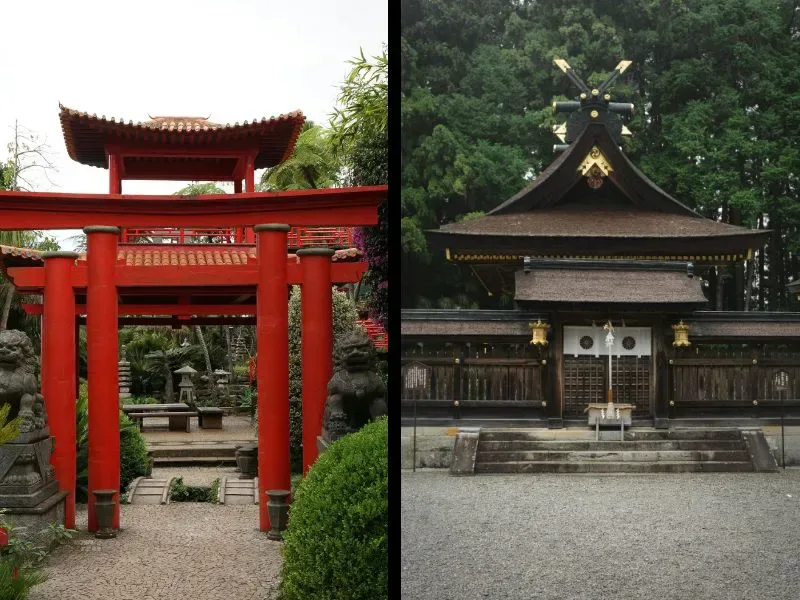
Understanding these basic etiquettes becomes easier once visitors can distinguish between Buddhist temples and Shinto shrines. There are two simple ways to differentiate it. First, Shinto shrines are characterized by a simple gate called a "torii," which symbolizes the boundary between the sacred world and the human world. In contrast, the entrance to a Buddhist temple often resembles a large building rather than a traditional gate. Second, Buddhist temples typically feature statues or images of the Buddha, while Shinto shrines do not display such representations.
In short, Shinto shrines are places where deities are worshipped, while Buddhist temples are associated with the Buddha.

Visiting a Shinto Shrine
Before entering a torii gate, it is customary to bow and walk along the sides of the pathway rather than the center. The center of the path and the torii gate are believed to be reserved for the gods, not for humans.
On the way to the shrine, you will usually find a small pavilion with water called a "chozuya". This marks the first ritual, where visitors purify themselves before approaching the main shrine. Use the ladle to pour water over your left hand, then your right hand. Next, pour a small amount of water into your left hand and gently rinse your mouth; do not drink directly from the ladle. Finish by holding the ladle upright to allow any remaining water to run down the handle, cleaning it for the next person. This purification ritual should be performed even in cold weather.
Once you reach the shrine, show respect by following the proper prayer steps, which are performed in several stages.
Bow lightly
as a sign of greeting and respect.
Offer a coin into the offering box
The amount does not matter; a higher value does not increase the likelihood of your request being granted. Some Japanese people believe that a ¥5 coin brings good relationships because go-en (5 yen in Japanese) sounds the same as the word for “connection” or “relationship.” However, this belief is only a myth, as the gods existed long before the yen currency.
Ring the bell two or three times
if there is one, as a sign of notification to the gods of the arrival of humans.
Bow deeply twice
bending forward at about a 90-degree angle.
Clap your hands twice
with your left hand slightly in front of your right.
Offer your prayer
remembering to express gratitude rather than only making requests.
Bow deeply once more
to conclude the prayer.
Visiting a Buddhist Shrine
The rules are the same as entering a Shinto shrine. Bow slightly before entering the shrine grounds, walk along the sides of the path, and purify yourself at the chozuya. However, the manner of paying respect to the shrine differs.
Light incense (usually provided at the shrine)
The smoke and fragrance of incense are believed to be offerings to the Buddha. Lighting your incense from one that is already burning is considered taboo, as it symbolically means taking on the sins left behind by others.
Bow slightly
Offer a coin into the offering box
Ring the bell (if available) 2 or 3 times
Bow lightly again and pray with your hands joined together
but do not clap. Holding prayer beads or a rosary during the prayer is encouraged. Remember to express gratitude to Buddha during your prayer.
Want to go deeper?
Go deeper in our Ultimate Guide to Shrines and Temples in Tokyo for everything you need to know.
After offering prayers, visitors can purchase "ema", small wooden plaques on which wishes or prayers are written and then hung at the shrine so the gods may receive them. Other popular shrine souvenirs include hamaya (sacred arrows) and omamori (protective charms), such as those for safe travel or fertility. These items are usually taken home and displayed for protection.
Draw a Fortune
For a small fee, visitors can draw an omikuji, a paper fortune that predicts luck for the future. Omikuji range from great fortune to bad luck and often include advice on areas such as relationships, health, and personal goals. While usually written in Japanese, some shrines also provide English versions. Omikuji can be classified as follows (from best to worst):
| 大吉 | Dai-kichi | Great blessing |
| 中吉 | Chuu-kichi | Moderate blessing |
| 小吉 | Sho-kichi | Small blessing |
| 吉 | Kichi | Blessing |
| 末吉 | Sue-kichi | Future blessing |
| 凶 | Kyo | Bad luck |
| 大凶 | Dai-kyo | Great misfortune |
Shrines and Temples with English Omikuji in Tokyo and Kyoto

-Meiji Shrine (Shibuya, Tokyo)
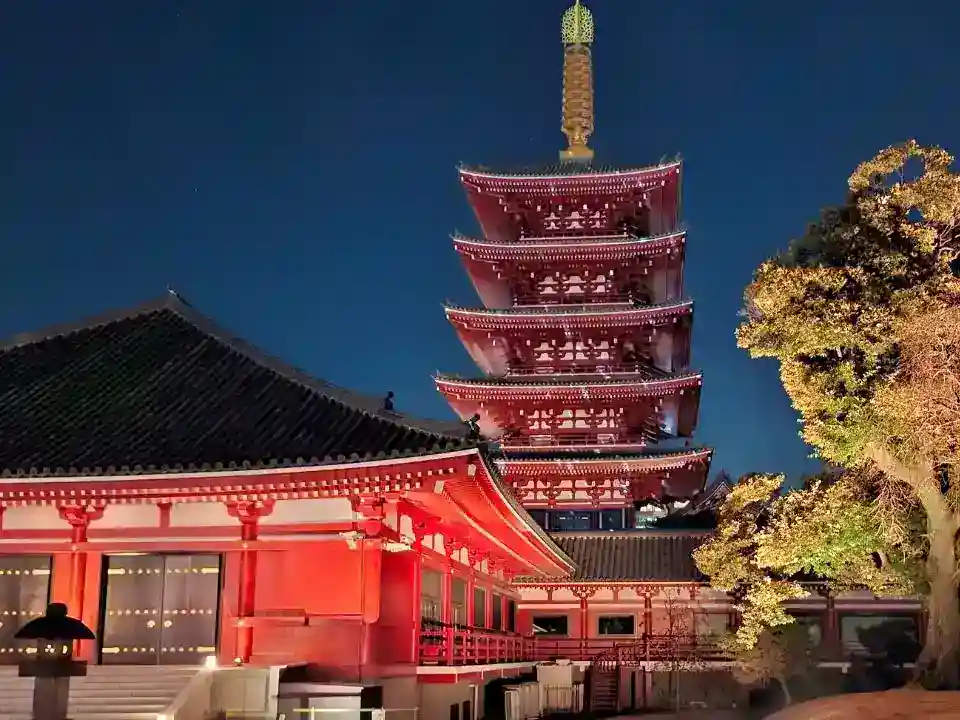
-Senso-ji (Asakusa, Taito City, Tokyo)
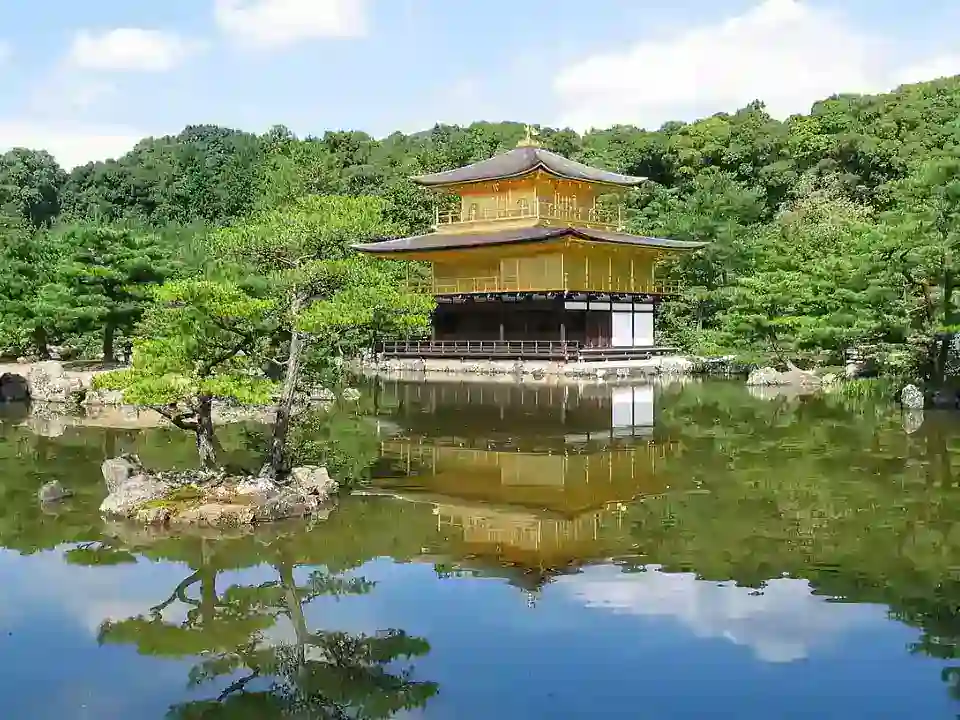
-Kinkaku-ji (Kita Ward, Kyoto)
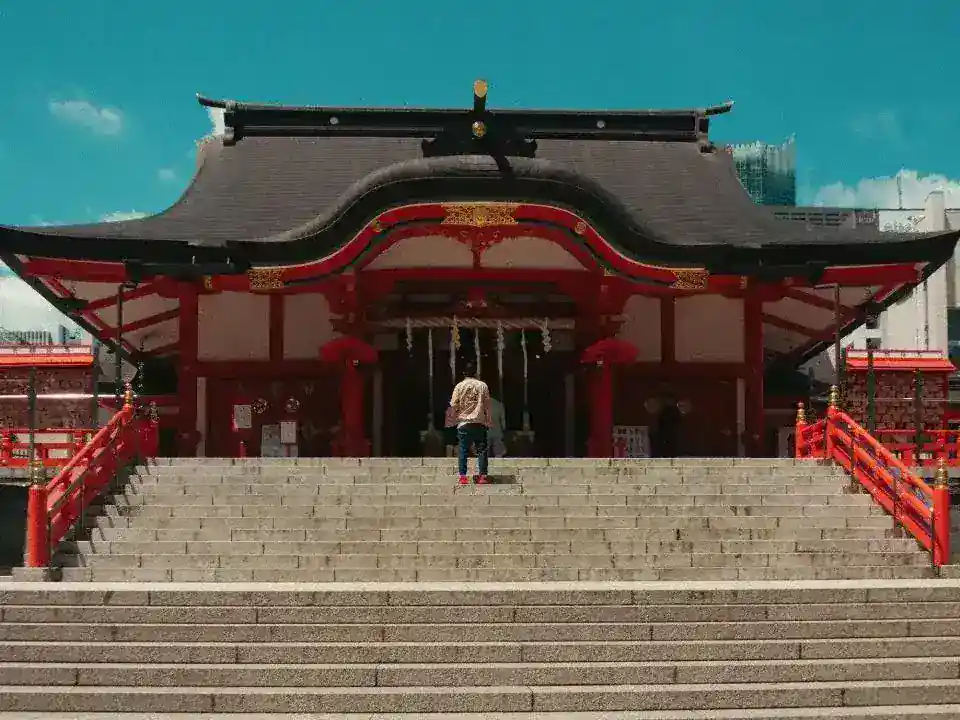
-Hanazono Shrine (Shinjuku, Tokyo)
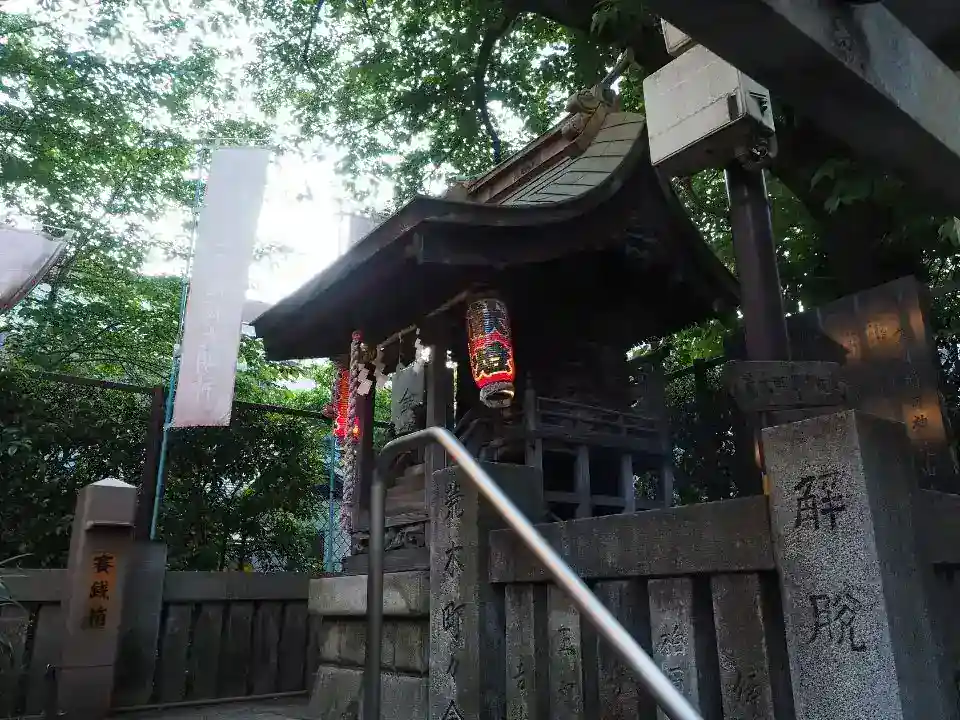
-Jindai-ji (Chōfu, Tokyo)
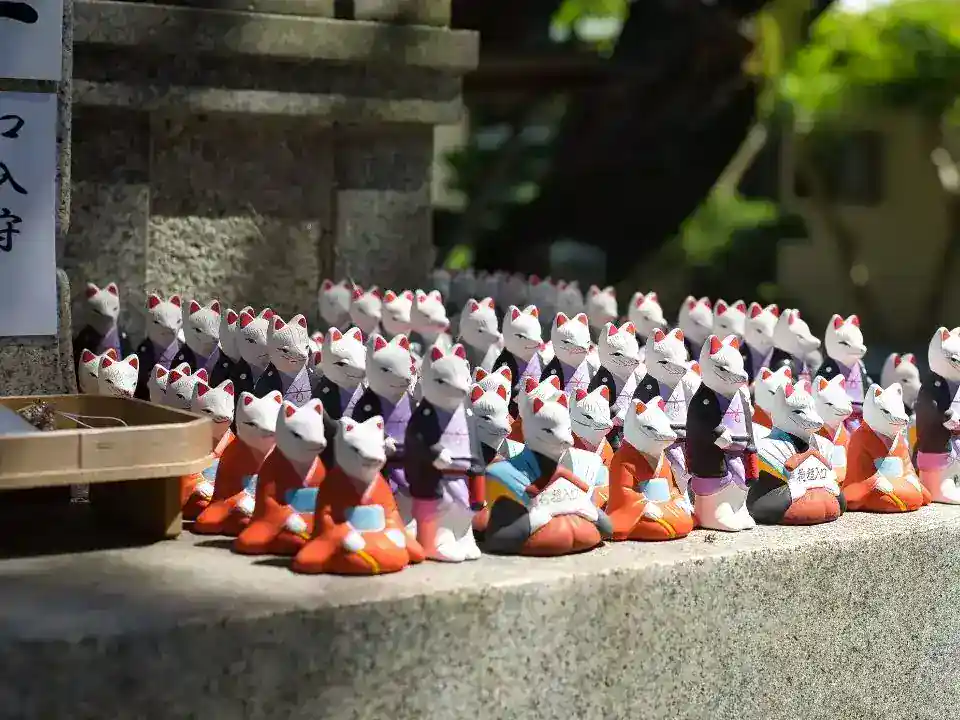
-Araki Shrine (Fushimi Inari area, Kyoto)
Greetings in Japanese Etiquette

Japanese is more than just a means of communication. Word choice, politeness, and manner of speaking convey respect, even efforts to maintain social harmony. The historical and cultural influences on the structure of the Japanese language make politeness deeply embedded in everyday conversation.
For example, expressions like "Arigatou Gozaimasu" or "Sumimasen" not only convey gratitude but also reinforce social etiquette that respects others and reflects politeness. For visitors, even without fluency in Japanese, using simple polite expressions, a low tone, and paying attention to social context are sufficient to show respect. There is also bowing (Ojigi), which is the most common and culturally appropriate way to greet someone, show respect, thank someone, or apologize. It has become an important cultural tool that everyone in Japan is taught to practice properly, from an early age into a professional life.
Planning a longer stay?
Our Top 15 Tips to Make Japanese Friends can help you connect naturally.
Bowing in Japanese Etiquette
In Japan, people mostly greet each other by bowing. There are many different types of bows, from a slight nod of the head to a deep bow at the waist. Deeper and longer bows indicate respect, while small nods are more casual and informal. Bows are also used to express gratitude, apologize, make requests, or ask for help.
Most Japanese people don't expect foreigners to know the proper bowing rules. For most interactions tourists encounter, such as greeting shopkeepers or expressing gratitude, a gentle nod is acceptable and appreciated. Therefore, even a slight nod or a simple bow demonstrates respect and cultural awareness. Handshakes are very rare, but exceptions can be made, especially in international business situations.
Common Polite Greeting Phrases in Japanese
In everyday Japanese etiquette, greetings serve not only as conversation openers but also as a sign of respect. Choosing the right greeting depends on the time and situation. Using appropriate greetings demonstrates cultural awareness and basic Japanese etiquette.
| Romaji | Ohayou Gozaimasu |
| Japanese | おはようございます |
| English | Good Morning |
"Ohayou Gozaimasu" is a polite way to say "Good Morning" in Japanese. This is commonly used until around 11 a.m. Using "Gozaimasu" here indicates politeness and is usually used for formal conversations; in more casual situations, simply "Ohayou" can be used. Of course, knowing how to say "Ohayou Gozaimasu" is important if you work with Japanese people. The impression you make is largely determined by your morning greeting.
| Romaji | Konnichiwa |
| Japanese | こんにちは |
| English | Hello or Good Afternoon |
"Konnichiwa" is a standard greeting meaning "Hello" or "Good Afternoon," typically used during the day or evening as a general greeting. It can generally be used as a neutral, polite greeting, making it suitable for almost any situation. Due to its flexibility, "Konnichiwa" is one of the most frequently used greetings by visitors to Japan.
| Romaji | Konbanwa |
| Japanese | こんばんは |
| English | Good Evening |
Sounding kind of similar to "Konnichiwa," "Konbanwa" is the Japanese greeting for "good evening." According to NHK, the Japan Broadcasting Corporation, "Konbanwa" is best used after the sun has set and it's getting dark. Like konnichiwa, konbanwa is neutral and can be used in both formal and informal contexts.
| Romaji | Sumimasen |
| Japanese | すみません) |
| English | I'm Sorry/Excuse me |
This phrase has many different meanings. Besides meaning "Sorry," it's also used to express permission or politely get someone's attention, such as when you want to ask a stranger. It may seem a little confusing at first, but after using it a few times, it will become second nature. When Japanese people say "Sumimasen," they often bow as a sign of respect or apology.
| Romaji | Gomennasai |
| Japanese | ごめんなさい |
| English | I'm Apologize |
This expression is generally used to express a sincere or personal apology.
Unlike "Sumimasen," which can also be used to attract attention or make a polite request, "Gomennasai" is particularly for situations where you want to apologize more directly.

| Romaji | Arigatou Gozaimasu |
| Japanese | ありがとうございます |
| English | Thank You |
A polite expression for saying "Thank you." This phrase is used in both formal and semi-formal situations. The shorter form, "Arigatou," is used in casual contexts.
| Romaji | Yoroshiku Onegaishimasu |
| Japanese | よろしくお願いします |
| English | I look forward to working with you |
It roughly means “Please take care of me” or “I look forward to working with you.” It expresses politeness and a request for cooperation rather than a direct request. While it doesn't have a direct equivalent meaning in English, “Yoroshiku Onegaishimasu” is commonly used after introducing yourself, in the workplace, or at the start of a new interaction. To learn more about how “Onegaishimasu” is used, read our article on How to Say Please in Japanese.
| Romaji | Moshi Moshi |
| Japanese | もしもし |
| English | I speak/Hello |
"Moshi Moshi" is a Japanese telephone greeting. It's used when answering the phone or when you’re trying to get someone’s attention over the line. It's a casual greeting and is never used in face-to-face communication. It can also be used to confirm the line is still open when the conversation suddenly goes silent.
Bowing vs. Handshakes + Punctuality
Japanese is more than just a means of communication. Word choice, politeness, and manner of speaking convey respect, even efforts to maintain social harmony. The historical and cultural influences on the structure of the Japanese language make politeness deeply embedded in everyday conversation.
For example, expressions like "Arigatou Gozaimasu" or "Sumimasen" not only convey gratitude but also reinforce social etiquette that respects others and reflects politeness. For visitors, even without fluency in Japanese, using simple polite expressions, a low tone, and paying attention to social context are sufficient to show respect. There is also bowing (Ojigi), which is the most common and culturally appropriate way to greet someone, show respect, thank someone, or apologize. It has become an important cultural tool that everyone in Japan is taught to practice properly, from an early age into a professional life.
Bowing vs. Handshakes
In Japan, physical contact during greetings is generally limited, and bowing remains the most common and culturally appropriate form of greeting. As explained before, there are so many kinds of bowing, which depend on the kind of situation you are in.
Although handshakes have become more common, especially in international business environments where different cultures interact, they are still considered secondary to bowing in everyday Japanese etiquette. Physical gestures such as hugging, patting someone on the back, or other casual touches are typically for close friends or family and are uncommon in public. As a result, initiating physical contact may feel uncomfortable for some people.
Let's step inside Japan’s traditional houses
By exploring more in our Ultimate Guide to the Traditional Japanese House.
For visitors, the safest approach is to follow the other person’s lead. If someone offers a handshake, it is acceptable to respond, but when in doubt, bowing is the most appropriate choice. Japanese etiquette really highlights the importance of personal space and situational awareness over physical expression.
Punctuality
Punctuality is highly valued in Japan and is considered a sign of respect for others’ time. Arriving late to any occasion is generally frowned upon, whether you are meeting friends, colleagues, or clients. At the same time, arriving too early can also be inconvenient, as it may place unnecessary pressure on the host or imply that they are making you wait. Arriving a few minutes early is usually the best approach.
Why Etiquette Is Such an Important Part of Japanese Culture
The History Behind it
One of the greatest influences on Japanese etiquette is Confucianism, a philosophy that originated in China and was introduced to Japan around the 5th century. This teaching emphasizes the importance of respecting elders, being loyal, and understanding one's place in society. The concept that everyone has a specific role helps maintain social harmony, which is still strongly reflected in everyday life in Japan today.
Another major influence is Japan’s feudal system. For centuries, society was divided into classes such as samurai, farmers, artisans, and merchants, each with its own rules and expectations. This social structure fostered a culture of discipline and order, traces of which can still be seen today.

Online Japanese Lessons That Actually Work.
Our affordable online Japanese lessons are built for busy learners with small groups, real conversations, and flexible schedules that work for you.
Online Japanese Lessons That Actually Work.
Our affordable online Japanese lessons are built for busy learners with small groups, real conversations, and flexible schedules that work for you.
The role of the samurai is also inseparable from discussions of Japanese etiquette. They lived by Bushido, a code of ethics emphasizing honor, loyalty, and self-control. Over time, these values spread beyond the samurai class, helping shape the broader Japanese mindset, encouraging composure, responsibility, and respect for others.
Meanwhile, Shinto and Buddhism added a spiritual dimension to Japanese etiquette. Shinto emphasizes purity and respect for nature, reflected in simple practices such as removing shoes before entering a home. Meanwhile, Buddhism promotes compassion and mindfulness, so etiquette in Japan is not just about rules but also about attitude and respect in everyday life.
When arranged in chronological order, the influences appear as follows:
Shinto (Prehistoric origins)
Emphasized purity, cleanliness, and harmony with nature, which instills sincerity for others into social etiquette.
Confucianism (5th–6th Century)
Teaches respect for elders, loyalty, and social hierarchy that form the basis of everyday harmony in Japan.
Buddhism (6th Century)
Teaches mindful compassion that encourages etiquette based on inner attitude, not just external rules.
Samurai & Bushido (12th Century onward)
A code of ethics that influences composure, responsibility, and respect in society.
Japan’s Feudal System (12th–19th Century)
Society is divided into fixed classes that establish discipline and order.
The Japanese Social Interaction Pillars
In Japanese culture, politeness is a fundamental pillar of social interaction. Expressions of gratitude, apology, and acknowledgment are used frequently, even in everyday interactions, as a way to convey appreciation and maintain mutual respect.
An important cultural concept closely tied to etiquette is the distinction between tatemae (outward expression) and honne (one’s true feelings). In Japanese society, people often prioritize tatemae to preserve harmony.
Simple gestures, such as bowing or saying arigatou gozaimasu, play an essential role in reinforcing social harmony. Social etiquette also strongly influences how people behave in Japan. Many aspects of Japanese etiquette are regulated by informal and unwritten rules that shape daily interactions.
The Impact on Modern-Day Japan
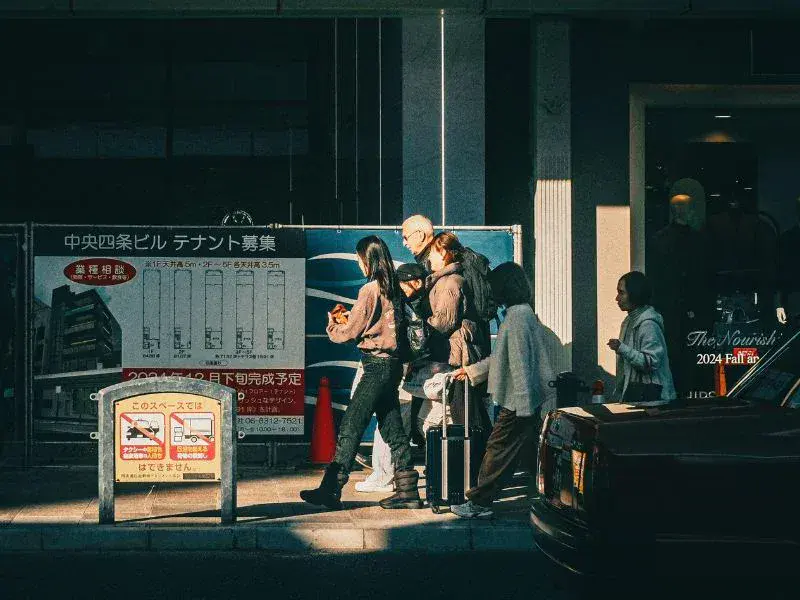
Although many traditional customs and social norms remain deeply rooted in the current Japanese society, modern influences have gradually shaped how people behave in daily life. Younger generations, in particular, may adopt more relaxed and informal attitudes in certain situations, especially in urban environments.
In large cities such as Tokyo, greater openness to individual expression can be observed, particularly among urban youth. Despite this shift, respect for core values for others remains strong, showing how Japanese customs evolve while maintaining their cultural roots.
Final Thoughts
Understanding Japanese etiquette may feel somewhat challenging at the beginning, especially for first-time visitors, but it is fundamentally about showing kindness and consideration for others. In Japan, people highly value harmony in shared spaces, whether on buses or trains, in restaurants, or when visiting temples and shrines. While it’s perfectly okay if tourists can’t follow every single rule, making a sincere effort to embrace local traditions is always warmly welcomed.
Ultimately, Japanese etiquette is less about perfection and more about mindfulness. Paying attention to your surroundings and acting with courtesy will help you blend in, avoid awkward situations, and you'll enjoy Japan even more.
Related Articles:
Ultimate Guide to Japanese Thrift Stores in Tokyo
Ultimate Guide to Places to Visit in Okinawa
Ultimate Guide to Easy Japanese
Top 15 Japanese Listening Tips
Ultimate Guide to Japanese Verbs
Ultimate Guide to Japanese Tea
Ultimate Guide to Okinawan Food and Cuisine
Ultimate Guide to Otaku Culture
Top 10 Anime by the Decades
How to Use a Japanese Toilet: A Complete Guide
The post Ultimate Guide to Japanese Etiquette appeared first on Japan Switch.
]]>The post Ultimate Guide to Eating Vegetarian in Tokyo appeared first on Japan Switch.
]]>Ultimate Guide to Eating Vegetarian in Tokyo
By Astri Elvarita | February 02th, 2026
If you’re looking for vegetarian in Tokyo, you’ve probably noticed that many Japanese foods use fish or meat broth even when they appear to be vegetarian. Understanding common ingredients and knowing where to dine can help reduce hesitation and improve your dining experience.
To make things easier, this article guides you to find reliable vegetarian restaurants, vegetarian-friendly supermarket options, and helpful tips so you can enjoy Tokyo without worrying about hidden ingredients.
This article is a part of our extensive series on Learning about Japan through Online Japanese Lessons at Japan Switch.
No More Cookie-Cutter Japanese Lessons!
At Japan Switch, we teach the Japanese you’ll actually hear, actually use, and actually need and not just textbook sentences you’ll never say.
Does ‘Vegetarian’ mean the same thing in Japan?
A vegetarian diet, which excludes all meat, poultry, or fish products, has become increasingly popular in the West, where vegetarian options are now common in supermarkets and restaurants. It is a meal plan made up of foods that mainly come from plants.
In Japan, the word "vegetarian" is widely well-known, but its understanding often differs from Western perceptions. Many people recognize it as a diet that avoids meat, but some still include fish, seafood, or animal-based broths, such as dashi (typically made from fish). The concept of completely avoiding all animal products is relatively new and has only begun to gain wider awareness in recent years, as many Japanese are now coming to understand.
With the growing popularity of vegetarianism in Japan, vegetarian restaurants are becoming more common and easier to find. They offer meat-free dishes so that people can enjoy entirely plant-based meals without worrying about hidden ingredients. Whether in bustling cities or quiet neighborhoods, these restaurants offer vegetarian menus that do not contain any hidden meat ingredients.
Curious About Japanese Culture?
Discover how locals live with our Ultimate Guide to Japanese Culture.
3 Best Pizza Joints for Vegetarians in Tokyo

Pizza Studio Tamaki (PST)
There's no better place to start than Pizza Studio Tamaki (PST). It has earned repeated mentions in the Michelin Guide Tokyo and numerous culinary awards, positioning it among Japan’s most acclaimed pizza joints.
Starting from ¥1,890, they offer the Tamaki signature, featuring smoked mozzarella, Pecorino Romano, basil, and cherry tomatoes, making it the best vegetarian-friendly pizza from PST. Other signature creations, like the 5 Formaggi pizza, showcase PST's exquisite harmony of salt, cream, and truffle, often enhanced with Okinawan sea salt baked into the crust for a more intense savory flavor. While some pizzas are topped with meat, vegetarian options are nearly as many.
Location: 1-24-6-105 Higashi-azabu, Minato-ku, Tokyo.
Open Hours:
Monday–Friday: 5 p.m.–10 p.m.
Saturday and Sunday: 12 p.m.–12:30 p.m., 5 p.m.–9 p.m.
Phone Number: +81 3-6277-8064
Website: pst-roppongi.com
Nearest Transport: 2-minute walk from the Nakanohashi exit of Akabanebashi Station.
Language Support: English menu available; English-speaking staff. English menu available; English-speaking staff.
Pizzakaya
Pizzakaya claims to serve the best vegetarian pizza option in Tokyo, a bold claim, but this California-style pizza joint comes close. Pizzakaya combines the atmosphere of an American pizzeria with the casual vibe of a Japanese izakaya pub. They also offer a wide selection of American craft beers to go with your pizza. While beer pairs well with pizza, Japan is also known for its traditional sake culture. Explore this further in our Ultimate Guide to Sake Brewery.
Pizzakaya is perfect for vegetarians, as it offers a wide variety of meatless pizzas with delicious, customizable toppings. They also offer gluten-free pizzas, allowing those with allergies or special diets to enjoy them as well. Prices for small 10‑inch (25 cm) vegetarian pizzas range from ¥1,990 to around ¥2,490, depending on the variety, with an additional ¥500 for a gluten-free crust. The menu goes beyond pizza; there are salads, pastas, and more, some of which can be made vegetarian. Pizzakaya is the perfect place for anyone looking for vegetarian pizza in Tokyo.
Location: 2F, Sumitomo Fudosan Roppongi Grand Tower, 3-2-1 Roppongi, Minato-ku, Tokyo.
Open Hours:
Monday–Friday: 11:30 a.m.–11 p.m.
Saturday: 5 p.m.–11 p.m.
Sunday: 12 p.m.–10 p.m.
Phone Number: +03-3479-8383
Website: pizzakaya.com
Nearest Transport: 1-minute walk from Roppongi-Itchome Station.
Language Support: English menu available; English-speaking staff.
Online Japanese Lessons That Actually Work.
Our affordable online Japanese lessons are built for busy learners with small groups, real conversations, and flexible schedules that work for you.
Online Japanese Lessons That Actually Work.
Our affordable online Japanese lessons are built for busy learners with small groups, real conversations, and flexible schedules that work for you.
800° Degrees Neapolitan
800° DEGREES is a US-based Neapolitan-style pizza chain that is conveniently located in areas like Shinjuku and Shibuya. There are vegetarian options, and the restaurant even offers vegan cheese and ham. The pizzas are flavorful, and the ingredients are high-quality. Many people recommend the Margherita pizza, topped simply with tomatoes and cheese, as the best choice for vegetarians. Or, if you prefer, you can even customize your own pizza with many base options, starting at ¥1,200, with add-ons ranging from ¥300 to ¥700.
Thanks to its strategic location, it attracts a large foreign customer base. While the prices are generally reasonable, the overall experience, quality, and customization make it worth the effort.
Location: 2F, NEWoMan Shinjuku, 5-24-55 Sendagaya, Shibuya-ku, Tokyo.
Open Hours: 11 a.m.–10 p.m. daily.
Phone Number: +81 3-3353-1800
Website: 800degreespizza.jp
Nearest Transport: Directly Connected to Shinjuku Station, Koshu Kaido Exit.
Language Support: English menu available; English-speaking staff.
3 Best Cafes for Vegetarians in Tokyo
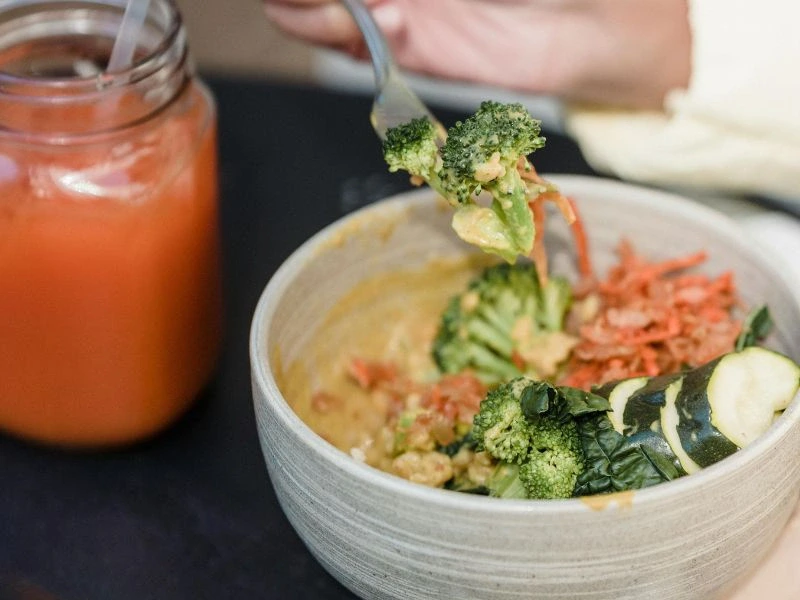
HEMP CAFÉ TOKYO
A 100% vegetarian café focused on hemp, Hemp Cafe Tokyo uses organic hemp across its menu, from appetizers to desserts to even the drinks. This restaurant makes hemp a 'superfood' and combines it with raw, gluten-free dishes, making the food both nutrient-rich and flavorful.
Recommended menu items frequently mentioned by customers include hemp tacos, vegan burritos, vegan sushi, and hemp ice cream. Prices for these dishes range from around ¥1,380 (such as hemp tacos or burritos) up to about ¥1,880. The seasonal menu changes frequently and can be viewed on their social media. Hemp Café Tokyo is renowned for being entirely plant-based, not just "vegetarian-friendly," making it one of the best vegetarian cafes among meat-free diners.
Location: 3-17-14-8F Higashi (東3-17-14), Shibuya-ku, Tokyo.
Open Hours:
Monday, Wednesday–Friday, Sunday: 11:30 a.m.–3 p.m., 6–10 p.m.
Saturday: 11:30 a.m.–3 p.m.
Tuesday: Closed
Phone Number: +81 3-6427-1984
Website: hempcafetokyo.com
Nearest Transport: 5-minute walk from Ebisu Station.
Language Support: English menu available, and they cater to non‐Japanese speakers.
Learn Japanese the Easy Way
Learn simple and practical phrases with our Ultimate Guide to Easy Japanese.
Bardon Organic Café
Bardon Organic Café is a compact and highly specialized café in Tokyo's luxury shopping district, Ginza. It focuses on organic, plant-based, gluten-free, and raw food. Its signature menu items include a nut-and-seed-based raw bar; for example, the "KanaeBar" starts from ¥3,856 (8 bars, 1 of each flavor).
The café emphasizes the use of ingredients grown without chemical fertilizers or pesticides, with an overall style that emphasizes "clean eating" and looking good from the inside out. Compared to other cafes, Bardon Organic Cafe stands out by emphasizing organic and vegetarian dishes, making it one of the best vegetarian cafes for health-conscious customers.
Location: 1F, Blue Box Building, 1-21-12 Ginza, Chuo-ku, Tokyo.
Open Hours:
Monday–Tuesday, Friday–Sunday: 11:00 a.m.–6:00 p.m.
Wednesday and Thursday: Closed
Phone Number: +81-3-6228-7133
Website: bardon-cafe.com
Nearest Transport: 5-minute walk from Ginza-itchome Station or Higashi-Ginza Station.
Language Support: English menu available; English-speaking staff.
If you enjoy discovering unusual food experiences, our Top 12 Worth Trying But Weird Japanese Foods is a fun place to start.
Mr. Farmer
If you want farm-fresh dishes, Mr. Farmer is the right choice, with the philosophy of 'beauty and health created from food.' Its menu features fresh vegetables, salads, and main dishes that use high‑quality, often organic produce sourced directly from farmers. For example, vegan dishes include a Spicy Mexican Taco salad for ¥1,790, or ¥2,090 when ordered with the bread and soup set. They also offer desserts that start from ¥690, with the veggie-full smoothie priced at ¥840.
Although Mr. Farmer offers many vegetarian and vegan options, it is not entirely meat-free. Some dishes may contain animal products, but the café openly supports vegan and gluten‑free options.
Location: 1F, Sepia Harajuku Building, 4-5-12 Jingumae, Shibuya-ku, Tokyo.
Open Hours:
Monday–Friday: 10:00 a.m.–9:00 p.m.
Saturday and Sunday: 9:00 a.m.–9:00 p.m.
Phone Number: +81-3-5413-4215
Website: mr-farmer.jp
Nearest Transport: 4-minute walk from Omotesando Station.
Language Support: English menu available; English-speaking staff.
Top Vegetarian Versions of Japanese Dishes
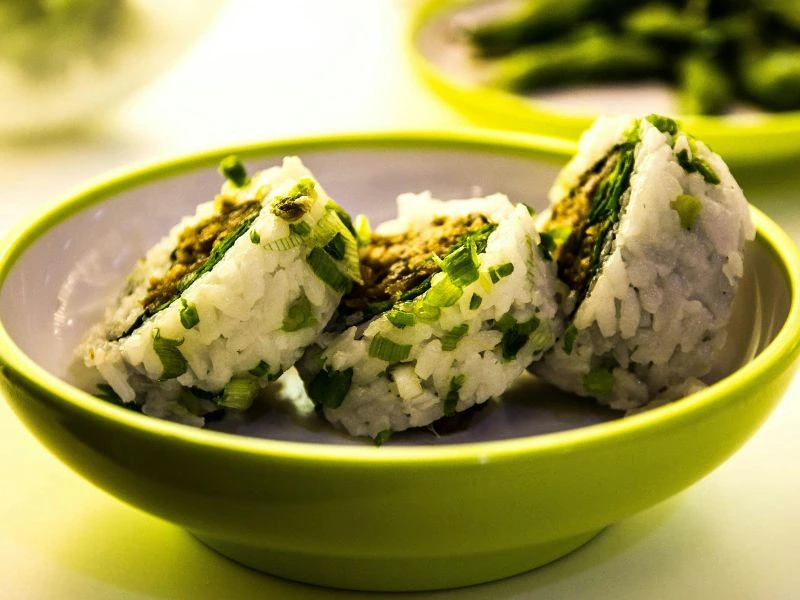
Best Vegetarian Sushi Restaurant in Tokyo:
Gonpachi
Gonpachi (Nishi-Azabu), famous for being the inspiration for a scene in the Kill Bill film, offers one of the most photogenic experiences in Tokyo. They also offer a special vegan menu featuring vegetable-based sushi, which is the Vegan Sushi Assortment (¥1,980 for 6 pieces) and Vegan Roll. Each piece features seasonal Japanese vegetables, arranged with the same care as traditional nigiri. In addition to vegan sushi, there are alternative Japanese dishes to try, such as vegetable tempura, grilled vegetable skewers, and many more! Interested in understanding sushi beyond what’s on the menu? See our Ultimate Guide to Japanese Sushi.
The space is impressive, featuring a large restaurant that has two floors filled with wood ornaments, bamboo, and lanterns, equipped with taiko drums that give a strong Japanese ambiance. However, reservations are highly recommended, as this is a popular tourist spot; the tables can fill up quickly, especially on weekends or in the evenings.
Location: 1-chōme-13-11 Nishiazabu, Minato City, Tokyo.
Open Hours: 11.30 a.m.–3.30 a.m. daily.
Phone Number: +81-50-5443-1691
Website: gonpachi.jp
Nearest Transport: 9 min walk from Roppongi Station or 16 min walk from Omotesando Station.
Language Support: English menu available; English-speaking staff who are familiar with vegan or vegetarian requests.
Best Vegetarian Ramen Restaurant in Tokyo:
Kyushu Jangara Ramen
Here, you can enjoy delicious and authentic ramen that has been veganized while sitting in a traditional Japanese ramen restaurant nestled among the locals. Kyūshū Jangara is a popular ramen chain that traditionally specializes in Hakata-style tonkotsu (pork bone) ramen but is increasingly catering to plant-based diners.
A highlight of the vegetarian/vegan menu is the soy-based char siu, and a seasonal option, vegan Yuzu-Shio ramen, is also available. While many ramen shops now offer only one vegetarian or vegan option, Kyūshū Jangara openly promotes its vegetarian menu, with vegan ramen bowls clearly marked in English, making plant-based options easy for tourists and raising awareness among plant-based diners even broader. Prices for these vegan ramen bowls start at ¥1,120 and go up to around ¥1,420 for the richer versions.
Location: 1F, 1‑13‑21 Jingūmae, Shibuya-ku, Tokyo.
Open Hours: 10:00 a.m.–10:00 p.m. daily.
Phone Number: +81‑3‑3404‑5405
Website: kyushujangara.co.jp
Nearest Transport: 2-minute walk from Harajuku Station.
Language Support: English menu available; some staff speak English.
Wanna Order Japanese Food Like a Local?
Learn how with our Ultimate Guide to Ordering Food in Japanese.
Best Vegetarian Japanese Curry Restaurant in Tokyo:
CoCo Ichibanya
"Curry House CoCo Ichibanya," also known as "CoCoIchi," is a popular Japanese curry restaurant with branches all over Japan. They're famous for their delicious and budget‑friendly curry, plus, more importantly, they also offer vegetarian options!
Starting from ¥683 for the basic vegetarian curry and going up to about ¥955 when toppings are added. This restaurant offers clearly labeled vegetarian curry sauces, such as plain vegetable or soy meat hamburger curry. According to sources, this vegetarian curry is meat- and fish-free, although diners should sometimes check to ensure there is no cross-contamination of cooking oil. You can even customize your rice portion to your liking, though this does come at an additional cost. Overall, CoCo Ichibanya offers a reliable and easy-access vegetarian Japanese curry experience without losing its authentic flavor.
Location: 1F Nozawa Building, 3‑chome 11‑6, Roppongi, Minato‑ku, Tokyo.
Open Hours:
Sunday–Thursday: 11:00 a.m.–10:30 p.m.
Friday–Saturday: 11:00 a.m.–12:00 a.m.
Phone Number: +81‑3‑5414‑5341
Website: cocoichibanya.com
Nearest Transport: 3 min walk from Roppongi Station.
Language Support: English menu available; English-speaking staff who are familiar with vegan or vegetarian requests.
Best Vegetarian Izakaya in Tokyo:
Izakaya Masaka
Izakaya Masaka in Shibuya is an entirely vegan izakaya, making it the best vegetarian restaurant offering classic Japanese izakaya fare. You'll find dishes like soy-based meat karaage available in a variety of flavors (sesame, black vinegar, yuzu mayonnaise, etc.), paired with vegetable gyoza, fried maitake mushrooms, mapo tofu rice bowls, and other casual pub-style dishes. This is relatively rare among izakaya-style establishments in Tokyo, where vegetarian/vegan options are limited or require special requests. Prices for many dishes start from around ¥450, and most mains fall in the ¥600-¥850 range. On weekdays, this small but popular restaurant often has a wait of about an hour for a seat, with weekends likely even busier.
Location: 15-1 Udagawacho, Shibuya PARCO B1 (at basement level), Tokyo.
Open Hours: 12.00 p.m.–9.00 p.m. daily.
Phone Number: +81-3-5422-3020
Website: -
Nearest Transport: 6 min walk from Shibuya Station or 13 min walk from Shinsen Station.
Language Support: English menu available, and they cater to non‐Japanese speakers.amiliar with vegan or vegetarian requests.
Learn Japanese. Make friends. Enjoy Japan.
Save up to 30 - 60% on your Japanese lessons while learning online or in the heart of Tokyo
with Japan Switch!
Top Vegetarian Places for Snacks and Souvenirs in Tokyo

Tokyo’s Best Supermarket for Vegetarian:
National Azabu
National Azabu is an international supermarket in Hiroo, Tokyo, and is not a chain. It is known for its wide variety of imported products that cater to a variety of dietary needs. Vegan products are plentiful, with prices varying depending on the product, with convenience snacks costing around ¥100-¥300, imported chips or packaged snacks costing ¥500-¥850, and specialty items like vegan pasta, mayonnaise, chocolate, or ice cream. The store clearly labels its price tags with halal (H), vegetarian (H), organic (O), and gluten-free (G).
Unique offerings include a peanut butter machine for making preservative- and sugar-free peanut butter, which makes a great souvenir. Delivery is available locally within Minato-ku and nationwide via Yamato.
Location: 4 Chome-5-2 Minamiazabu, Minato-ku, Tokyo.
Open Hours: 9.00 a.m.–8.00 p.m. daily.
Phone Number: +81-3-3442-3181
Website: national-azabu.com
Nearest Transport: 3 min walk from Hiro-o Station.
English-speaking staff are available occasionally; they cater to foreign shoppers, and most products are labeled in English.
Best Vegan Souvenir Store at Tokyo Station by JR East Group
JR East Group, where the first store is located inside Tokyo Station, offers the Plant-Based Sweets Series, which is a perfect choice for vegetarian snacks and souvenirs. This is part of JR East’s retail network, not a standalone shop, which makes it accessible for travelers using the train.
Prices vary depending on size and type: smaller packages cost around ¥1,080-¥1,200, while larger gift boxes range from ¥1,296-¥2,400. These confectionery products are made entirely from plant-based ingredients, with no animal products, honey, alcohol, or refined sugar derived from animals. Highlights include the "PlantBasedJAPANQUALITY" logo on the packaging, which guarantees a completely plant-based product, as well as beautifully packaged gift sets that are ideal as souvenirs.
Interested in learning more about Japanese souvenir culture? Check out our Ultimate Guide to Japanese Omiyage.
There are some products to look out for:
- Tokyo Campanella Brown (from JPY 1,200).
- Almond Caramel Sand (from JPY 1,296).
- Las Olas Series: Matcha-flavored cookies (from JPY 1,080).
Location and Open Hours:
Inside Tokyo Station, in front of the Shinkansen South Transfer Gate
(About 8:00 a.m.–9:30 p.m. daily).
Nomono Tokyo, B1 floor, Marunouchi Underground Central Gate
(Monday‑Saturday: 7:00 a.m.–10:00 p.m., Sunday/holiday: ~ until 9:00 p.m.).
Website: ejrt.co.jp
English descriptions are included on the packaging, and the store caters to foreign shoppers, although not all staff may speak English fluently.
Best Area to Stay in Tokyo for Vegetarians: Nishiazabu
Nishiazabu is a stylish, conveniently located neighborhood near Shibuya. It offers a mix of delicious vegetarian cuisine. Popular spots include PST, the Vegetarian Cafe, which serves innovative dishes, and CoCo Ichibanya, which offers vegetarian curry options near Roppongi Station. Its proximity to National Azabu also provides easy access to international vegetarian supermarkets and specialty shops.
Not sure where to start your sightseeing itinerary? Read our Ultimate Guide to Sightseeing in Japan!
Get Your Japanese Visa Without Stress
Learn about application requirements and useful tips in our Ultimate Guide to Getting a Japanese Visa so you can be confident!
Essential Japanese Vocabulary for Shopping in Supermarkets

After discovering where to enjoy the best vegetarian restaurants around Tokyo, you might also want to explore local supermarkets to find ingredients for your own snacks or even cook for yourself. Shopping at the supermarket might be challenging for foreign vegetarians. Labels and ingredients are often written only in Japanese, and many daily products may contain hidden animal ingredients such as fish stock or gelatin (typically from beef or pork). Therefore, learning essential Japanese vocabulary for vegetarians can help you identify vegetarian products more easily.
Basic Vegetarian Vocabulary
| ベジタリアン | Bejitarian | Vegetarian |
| ヴィーガン | Viigan | Vegan |
| 動物性なし | Dōbutsusei nashi | Animal-free products |
| グルテン | Guruten | Gluten |
| グルテンフリ | Guruten furī | Gluten-free |
Common Animal Ingredients in Japanese
| 肉 | Niku | Meat |
| 魚 | Sakana | Fish |
| 鶏肉 | Toriniku | Chicken |
| 豚肉 | Butaniku | Pork |
| 牛肉 | Gyūniku | Beef |
| だし | Dashi | Fish stock (often hidden in soups) |
| ゼラチン | Zerachin | Gelatin (mostly from animals) |
Useful Phrases for Shopping
| Romaji | Kore wa bejitarian desu ka? |
| Japanese | これはベジタリアンですか ? |
| English | Is this vegetarian? |
| Romaji | Dōbutsusei no mono wa haitteimasu ka? |
| Japanese | 動物性のものは入っていますか? |
| English | Does this contain animal ingredients? |
| Romaji | (Animal/ingredients in Japanese) ga haitteimasu ka? |
| Japanese | (__)が入っていますか? |
| English | Does this contain(__)? |
Side Note
Most staff in supermarkets may not speak much English, so you can show these phrases or a translation app to make it easier.
Planning to use trains while traveling in Tokyo?
Learn how to navigate Tokyo’s trains in our Ultimate Guide to Tokyo Trains so you can travel stress-free.
Final Thoughts
Tokyo might seem difficult for vegetarians at first, especially with the common hidden-meat ingredients in many dishes. But once you know where to look, the city offers a wide variety of safe, satisfying vegetarian options. From Western-style restaurants to cafes serving plant-based versions of Japanese cuisine, the options are increasingly diverse.
With this guide, you now have great places to try, ordering tips, and useful Japanese vocabulary to help you shop safely. Eating vegetarian in Tokyo doesn't have to be stressful with careful preparation. Now, let's enjoy exploring the city and discovering your new favorite dishes!
Related Articles:
How to Use a Japanese Toilet: A Complete Guide
Ultimate Guide to Japanese Thrift Stores in Tokyo
Ultimate Guide to Japanese Medicine
Ultimate Guide to Japanese Washing Machines for Foreigners
How to Ask and Give Directions in Japanese
The post Ultimate Guide to Eating Vegetarian in Tokyo appeared first on Japan Switch.
]]>The post Ultimate Guide to Learning Japanese Through Anime appeared first on Japan Switch.
]]>Ultimate Guide to Learning Japanese through Anime
By Kah Mun Fu | January 9th, 2026
Learning Japanese by watching anime can be a fun, unconventional way to learn the language, but you might be wondering, how can you effectively study Japanese through anime without getting distracted? How should you learn Japanese while trying to listen to the dialogue? Is it even effective to learn the language through anime?
Whether you are a beginner who’s just getting into learning Japanese, or a near-native speaker wanting to immerse themselves in Japanese media, this guide has got you covered. In this guide, we will show you why you should learn Japanese through anime, recommendations according to language level, and the best tips to learn the language while watching anime. Let’s get started!
This article is a part of our extensive series on Learning about Japan through Online Japanese Lessons at Japan Switch.
No More Cookie-Cutter Japanese Lessons!
At Japan Switch, we teach the Japanese you’ll actually hear, actually use, and actually need and not just textbook sentences you’ll never say.
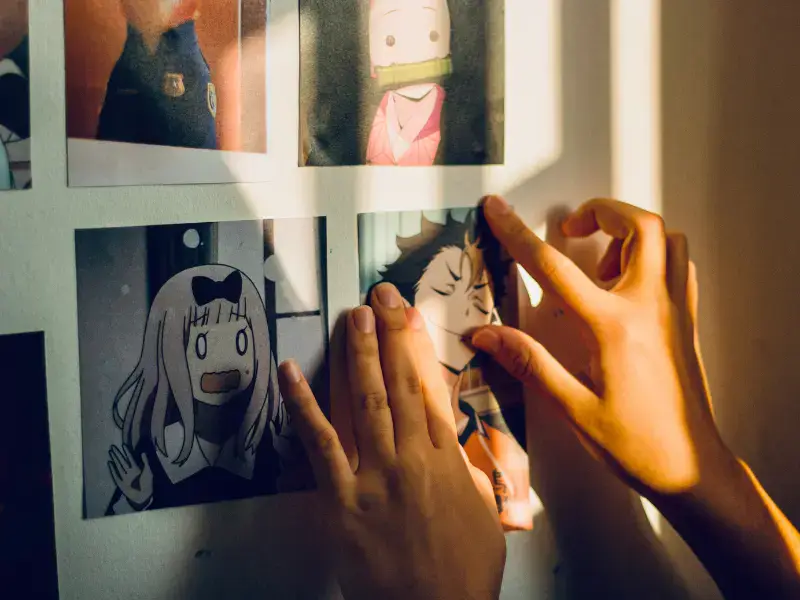
Why should you learn Japanese through Anime?
It can help you improve your listening skills
Just listening to the conversations happening while watching anime can help improve your listening comprehension. Many, if not most, characters in anime speak in a slow and clear manner, which makes it easy for learners to listen to the dialogue and comprehend what is going on. It’s also a great way to hear how certain words or grammar are used and in which contexts.
You can pick up useful vocabulary that you can use in Japanese conversation
While you listen to your favorite characters speak, they might say something that could be useful to you in daily conversation, such as a specific vocabulary you want to remember for future conversations, or grammar that may be useful when you try to articulate your thoughts and opinions.
Talking about anime in Japanese can be a great conversation topic for making Japanese friends
Once you have improved your speaking skills, you can try to make Japanese friends by speaking to them in their native language. When you’re starting to learn how to speak in Japanese, it can be difficult to continue a conversation with others. However, anime and manga are both very popular mediums in Japan, and this is a great conversation topic to help with conversation. You can talk about your favorite anime series to your Japanese friends as a conversation starter! Plus, watching anime can also help you to learn how Japanese speakers talk to each other as well.
You can learn about Japanese culture through anime
The most important thing about learning a language is learning about the culture the language originated from. You often can’t cleanly translate Japanese culture into your native language, and often you will encounter that some cultural points simply do not exist in other cultures, so you need to learn about Japanese culture; how people greet each other, customs, and manners. Watching anime, especially some genres of anime like slice of life, can help to learn about Japanese culture and mannerisms that you can pick up and apply to your Japanese learning.
Read our guide to Japanese Culture to learn more about manners, customs, and more!
Where can I find anime according to Japanese level?
It can be difficult to find anime based on Japanese difficulty online, however websites such as LearnNatively and JPDB have been compiling a list of anime based on Japanese difficulty. With JPDB, the website sorts and categorizes anime based on unique words and kanji, as well as average and peak difficulty, so it makes it easy to find anime based on how difficult the vocabulary is going to be.
Similarly, LearnNatively categorizes anime according to difficulty, however this is done by the community. You have the option to compare two anime series next to each other to see which one is easier to understand, or whether you want to challenge yourself by watching the more difficult option. Do note that not all anime is available for analysis for both options, however.
Learn Japanese. Make friends. Enjoy Japan.
Save up to 30 - 60% on your Japanese lessons while learning online or in the heart of Tokyo
with Japan Switch!

Best anime to learn Japanese according to level
Best anime to learn Japanese for beginners
At this level of Japanese, it is recommended that you watch children’s anime, as their clear, easy to understand language will be beneficial for Japanese learners aiming to get a foundation of the language. There are some anime out there that aren't children’s anime that can be useful for beginner Japanese learners, however.
Doraemon
Nobita Nobi, a ten-year old schoolboy, is struggling with academics and sports. Doraemon, a robot cat sent from the future, comes to take care of Nobita by providing him with gadgets and inventions to overcome a variety of problems. The series follows Doraemon and Nobita on their various adventures along with Nobita’s friends, Shizuka, Takeshi, and Suneo.
As one of the most iconic children’s anime of all time, Doraemon is perfect for beginners who want to get a grasp of Japanese. Its simple, easy to follow language makes it easy to understand, (plus, there will be opportunities to expand your vocabulary while watching the anime. Plus, the opening theme has the lyrics written on the screen, making it easy for learners to learn new vocabulary.
Chibi Maruko-chan
The premise of this anime is simple; elementary school student Momoko Sakura, otherwise known as “ Chibi Maruko-chan,” lives with her family in a small town and goes to school with her many friends. This anime is about enjoying the mundane and living a simple life.
The frequent use of plain form; futsuu-kei (普通形), makes it easy for beginners to understand daily conversations between Japanese speakers. Characters speak to each other in a way that feels natural, and the usage of general vocabulary also makes it easy for beginner learners to understand.
Sazae-san
As the longest running series in the world, Sazae-san follows the titular character, a typical Japanese housewife, and her daily life living with her family. This series captures the simplicity of Japanese family life in the suburbs.
The characters mainly speak in plain form, making it easy to understand for beginners wanting to get a grasp of how Japanese people speak to each other daily. Topics mainly covered in Sazae-san pertain to daily life in Japan, such as going out to do groceries or anything about home life, which can be helpful for beginners to learn about typical Japanese culture. Characters also speak in a slow and clear manner as well.
Shirokuma Cafe
This series follows a polar bear named Shirokuma, as he runs the Shirokuma Cafe, a popular hotspot for humans and animals alike just located near the local zoo. He finds joy in serving his customers, always eager to start a conversation with them. Shirokuma is accompanied by his friends, Penguin and Panda as they go on a series of wacky adventures.
While it might seem like a slice-of-life anime that’s hard to understand, some characters speak slowly and clearly, making it easy to follow for beginner Japanese learners. The way characters speak reflects how Japanese people speak daily as well, but there are puns that simply cannot be translated into English, and there are jokes that beginners might have a hard time understanding.
Koupen-chan
The premise of this adorable anime is simple; Koupen-chan, a baby emperor penguin, wants to make sure that everyone, including the audience, feels good about themselves. Koupen-chan tends to praise the audience for performing even the most basic of tasks. such as getting up in the morning.
This series is perfect for beginner Japanese learners as the language used is extremely simple and easy to understand. Koupen-chan also speaks in a slow and clear manner, so it should be no problem picking up new bits of vocabulary while watching this series.
Read our Guide to Beginner Japanese to get a grasp of everything you need to know about the language!
Best anime to learn Japanese for intermediate learners
At this level of Japanese, you should be able to understand daily conversations as well as express your thoughts and opinions. It is recommended that you watch slice-of-life anime, as the language used reflects everyday conversations that you will hear on a daily basis.
Wotakoi: Love Is Hard for Otaku
Narumi Momose, a fujoshi (girl who loves Boy’s Love) who wants to keep her nerdy obsession a secret, encounters an old friend from middle school, Hirotaka Nifuji on her first day of work at a new company. Wanting to act normal, she invites him out for drinks, only to find out that he is just as nerdy as she is. What follows is a cute romance that follows the two otaku.
This anime is perfect for intermediate learners due to the corporate setting of the anime; you can watch characters speak formally and informally with each other. It’s perfect for those who want to learn keigo (敬語) (honorifics mainly used in the workplace), as well as those wanting to know how Japanese people speak to each other daily. In addition, there will be references to Japanese otaku culture which can be useful if you want to learn ‘real Japanese’, as these references will never show up in textbooks.
Chiikawa
Short for Nanka chiisakute kawaii yatsu (なんか小さくてかわいいやつ), Chiikawa is an adorable anime centered around the titular character, Chiikawa, and its friends. Chiikawa and its friends go around eating and playing together, occasionally working odd jobs such as weeding and monster hunting to earn money.
While it may look like a children’s show, the target demographic of this show is seinen (青年); young adult men, so some of the vocabulary used is more difficult for beginner learners of Japanese. However, a few of the characters, such as Hachiware; a blue and white cat-looking critter, speak in a way that is easy to understand for beginner to intermediate Japanese learners. Also, this is a great opportunity to learn meirei-kei (命令形) as there is a flying squirrel character named Momonga that talks almost exclusively in this form.
K-On!
The story follows the lives of the Sakuragaoka High School Light Music Club members; drummer Ritsu Tainaka, bassist Mio Akiyama, keyboardist Tsumugi Kotobuki, and inexperienced guitarist Yui Hirasawa. They live out their lives, spend time with each other, and practice every day with the sole purpose of saving their club from disbandment.
Most of the language used is filled with general and school-related vocabulary, which make it easy to follow for intermediate learners. Moreover, characters also speak in a slow, clear, but natural manner, reflecting how native speakers talk to each other.
Nichijou
Set in the town of Tokisadame, Gunma Prefecture, Nichijou follows the lives of three high school girls, as well as a genius professor, her robot caretaker, and their talking cat. They all experience both the ordinary and the absurd, whether it’s talking about their test scores, or watching the school principal suplex a deer.
Although this might look like your atypical slice-of-life anime, this is one of the more absurd options on this list due to its humor and use of puns, which can be difficult for non-native speakers to understand. However, the language used is mostly in plain form, and the high school setting of the show can help learners learn more about daily life in Japan.
Teasing Master Takagi-san
Nishikata, a middle school boy, is friends with his classmate, Takagi. The thing is, Takagi loves to tease Nishikata daily, so he tries to get back at her by teasing her back. Things don’t work out as planned, however, as Takagi is able to masterfully predict how Nishikata will enact his teasing, often turning the tables against him.
This anime has been recommended by many Japanese learners as the language used is mainly everyday vocabulary, mixed with school-related vocabulary. The dialogue is easy to follow, as characters speak to each other in a slow, clear manner, and the repetition of certain phrases can help with memorization.
Online Japanese Lessons That Actually Work.
Our affordable online Japanese lessons are built for busy learners with small groups, real conversations, and flexible schedules that work for you.
Online Japanese Lessons That Actually Work.
Our affordable online Japanese lessons are built for busy learners with small groups, real conversations, and flexible schedules that work for you.
Best anime to learn Japanese for advanced learners
At this level of Japanese, you should be able to understand most anime available to you. However, learning Japanese does not have to end with gaining near-native fluency in the language; there are a few anime series out there jam-packed with puns, slang, and pop culture references that may be difficult to understand at a lower level, in addition to complex vocabulary and grammar. If you are looking to challenge yourself, then these series might be a good place to brush up on your language skills.
Gintama
This anime is set in an alternate-history late-Edo period, where aliens called the Amanto have taken over and banned all swords in public. Gintoki Sakata, a freelancer who runs an odd-jobs business, is assisted by Shinpachi Shimura, Kagura and Sadaharu, who try to help others in any way they can, even if it doesn’t go according to plan.
Gintama mainly parodies almost everything Japanese culture related, from memes to popular anime and movies. Characters also talk at a fast pace, which makes listening a challenge for advanced learners. For near-native speakers who want to learn about Japanese pop culture references, Gintama might be the series for you!
The Apothecary Diaries
When Maomao, the daughter of an apothecary, is kidnapped and sold into service of the emperor and his court, she finds herself working as a lowly maid. However, all that changed when the emperor’s children fell ill, and she uses her skills to find the cause. She is then tasked to solve the various mysteries that occur within the imperial court.
The use of historicl vocabulary that isn’t heard as much in contemporary Japan makes this anime challenging for beginners and intermediate Japanese speakers. Not to mention, Maomao occasionally speaks fast when talking about the medicinal properties of ingredients. Regardless, if you are interested in history (keep in mind, this takes place in a land inspired by Tang Dynasty China), as well as medical vocabulary, then this might be the series for you.
Jojo’s Bizarre Adventure
Known for its over-the-top dialogue, character design, and engaging plot, Jojo’s Bizarre Adventure follows several generations of the Joestar family, who are locked in a never-ending battle against the main antagonist, DIO, and his allies. Throughout the series, the story focuses on the concept of Stands, the manifestation of one’s soul with incredible powers.
As mentioned before, the over-the-top dialogue, as well as some expressions used in the anime, can be challenging for lower-level Japanese learners, as most characters do not speak that way in real life. For near-native Japanese speakers however, if you want to learn about certain expressions and metaphors that simply cannot be translated into English, then this anime is for you. Plus, you get to hear the inner monologues of the characters as they fight their enemies while posing dramatically.
The Way of the Househusband
Ex-Yakuza member Tatsu, who was once known as the “Immortal Dragon,” now lives his life as a househusband. He cooks, cleans, and takes care of the house, all whilst supporting his wife’s career. He is often misunderstood by authorities due to his mannerisms, but he also encounters Yakuza members who try to recruit him back.
This may look like a comedic slice-of-life anime, but the use of Yakuza jargon will make it difficult for beginner and intermediate learners to understand. In addition, Tatsu, the main character, will also be speaking in the Kansai dialect, which is totally different to how standard Japanese is spoken. That is not to say that his way of speaking will be incomprehensible, however. Advanced learners can challenge themselves by learning the Kansai-dialect, as well as various Yakuza-themed vocabulary as well!
Delicious in Dungeon
After a dungeon crawl goes terribly wrong, Laios Touden, an adventurer, resolves to go back into the dungeon to save his little sister, Falin, from being digested by a red dragon. Accompanied by his allies, Marcille and Chilchuck, they realized that they won’t be able to make it far into the dungeons, until the dwarven warrior Senshi offers them a solution; eat the monsters that they slay.
This anime contains a lot of fantasy-related jargon that is simply not used on a daily basis, making this anime a challenge for advanced speakers. On the bright side, for those who also want to learn about cooking-related vocabulary, then this anime is perfect as Senshi clearly speaks out the instructions on how to cook said monsters into delicious meals.

Supplementary tools to help with Japanese learning
Yomitan
Yomitan is a browser extension that allows you to see the definition of Japanese vocabulary. All you have to do is hover over the text while the extension is active, and the extension will automatically detect the vocabulary. Pair this extension with programs such as Subadub, which will make the subtitles highlightable.
Availability: Available for free for Chrome, Firefox, and Microsoft Edge.
Anki
Anki is a program that you can use to create and utilize flashcards to aid in your Japanese study. The program uses spaced repetition, which means that once you learned and memorized certain vocabulary and grammar, the flashcard won’t appear as often. You can customize these flashcards to have images and audio on them, as well as how much you want to review these flashcards, and how many flashcards you want to review daily.
Availability: Available for free on the PC, however there is a mobile version available. Do note that you will have to pay 4000 yen to use the mobile version.
Jisho.org
Jisho.org is a website that is essentially a Japanese dictionary. You can search for specific vocabulary just by typing in English, Japanese characters or Romaji. In addition, the website will tell you about a word’s JLPT level, as well as whether it is a common word or not.
Availability: You can access the website on a phone, tablet or computer browser.
Language Reactor
Language Reactor is a browser extension that helps you learn languages from watching your favorite movies and series. You can use this extension with Netflix, as the extension will include dual subtitles to enhance your language learning, a popup dictionary, and video controls for you to go back on when you want to learn a specific word. The extension also works for YouTube, book apps, and almost all websites.
Availability: Currently, it’s only available on Chrome.
Check out our Guide to Japanese Learning Apps to find out what apps are out there to help you improve your Japanese!
Best techniques to learn Japanese from anime
Watch with Japanese subtitles
It may be difficult to pick up new words and grammar just by watching the anime of your choice, and that’s where watching with Japanese subtitles can come in handy. While you watch and listen for new vocabulary and grammar, you can use the subtitles to figure out what is being said. Pair this technique with browser extensions such as Subadub, which makes the subtitles highlightable (you can even pair this with Yomitan as well).
Flashcards
It’s important to create and review flashcards for new words and grammar points that you come across. Regularly reviewing flashcards helps with memory retention, and helps with figuring out what vocabulary and grammar you need to improve upon. While watching your favorite anime series, create a flashcard for every piece of vocabulary or grammar you come across, and review your flashcards daily. Also, try to incorporate an example sentence in your flashcards, so that you can remember the definition of a word or how to use this specific grammar point in your day to day conversation.
Shadowing
This is a technique that involves imitating a native speaker of the language you are learning; in this case, Japanese. This technique can help with improving your pronunciation, intonation, and the speed at which you talk. To effectively utilize this technique, pick a scene and character from your favorite anime, and mimic the way your character speaks as you watch the scene play out. Even if you think you might sound terrible, it might be helpful to record yourself mimicking said character just so you can hear how you sound.
Want more tips to improve your learning?
Check out our Guide to Japanese Study Tips for more ways to improve your Japanese studies!

Is learning Japanese through Anime effective?
The advantages of learning Japanese by watching anime is that it can be engaging compared to more conventional methods such as books and group classes. In addition, anime characters tend to be more natural sounding compared to textbook Japanese, as they reflect how ordinary Japanese people speak. Moreover, watching anime can be good for language immersion; which is to say, if you expose yourself to the language,
However, it doesn’t come without disadvantages. Watching anime can be distracting especially if you want to pick out new vocabulary and grammar. Furthermore, some phrases that might be said in anime are not necessarily used in everyday conversation; for example, if you are watching a history anime, there might be jargon that might not be used in day to day life, unless you were studying about Japanese history and would like to learn about specialized vocabulary.
In the end, whether you want to learn Japanese just by watching anime, or you want to supplement your learning with conventional tools such as classes and textbooks, it’s all about the commitment to learning Japanese. Put in the effort to learn Japanese, and you’ll yield results in the future.
Related articles:
Ultimate Guide to Otaku Culture
Top 15 Japanese Conversation Tips
Ultimate Guide to Japanese Pop Culture
Ultimate Guide to JLPT Practice and the Exam
Top 24 Things to do in Akihabara
The post Ultimate Guide to Learning Japanese Through Anime appeared first on Japan Switch.
]]>The post Ultimate Guide to Live Music in Tokyo appeared first on Japan Switch.
]]>Ultimate Guide to Live Music in Tokyo
By Kah Mun Fu | December 5th, 2025
So you want to go to a live music performance in Tokyo, but you don’t know where to start; maybe you tried to search up where the best venues are, which artists are worth listening to, what to do at a live music venue, or maybe you’re worried about how to purchase concert tickets for your favorite artist that’s coming to Tokyo?
Going to a live music performance in Tokyo can be a memorable experience for those living in or visiting Tokyo. In this guide, whether you’re looking to dive into Tokyo’s underground music scene for the first time, or whether you’re looking to attend major concerts in Tokyo, we’ll show you the best places to enjoy live music in Tokyo, how to obtain tickets, and how to enjoy a concert in Tokyo.
This article is a part of our extensive series on Learning about Japan through Online Japanese Lessons at Japan Switch.
No More Cookie-Cutter Japanese Lessons!
At Japan Switch, we teach the Japanese you’ll actually hear, actually use, and actually need and not just textbook sentences you’ll never say.
Local live music in Tokyo vs. Major artists: what’s the difference?
The first thing to consider is: what type of music are you looking to listen to live? Have you only seen major artists live and want to venture into Tokyo’s underground music scene, or do you want to get a chance to see your favorite major acts perform live? Do you prefer the smaller, intimate vibe of a small venue, or the larger, electric feel of a major venue?
For smaller, indie acts, tickets are generally more accessible and cheaper, around 2000 to 3500 yen. For some venues, you don’t need to purchase a ticket in advance, you can just pay at the door if you wish. Although you will be supporting smaller, indie artists, they generally don’t have as much exposure or fame outside of Tokyo’s underground music scene. That doesn’t mean they don’t make great music or put on an amazing show though! Every major artist had to start somewhere and there are plenty of undiscovered gems that your Spotify algorithm is hiding from you that you can find by actually getting out to a show!
Major artists on the other hand, are more well known compared to smaller, indie artists, and they tend to perform at larger venues such as the Budokan or Tokyo Dome. This makes it easy for fans to find a sense of community in Tokyo. However, tickets tend to be more expensive and less accessible as they will usually sell out faster. In addition, it can be difficult to obtain tickets during presales as they are sold via lottery, or chuusen (抽選). Regardless, going to see a major act perform in Tokyo is a memorable experience, and you can certainly brag about going to see that artist to your friends.

What’s the live music scene like in Tokyo?
At first glance, you may see that the Tokyo music scene is vibrant, with many independent musicians giving it their all to perform live. From buskers to major acts performing in the biggest venues, Tokyo has it all. Small, live music venues, otherwise known as ‘livehouses’ in Japan, are perceived to be small and intimate, with many genres of music being played and widely accepted amongst Tokyo’s underground music scene. Some areas of Tokyo are known for playing specific genres of music, which we will explore later.
Some may worry that the music scene in Tokyo can feel isolating as a foreigner, however, in Japanese livehouses, individuality will always be respected. Even if you know very little Japanese or you have come to see the artist for the first time, you won’t be judged, so long as you’re following basic concert etiquette. Because you and other people have come for the music, it can feel like you have found a community within such a short span of time. In addition, if you’re worried about safety at a livehouse, rest assured, Tokyo is one of the safest cities in the world, so the same is to be expected of its livehouses.
Although J-pop is considered the main genre of music in Tokyo, you can easily find other genres of music being played at livehouses including, but not limited to rock, punk, metal, jazz, disco, and all sorts of electronic music, such as techno, synth-pop, and trance music. Whatever the individual tastes of concert goers are, there is something for everyone!
Online Japanese Lessons That Actually Work.
Our affordable online Japanese lessons are built for busy learners with small groups, real conversations, and flexible schedules that work for you.
Online Japanese Lessons That Actually Work.
Our affordable online Japanese lessons are built for busy learners with small groups, real conversations, and flexible schedules that work for you.
Where can I find information on Tokyo’s live music scene?
It can be difficult to find a compiled list of information regarding live music events in Tokyo, as you would have to check each livehouse’s schedule to see what’s happening. However, there are some websites and social media accounts that have attempted to compile information from recommended livehouses on where the best live events to support smaller artists are. Some recommendations on where to find this information are:
- Tokyo Gig Guide - a website that compiles a list of livehouses and the latest upcoming gigs. You can search for a gig based on which genre you’re interested in.
- Gigs in Tokyo - an Instagram account that posts about the latest gigs in Tokyo. They mainly focus on artists rather than venues, however they do provide a form that allows for ticket reservations with English support.
Where to find the best local live music in Tokyo
Best livehouses to enjoy live music in Shibuya
Shibuya is well known for its nightlife, and its livehouses are no exception. You can find many music venues in the area, from small, intimate livehouses that host open mic nights, to medium sized concert halls that put on showstopping performances from both local and international artists.
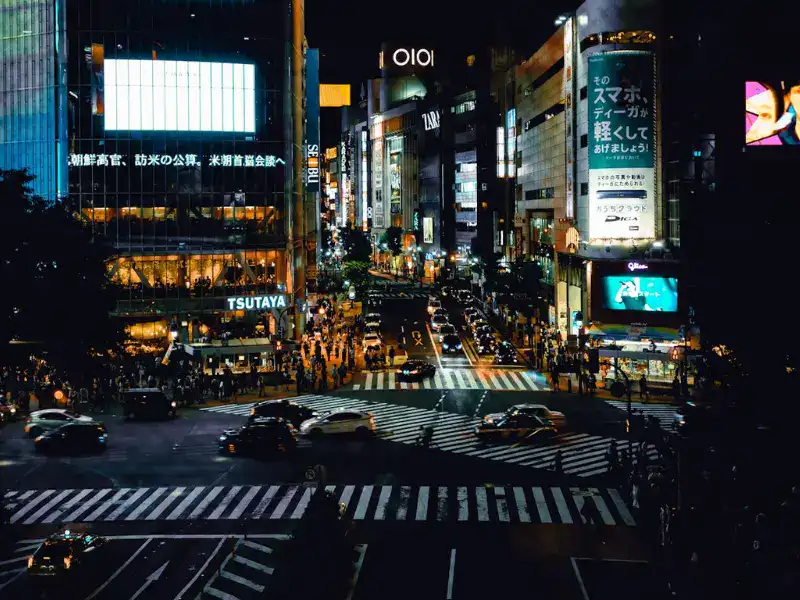
Shibuya 7th Floor
Shibuya 7th Floor is a livehouse that features mainly small acts. They serve a variety of food and drinks, and their bar time runs from 11pm to 4:30am at some events.
Location: O-West Building 2-3, Maruyamacho, Shibuya City, Tokyo 150-0044
Open hours: Varies from event to event. Check the website’s schedule for more details.
Price of admission: Varies from artist to artist. Check the website’s schedule for more details.
English support: None. The entire website is in Japanese.
Tokio Tokyo
Located five minutes away from Shibuya station, Tokio Tokyo is a livehouse whose main mission is to showcase up and coming independent artists in Tokyo, and to help them put on amazing live performances. A variety of genres are played at this venue, including J-pop and rock.
Location: 3-7-B1 Udagawa-cho, Shibuya City, Tokyo 150-0042
Open hours: Every day, 6pm to 11pm
Price of admission: Varies from artist to artist. Check the website’s schedule for more details.
English support: An English version of the website is available.
clubasia
Opened in 1996, this venue has been the driving force behind Shibuya’s vibrant nightlife. This nightclub doubles as a livehouse, with performances and live DJ sets from various artists. A variety of genres are played at clubasia, including but not limited to EDM, trance, techno, and hip-hop, J-pop, hardcore, and metalcore.
Location: 1-8 Maruyamacho, Shibuya City, Tokyo 150-0044
Open hours: Open 24 hours a day.
Price of admission: Varies from event to event. Check the website for more details.
English support: An English version of their website is available.
Ruby Room
Ruby Room is a live music venue that doubles as a DJ bar and nightclub. Here you can find a range of live events happening at the Ruby Room, from DJ sets playing techno, disco, and hip-hop, to live bands performing indie music. However, the Ruby Room is best known for offering open mic nights every Tuesday, so if you’re an aspiring musician, this might be the best place for you to showcase your talents.
Location: 2-25-17 Dogenzaka, Shibuya City, Tokyo 150-004
Open hours: Every day, 7pm to 2am
Price of admission: Varies from event to event. Generally on Open Mic nights, the entrance fee is 2000 yen + 2 drinks. Check their website for more details.
English support: Yes, the website is entirely in English.
Check out the Top 20 things to do in Shibuya for a guide on the best things to experience in Shibuya!


Be more than just daijoubu.
Whether you're starting from scratch or have been down the rabbit hole a few times, we're here to help navigate the world of learning Japanese together!
Best livehouses to enjoy live music in Shinjuku
Although Shinjuku in the daytime is known for its shopping districts, parks, and the labyrinth-like Shinjuku station, the area is also known for its nightlife. You can find a variety of livehouses, jazz bars, and medium sized concert halls in this part of Tokyo.

Shinjuku Loft
Not to be confused with the chain store of the same name, Shinjuku Loft is a livehouse that mainly plays alternative rock, new wave and indie rock, however you can hear a variety of genres at this venue, including idol music.
Location: 1-12-9 Kabukicho, Shinjuku City, Tokyo 160-0021
Open hours: Varies from event to event. Check the website’s schedule for more details.
Price of admission: Varies from event to event. Check the website’s schedule for more details.
English support: None, but the navigation tabs are in English.
Anti Knock
Anti Knock is another livehouse that mainly features up and coming punk, rock and metal bands. This place is perfect if you’re looking to rock out on a Saturday night in Shinjuku.
Location: Rayflat Bld. 4-3-15, Shinjuku, Shinjuku City, Tokyo, 160-0022
Open hours: Varies from event to event. Check the website’s schedule for more details.
Price of admission: Varies from event to event. Check the website’s schedule for more details.
English support: Directions on how to get to the venue are in English. Otherwise, everything else on the website is in Japanese.
Marz
With a capacity of 250 people, Marz is another livehouse that is best known for a live music event called Live Action, featuring up and coming DJs and artists. Some genres that get played at this venue include J-pop, progressive rock, and shoegaze.
Location: Dai1tokiwa Bld. B1F, 2-45-1, Kabukicho, Shinjuku City, Tokyo, 160-0021
Open hours: Varies from event to event. Check the website’s schedule for more details.
Price of admission: Varies from event to event. Check the website’s schedule for more details.
English support: Only one page is in English, and that is the Access page.
Shinjuku Pit Inn
Shinjuku Pit Inn is a jazz bar located a ten minutes walk from Shinjuku Station. This venue, reopened in 1992, features a variety of jazz artists from both Japan and abroad.
Location: 2-12-4 ACCORD BLDG. B1, Shinjuku, Shinjuku City, Tokyo 160-0022
Open hours: Generally, daytime shows open at 1:30pm to 4:30 pm. Evening shows open from 7pm to 10pm. Check the website’s schedule for more information.
Price of admission: Varies from artist to artist. Check the website’s schedule for more information.
English support: An English version of their website is available.
Check out Out & About: What To Do in Shinjuku at Night for a guide on how to enjoy Shinjuku's vibrant nightlife!
Learn Japanese. Make friends. Enjoy Japan.
Save up to 30 - 60% on your Japanese lessons while learning online or in the heart of Tokyo
with Japan Switch!
Best livehouses to enjoy live music in Shimo-Kitazawa
Although Shimo-Kitazawa is known for being both a trendy hotspot for Tokyo youth and its thrift stores, the area is also known for being a significant area for Tokyo’s underground music scene, with many famous Japanese artists laying down their foundations here. You can find many livehouses in the area, each with their own history and vibe.
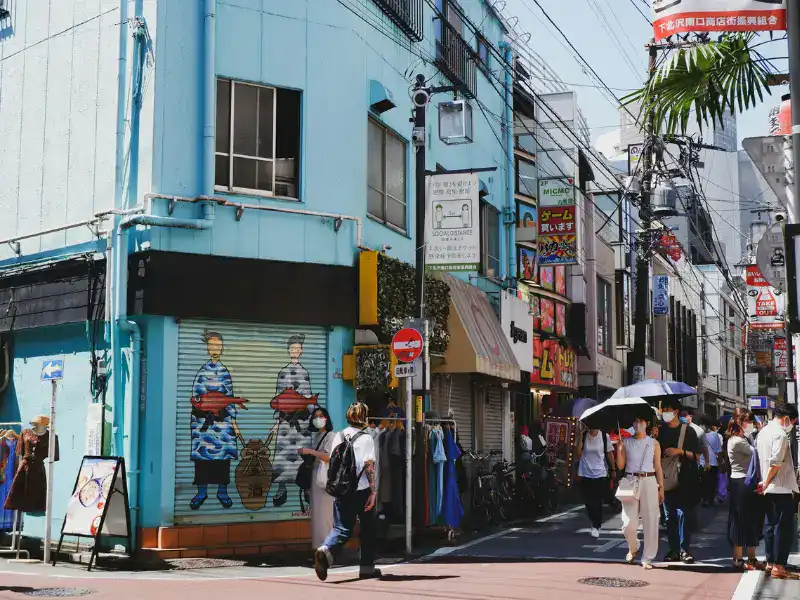
Basement Bar
This livehouse has been highly recommended by many due to how dedicated the organizers and management are to live music, as well as how impactful this venue is to the Japanese music scene as a whole. Many genres are played at this venue, including but not limited to blues, disco, punk, rock n’ roll, and hip-hop.
Location: 5 Chome-18-1 Daizawa, Setagaya City, Tokyo 155-0032
Open hours: Varies from event to event. Check their website for more details.
Price of admission: Varies from artist to artist. Check their website for more details.
English support: None, but the navigation tabs are in English.
Live Haus
With a capacity of 100 people, Live Haus is a livehouse that’s located just three minutes away from Shimo-Kitazawa station. The venue aims to be inclusive to everyone who attends, as well as to support underground music in Tokyo. A variety of genres can be heard at this venue, including indie rock, experimental music, and synth-pop.
Location: B1F, 2-14-2 Kitazawa, Setagaya City, Tokyo 155-0031
Open hours: Varies from event to event. Check the website’s schedule for more details.
Price of admission: Varies from artist to artist. Check the website’s schedule for more details.
English support: Other than the navigation tabs, their website is entirely in Japanese.
THREE
Located next door to Basement Bar is another livehouse owned by the same people, THREE. Like Basement Bar, THREE has also been highly recommended for the same reasons; how the venue is dedicated to putting on top quality live acts, as well as its impact. Expect to hear a variety of genres including, but not limited to, punk, rock n’ roll, disco, electronic music, etc.
Location: 5 Chome-18-1 Daizawa, Setagaya City, Tokyo 155-0032
Open hours: Varies from event to event. Check their website for more details.
Price of admission: Varies from artist to artist. Check their website for more details.
English support: None, but the navigation tabs are in English.
Shimokitazawa Artist
This is another livehouse in Shimo-Kitazawa where you can enjoy mainly acoustic music every night. Every month, they host open mic nights for aspiring artists wanting to begin their musical journey into stardom.
Location: 2F Shuttle hiei, 3-25-1, Kitazawa, Setagaya City, Tokyo 155-0031
Open hours: Varies from event to event. Check the website’s schedule for more details.
Price of admission: Generally 2000 yen + one drink. Check the website's schedule for more details.
English support: None, the website is entirely in Japanese, except for the navigation tabs.
Read our Ultimate Guide to J-Rock to learn more about this unique genre of Japanese music!
Best livehouses to enjoy live music in Koenji
Koenji might look like your average Japanese neighborhood, but its music scene is second to none. The area was known in the 1960s for having a great number of “rock-kissas,” music cafes where people would come to listen to the latest records. Nowadays, Koenji is known for having a punk vibe, and that vibe is apparent in their livehouses and bars.
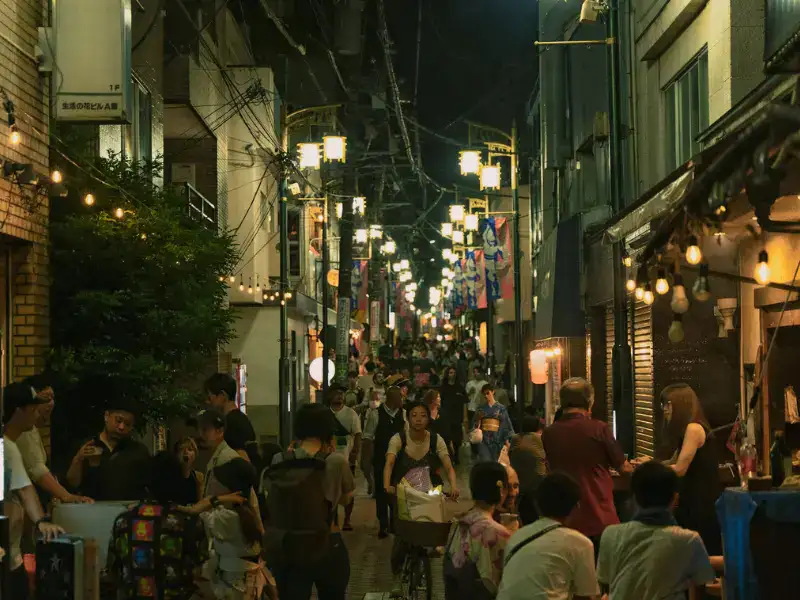
Koenji Club ROOTS
Koenji Club ROOTS is a livehouse just a minute away from Koenji Station. Here, they host a variety of niche, independent bands and artists. Expect mainly alternative rock to be played at this venue.
Location: 3-22-3, Koenjikita, Suginami City, Tokyo 166-0002
Open hours: Varies from event to event. Check the website’s schedule for more details.
Price of admission: Varies from event to event. Check the website’s schedule for more details.
English support: The website’s navigation tabs are in English, but everything else is in Japanese.
20000V Den-Atsu
Although the original venue, 20000V was lost to a fire in 2009, this livehouse has reopened under the game 20000V Den-Atsu. This venue mainly plays punk, metal, and grunge music, and is well known in Tokyo’s underground music scene due to their loud sound system.
Location: 1-7-23 Koenjiminami, Suginami City, Tokyo 166-0003
Open hours: Varies from event to event. Check the website’s schedule for more details.
Price of admission: Varies from event to event. Check the website’s schedule for more details.
English support: The website’s navigation tabs are in English, but everything else is in Japanese.
Jirokichi
Just three minutes from Koenji Station is the neighborhood’s first and oldest livehouse, Jirokichi. Founded in 1975, this venue has a rich history, as the term “livehouse” actually came from its establishment. Although a variety of genres are played at Jirokichi, the venue mainly plays blues, jazz and occasionally rock music.
Location: 2-3-4, Koenjikita, Suginami City, Tokyo 166-0002
Open hours: Every day, 6:30pm to 12am.
Price of admission: Varies from artist to artist. Check the website's schedule for more details.
English support: Navigation tabs are in English, but the rest of the website is in Japanese.
SUB Store Tokyo
Although SUB Store might look like a used book and record store, every Friday to Sunday, it hosts many live music events featuring small, indie artists and DJs. You can listen to a variety of genres at SUB Store, including alternative rock, sub pop, and post-punk. The venue offers authentic Indonesian food for you to try as well.
Location: 3-1-12 Koenjikita, Suginami City, Tokyo 166-0002
Open hours: Wednesday to Sunday, 5pm to 11pm.
Price of admission: Varies from event to event. Check SUB Store’s social media for more information.
English support: Yes, their website and social media accounts are in English.


Other places to enjoy live music in Tokyo
That doesn’t mean that the suburbs above are the best places to enjoy live music. There are other livehouses and concert halls in Tokyo that are worth visiting, with some venues hosting major acts, both local and international.
Liquidroom
Located four minutes away from Ebisu station, this livehouse hosts both indie and well known artists who play a variety of genres including, but not limited to, J-rock, J-pop and even metal. The venue also has a lounge on the 2nd floor where a variety of events, including live DJ sets, are held. Some famous artists that have played at this venue include Chali XCX, Lewis Capaldi, and ONE OK ROCK.
Location: 3-16-6, Higashi, Shibuya City, Tokyo 150-0011
Open hours: Varies from event to event. Check the website’s schedule for more details.
Price of admission: Varies from artist to artist. Check the website’s schedule for more details.
English support: There is no English version of their website, though the navigation tabs are in English.
Zepp Diver City
Zepp Diver City is part of a group of livehouses located not only in Tokyo, but in Japan and some parts of Asia. Located next to Diver City shopping mall, this venue mainly hosts artists performing J-pop, rock, and punk, though electronic music is occasionally played there. This venue is also known for hosting major artists such as Gorillaz, BABYMETAL, and Weezer.
Location: 1-1-10 Diver City Tokyo Plaza, Aomi, Edogawa City, Tokyo 135-0064
Open hours: Varies from event to event. Check the website’s schedule for more details.
Price of admission: Varies from artist to artist. Check the website's schedule for more details.
English support: There is no English version of their website, though some parts such as the navigation tabs are in English.
Blue Note Tokyo
Located just an eight minute walk away from Omotesando station, Blue Note Tokyo is the Tokyo branch of the famed Blue Note jazz bar in New York. Although the main genre played at Blue Note Tokyo is jazz, other genres such as classical, soul, and R&B are played there. Many famous musicians, both local and abroad, have played at this venue. In addition, the venue also offers a variety of dishes and drinks to accompany your visit.
Location: 6-3-16 Minami-Aoyama, Minato City, Tokyo 107-0062
Open hours: Varies from event to event. Check the website’s schedule for more details.
Price of admission: Prices vary from artist to artist, though as of writing this article, the cheapest show was around 8000 yen to 11300 yen. Check the website for more details.
English support: There is an English translation of the venue’s website, and reservations can be made in English online.
Rock Bar BAUHAUS
BAUHAUS is a rock bar located one minute away from Roppongi station. Their in-house band plays a variety of songs from different genres, such as rock, metal, and even pop, depending on the overall atmosphere of the venue.
Location: Urban Building B1F, 7-13-2 Roppongi, Minato City, Tokyo 106-0032
Open hours: 7pm to 1am, every Tuesday to Saturday.
Price of admission: Usually 3400 yen plus 1 drink (around 1000 yen). Check their schedule online for more details.
English support: There is an English version of their website.
Check out Our Favorite Things to Do in Odaiba for a guide on how to best enjoy this popular entertainment center!
Where to enjoy live music in Tokyo: Major acts
If you’re looking to enjoy live music from major acts, whether local or international, then knowing where to find information on those gigs is important. For local artists, check their social media accounts or ticketing websites to see whether they are performing in Tokyo. This is also the same for international artists, however, websites such as Tokyo Cheapo and Time Out have a compiled list of international acts that are planning to perform in the Tokyo area. Live Nation Japan is also a good site for finding local and international major acts as well.
Famous concert halls in Tokyo
Budokan
Originally built for the 1964 Tokyo Summer Olympics, the Nippon Budokan is one of the most famous stadiums in the Tokyo area not just for sports events, but for concerts as well. Located a five minute walk from Kudanshita station, this concert hall has famously hosted the Beatles in 1966.
Location: 2-3 Kitanomarukoen, Chiyoda City, Tokyo 102-8321
General admission costs: Varies from artist to artist. Always check the promoter’s website to get exact prices.
Tokyo Garden Theater
Tokyo Garden Theater is one of the newer concert venues out there, with a capacity of 8000 people. This venue, located 14 minutes away from Kokusai-Tenjijou station, has recently hosted many local and international artists such as Vaundy, Kylie Minogue, and AKB48.
Location: 2 Chome-1-6 Ariake, Koto City, Tokyo 135-0063
General admission costs: Varies from artist to artist. Always check the promoter’s website to get exact prices.
Tokyo Dome
WIth a capacity of 55,000, Tokyo Dome is one of the biggest stadiums located in the Tokyo area, located five minutes away from Suidobashi station. Notable artists that have performed at this venue in recent times include Bruno Mars, Taylor Swift, and YOASOBI. If an artist or band happens to be performing at Tokyo Dome, then you know that they have reached peak popularity in Japan.
Location: 1 Chome-3-61 Koraku, Bunkyo City, Tokyo 112-0004
General admission costs: Varies from artist to artist. Always check the promoter’s website to get exact prices.
Affordable Online and Offline Daytime Lessons in Tokyo
Stress-free Japanese lessons in the heart of Tokyo or from the comfort of your own home!
Affordable Japanese Lessons
Monthly Contracts
No Entrance Fees
No Hidden Fees
400+ Students
Online or Offline Lessons
How to buy concert tickets
Now that you found an artist or band to see live, it’s time to buy your tickets!
Before you purchase your tickets, most Japanese ticketing sites require you to have an account with the ticketing site, as well as a Japanese phone number. This is an anti-scalping measure to ensure that tickets cannot be resold to others at unfair prices. To make an account, simply input your email address and password, and once you have done that, input your name, date of birth, your Japanese address, and your Japanese phone number.
Once you get your account set up, you can finally start to buy tickets. If you’re buying tickets during a presale, then chances are you will have to go through the chuusen (抽選). The website will tell you whether you have won or lost the lottery, and depending on the outcome, you can pay for your ticket or try again respectively. Otherwise, the process to purchase tickets during general sales is standard; select the date you wish to see the artist live, and the number of tickets you’re purchasing. You can pay for your ticket either online or in some cases, the convenience store.
If you’re going to see a smaller, indie artist at a livehouse, it is possible to reserve your ticket in advance via email or social media and pay directly at the door. There is also the option to pay for same-day tickets, though be prepared that they can cost a little more than if you were to purchase tickets in advance.
Ticketing sites to buy tickets for live music in Tokyo
ePlus
ePlus is one of the three major ticketing sites in Japan, which include Ticket Pia and Lawson Ticket. You can find a range of artists and bands on this website, from local, smaller indie bands to the most popular international artists. There’s even the option to search for live music events according to region and prefecture. Most concert organizers in Japan will probably use this website to sell their tickets.
English support: An English version of the ePlus website is available for international customers, albeit with limited features.
Japanese phone number: Required in order to make an account
Ticket Pia
Ticket Pia is another ticketing site that is commonly used in Japan, and most shows will probably rely on this website to sell concert tickets. Like ePlus, you can find a live music event according to area, but unlike ePlus, Ticket Pia doesn’t allow you to search for live events by prefecture, though there is a good chance that if an artist is performing in the Kanto area, they will most likely visit Tokyo.
English support: Yes, the website uses a machine translation service, however you can only search in Japanese.
Japanese phone number: Required in order to make an account.
Lawson Ticket
Lawson Ticket is also another ticketing site that is commonly used in Japan. The website allows you to search for a range of concerts, from local artists to international acts. However, you can only search by area and not by prefecture.
English support: Yes, the website uses a machine translation service, however you can only search in Japanese.
Japanese phone number: Required to make an account.
Zaiko
This is a ticketing site that is one of the more foreigner friendly options out there. Here you can find a variety of concerts to attend, including idol concerts. They are best known for offering ticket sales to overseas customers wanting to attend live events in Japan.
English support: Yes, their website is entirely in English.
Japanese phone number: Not necessarily required.
Useful vocabulary related to live music in Tokyo
Ticket-related vocabulary
| 抽選 | chuusen | Lottery |
| 当選 | tousen | Lottery success |
| 落選 | rakusen | Lottery failure |
| 席 | seki | Seat |
| 申し込み | moushikomi | Application |
| スタンディング | sutandingu | Standing ticket |
| 枚数 | maisuu | Number of tickets |
Useful phrases and vocabulary to enjoy live music in Tokyo
| 整理番号 | seiri bangou | Reference number |
| 電話番号 | denwa bangou | Phone number |
| 名前 | namae | Name |
| 1ドリンク別 | 1-dorinku betsu | Drink fee is separate |
| ソフトドリンク | sofuto dorinku | Soft drink (non-alcoholic) |
| アルコール | aruko-ru | Alcohol |
| ~はどこですか? | ~wa doko desu ka? | Where is the (area)? |
| コインロッカー | ~koin rokka | Coin locker |
| トイレ | ~toire | Toilet |
| 開場 | ~kaijou | Venue opening time |
| 誰を見に来ましたか? | ~dare wo mi ni kimashitaka? | Which artist/band are you here to see? |
| ドリンクはいくらですか? | ~dorinku wa ikura desu ka? | How much is a drink? |
| これをください。 | ~kore wo kudasai. | I’ll have this, please. |
Check out our Top Tips to Improve Bad Japanese and brush up on your Japanese skills!


The Most Affordable Japanese Group Lessons in Tokyo
Start your Japanese Journey with Japan Switch and let us be your guide! Whether you're starting from scratch or have been down the rabbit hole a few times, we're here to help navigate the exciting (and challenging) intricacies of learning Japanese together.
How to enjoy live music in Tokyo
Before the show
Age limits
Before deciding on which show to go to, do keep in mind that some shows may have age limits. Most shows in Tokyo do not have a set age limit and children are welcome to attend, though those under the age of 16 must be accompanied by an adult. Preschool children are not allowed to enter, however.
However, if a show begins at 11pm, then there will definitely be an age limit; generally, those under 20 years old will not be allowed into the venue in such cases. Make sure to bring some form of identification if you are attending a late night concert as venue staff will most likely verify your age.
How to obtain your ticket
If you purchased a physical ticket, please note that most shows in Japan will only allow you to receive your ticket on the day of the show itself. Very few shows in Japan will allow you to pick up your concert ticket in advance at the convenience store. If there is the option to pick up your ticket at the convenience store, then you will be given a code to print out at one of the printing machines.
If you purchased a digital ticket, you will receive an email from the ticketing app of your choice notifying you that the ticket is available to download. You will usually receive this email at least a week before concert day. After this, go to your ticketing app and download the ticket and it should either be presented to you as either a smart ticket or a QR code you can scan on the day of the concert.
At the venue
Opening times
In Japan, concerts tend to start and end earlier; most concerts start at around 7pm and end at 9pm, though show times may vary. This is to ensure that everyone can catch their train home once the show ends. As for opening times, the venue tends to open at least one hour before the show starts, so that people can find their designated spots inside, use the bathroom, or buy a drink.
This applies mainly for major artists and large venues. If the ticket you purchased doesn’t have a designated seat, you will see a number which indicates the order in which you will be entering the venue. This is called a seiri-bangou (整理番号), and this will determine the order in which you will be able to enter the venue.
When your number is called, this is your signal to enter the venue. Depending on which number you will get, it could potentially affect your ability to get the barrier, if you are looking to snag a spot there. The way they call out the numbers can vary from show to show; some venues will call for a group of people with numbers between a range of two numbers (for example, they will call for people with numbers between 20 to 29).
Be prepared in advance!
It is generally recommended that you get to the venue early. This will give you ample time to survey the merch table, meet with other fans, or grab a bite to eat in the surrounding area. Store all large, non-essential valuables in a coin-operated locker at the venue if the service is available, otherwise pack lightly; bring your wallet containing some cash and some form of identification in case the venue decides to confirm your age. You may also consider bringing a power bank to charge your phone during the show. If needed, bring earplugs to protect your hearing.
Concert etiquette
Are taking photos and videos allowed?
It depends on who is performing. Some shows enforce a no-photos policy that if caught, will result in you getting ejected from the venue. Other shows welcome other concert goers to take photos or videos, and the artist or band will appreciate the exposure if they get tagged on social media. Regardless, always check the artist or band’s policy on photos and videos and follow the rules of the venue at all times.
Why is everyone standing still during the performance?
This may come as a culture shock to many attending their first concert not just in Tokyo, but in Japan as a whole. In Japan, people tend to be more muted and subtle in their reactions, and going to a concert is no different. In this case, people tend to not cheer for their favorite artist or band not only out of respect for the people performing, but because they perceive live concerts like a piece of art at a gallery.
However, audience reactions can vary from concert to concert. There have been many instances where people end up singing and dancing along to their favorite songs during the show. For rock, punk and metal concerts, moshing is to be expected if permitted. However, don’t expect every concert to have the same level of energy as a show outside of Japan. You can still sing, dance, and cheer for your favorite artists; just make sure to mind your manners at all times.
Why do I need to buy a drink?
In Japan, most concert venues generally expect you to buy a drink. Think of it as a fee for using the venue. The drink fee is separate from the ticket, and you will be expected to pay at least 500 yen for a drink token at the entrance, though this may vary from venue to venue. The drink doesn’t necessarily have to be alcoholic; it can be a soft drink or even water, but you need to buy a drink regardless. In addition, you don’t necessarily have to purchase a drink right before a show, you can buy a drink at the end of the show as well.
To tell if you need to buy a drink or not, look out for the words 1D or 1ドリンク (dorinku) on either the ticketing website or on the venue’s promotional material. Keep in mind, however, that the legal drinking age in Japan is over 20.
Final Thoughts
Going to a livehouse in Tokyo doesn’t have to be intimidating, nor does buying concert tickets. It’s all about finding the right livehouse to go to, how to get in, and how to best enjoy the music. If you have followed this guide all the way to the end, then hopefully you should be able to enjoy yourself and get that dopamine boost that you get from listening to live music in Tokyo. Have fun and rock your heart out!
Related articles:
Out & About: What to do in Tokyo at Night
Ultimate Guide to Useful Japanese Phrases
Ultimate Guide to the Best Mexican Food in Tokyo
Our Favorite Things to Do in Ueno
Our Favorite Things to do in Yokohama
Ultimate Guide to Useful Japanese Phrases
Ultimate Guide to Otaku Culture
Ultimate Guide to Amusement Parks in Tokyo
Ultimate Guide to Tokyo Trains
The post Ultimate Guide to Live Music in Tokyo appeared first on Japan Switch.
]]>The post Ultimate Guide to Places to Visit in Okinawa appeared first on Japan Switch.
]]>Ultimate Guide to Places to Visit in Okinawa
By Katie Huynh | November 12th, 2025
Japan isn’t all cities and countryside. If you travel South of Japan, you will be met with the most gorgeous beaches and beautiful culture. Welcome to Okinawa, the Hawaii of Japan: a true island paradise that isn’t talked about enough. This article will walk you through the best places to visit in Okinawa, from romantic getaways to family vacations.
This article is a part of our extensive series on Learning about Japan through Online Japanese Lessons at Japan Switch.
Preparing for Your Trip to Okinawa
Before embarking on your trip to Okinawa, there are a couple of essentials you should cover first.
When and Where to Book Flights
For domestic flights, it is recommended to book about two to three months in advance for the best prices. You can find prices as low as $70 USD, depending on what month you plan to arrive.
For international flights, I suggest booking at least four months before travel. Prices can spike up by hundreds of dollars if you wait too long. If flying from outside of Asia, expect prices to be around $950-$1500 USD as their lowest. While flying internationally can be expensive, Okinawa is a unique experience that makes the planning and expenses worth it.
Pro Tip For Affordable Flights
For affordable airlines within Japan, check out Peach Aviation and Jetstar Japan. Not only are the flights cost-effective, but they also have frequent discounts available. For instance, Peach Aviation holds a “Happy Peach Sale” every few months, and Jetstar Japan has their “Friday Frenzy” weekly, with limited-time sales every Friday evening on selected routes. If flying internationally, Skyscanner and Google Flights will be your best friend. You can track prices and compare across different airlines, allowing you to pick the most optimal flight for your needs.
The month you travel in also plays a huge part in the price of your plane ticket. The cheapest month to fly is December since it is off-season. Visiting Okinawa in December is ideal if you want to avoid crowds, however, activities will be limited. If you are interested in a more tropical-feel, consider going during peak seasons. Peak seasons are typically July to September, and flights around this time will be more costly due to greater demand. Additionally, if you are flying domestically, flights to Okinawa will be very expensive during Golden Week. To learn more about Golden Week, check out our article: Ultimate Guide to Golden Week.
How to Efficiently Plan an Itinerary
Once you book your flight, it is important to start planning your itinerary as soon as possible. If you are tech-savvy, you can organize all of your trip details in a spreadsheet. If you are looking for the easiest method possible, I suggest checking out Wanderlog, a free vacation planner. My favorite feature on Wanderlog is their map that shows the distance between all of the places you want to go to. It allows you to efficiently plan out your days by calculating how much time you need to commute, and by seeing what’s nearby. Imagine you have two places you want to go to, and you realize they are right next to each other. Now you can do both during the same day! For places to visit in Okinawa, this app is an absolute game changer, given that all of the popular destinations are spread apart. This feature specifically is a great time-saver, perfect for those who want convenience and efficiency.
How to Get Around in Okinawa
Unlike mainland Japan, Okinawa has a limited public transportation system, meaning that it is heavily reliant on cars. The most effective way to get around is driving, but how can we do that?
Obtaining an International Driving Permit (IDP)
If you are visiting from outside of Japan, you will need to obtain an International Driving Permit (IDP). In your home country, fill out an application and apply either in-person or by mail. You will need your home country-issued driver’s license. In the U.S., the best way to do this is through AAA. You will need to fill out an application and bring it to a nearby AAA with your driver’s license and two original passport photos. It takes just a couple of minutes to complete in-person, and costs $20 USD. Upon receival, the IDP will be valid for a year.
No More Cookie-Cutter Japanese Lessons!
At Japan Switch, we teach the Japanese you’ll actually hear, actually use, and actually need and not just textbook sentences you’ll never say.
Renting a Car in Okinawa
Now that you have your IDP, it is time to rent a car. You will definitely need it to see all of the places to visit in Okinawa. You can rent from major car rental companies either at Naha Airport or in Naha city center. However, the most efficient way to book is online. The most popular website for foreigners is Tabirai Japan, as it is English-friendly, compares all major Okinawa rental companies, and has free cancellation.
Before renting a car, there are some important tips to keep in mind.
There is an age requirement to rent a car.
While you need to be at least 18 to drive in Japan, most rental companies usually require you to be 20 or older, so be sure that you meet the age requirement or are traveling with someone else who does!
You will need to pay tolls.
Okinawa has one main expressway called the Okinawa Expressway (E58). You’ll pay tolls if you use this expressway, but most other roads on the island are free. There are two main options for you to pay tolls. The recommended option is with an ETC card, which will be provided by the rental company for an additional charge of around ¥330–¥550/day, or sometimes for free.
This is how to obtain an ETC reader.
All rental cars in Japan are already equipped with an ETC reader (the slot where the card goes). You just need to rent the card itself from the same place you rent your car. With the card, you can go through the ETC gate (purple lane) and the toll will automatically be charged without you doing anything. If you decide not to rent an ETC card, be sure to go through the green lane when driving. Take a toll ticket when entering, and pay cash when exiting.
Remember to fill up the gas tank.
When returning the car, be sure to refill the gas and keep the receipt in case the rental staff ask. You’re also expected to fill up at the nearest gas station to the return location, usually within 5–10 km. The receipt helps prove that.
Drive on the left side of the road.
This is the most crucial tip: remember to drive on the left side of the road! Practice safe driving and understand Japanese road rules.
Driving is a crucial part of your experience in Okinawa. Be sure to familiarize yourself with Japanese road signs before embarking on your journey. Read our Ultimate Guide to Japanese Road Signs to ensure maximum preparation!
Places to Visit in Okinawa for Families
Okinawa is a perfect getaway for families. Unlike Tokyo’s dense streets and packed trains, Okinawa is spacious and breathable. Okinawa’s calm environment allows for stress-free exploration. In addition, Okinawa has some of the most family-friendly activities in Japan.
Places to Visit in Okinawa: Nago Pineapple Park
Nago Pineapple Park is a tropical-themed attraction dedicated entirely to pineapples. The park offers a self-driving pineapple-shaped cart ride that takes you to fields of pineapples, lush gardens, and mini exhibits showing how the fruit is grown and processed. Inside, you’ll find a pineapple winery, a dessert café, and a gift shop selling pineapple-themed snacks, souvenirs, and even wine. This makes for a lighthearted activity for families.
Location: 1195 Tamemata, Nago City, Okinawa Prefecture, 905-0005
Hours: 10:00-18:00 (last entrance 17:30)
Prices: ¥1,500 for adults (16+), ¥800 for children (4-15), free for children under 4
Website: https://www.nagopine.com/index.html
Online Japanese Lessons That Actually Work.
Our affordable online Japanese lessons are built for busy learners with small groups, real conversations, and flexible schedules that work for you.
Online Japanese Lessons That Actually Work.
Our affordable online Japanese lessons are built for busy learners with small groups, real conversations, and flexible schedules that work for you.
Places to Visit in Okinawa: Okinawa Churaumi Aquarium
Okinawa Churaumi Aquarium is one of the world’s largest and most spectacular aquariums, making it one of the best places to visit in Okinawa. The name “Churaumi” combines the Okinawan words chura (beautiful) and umi (sea), which perfectly describes the crystal-blue ocean that surrounds the island. The aquarium features a wide variety of aquatic life. The highlight of the aquarium is a massive, 10-meter-deep tank home to giant whale sharks, manta rays, and hundreds of tropical fish. It is truly worth the hype, and is absolutely mesmerizing.
Location: 424 Ishikawa, Motobu, Kunigami District, Okinawa 905-0206
Hours: 8:30-18:30
Prices: ¥2,180 for adults, ¥1,440 for children, ¥710 for elementary and middle school, free for children under 6
Website: https://churaumi.okinawa/en/

Places to Visit in Okinawa: Okinawa World
Okinawa World is a great way to balance your tropical vacation with Okinawan culture, which differs from mainland Japanese culture. This theme park highlights traditional Ryūkyū (a kingdom that ruled the islands of Okinawa for centuries before it became part of Japan) architecture, crafts, and performances. The main attraction here is the Gyokusendo Cave, a massive limestone cave stretching over 5 kilometers with beautiful stalactite formations and underground streams.
Location: Maekawa-1336 Tamagusuku, Nanjo, Okinawa 901-0616
Hours: 9:00-17:30
Prices: ¥2,000 for adults (15+) and ¥1,000 for children (4-14)
Website: https://en.gyokusendo.co.jp/okinawaworld/
If you want to learn more about the Ryūkyūan culture and religion, our Ultimate Guide to Japanese Culture covers that.
Traveling with family can be stressful, especially if nobody knows Japan. Even knowing the basics can help immensely, so check out our article on Top 1000 Japanese Words You Need to Know!
Places to Visit in Okinawa for Couples
Okinawa can be incredibly romantic. With beautiful ocean views, it is the perfect place to take your lover for a romantic getaway. To up the level of romance, consider visiting Okinawa during White Day (March 14th). In Japan, only women give gifts on Valentine’s Day. Men reciprocate that a month later on White Day. Taking your partner to Okinawa would be the best gift for White Day.
Interested in learning more about White Day? Check out our Ultimate Guide to White Day in Japan!
Places to Visit in Okinawa: Cape Manzamo
Cape Manzamo is one of Okinawa’s iconic landmarks. It’s famous for its elephant-trunk-shaped rock and stunning views of the ocean. While you cannot swim here, there are nearby beaches such as Manza Beach and Sun Marina Beach. Cape Manzamo makes for a great romantic spot in Okinawa, with its beautiful scenery overlooking the blue waters.
Unfortunately, you will need to pay a small entrance fee of ¥100 to access the main viewing area at Cape Manzamo, but it’s totally worth it for the dramatic coastal cliffs, turquoise water, and sunset views.
Location: Onna, Kunigami District, Okinawa 904-0411
Hours: 8:00-20:00
Prices: ¥100
Website: https://www.manzamo.jp/
Places to Visit in Okinawa: Kouri Island
Kouri Island is a beautiful and romantic destination. The highlight of the trip is driving or biking across the Kouri Bridge, which connects Okinawa’s main island to Kouri Island. Located right by the bridge is Kouri Beach. Perfect for swimming, snorkeling, or just lounging. You can rent beach chairs, umbrellas, and even kayaks or paddle boards in summer.
The island’s most famous landmark is the heart rock: two heart-shaped rocks standing side by side in the ocean. It’s a popular couple’s spot, often called the “Island of Love.” The Heart Rock is accessible via a short walk down to Tinu Beach, but note that there’s a small parking fee (¥300–¥500).
Pro Tip: Don’t miss Kouri Island Shrimp Wagon, a food truck famous for garlic shrimp bowls. There are also many cafés with ocean views, like L LOTA or Café Kokuu which offer great coffee and locally sourced meals.
Location: Kouri, Nakijin, Kunigami District, Okinawa 905-0406
Hours: Open 24 hours
Prices: Free
Website: https://visitokinawajapan.com/destinations/okinawa-main-island/northern-okinawa-main-island/kouri-island/
Okinawa has some of the most beautiful sights in Japan. If you are interested in sightseeing in other parts of Japan, you don't want to miss our Ultimate Guide to Sightseeing in Japan.
3 Places to Visit in Okinawa for Anyone
Who said Okinawa was only for families and lovers? Okinawa is for anyone and everyone! You can come here solo or with a group of friends. Regardless, you can expect to have a great time.
Places to Visit in Okinawa: Naha Kokusai Dori Shopping Street
Located right in central Naha is Kokusaidori Street, a major shopping and entertainment street. You can find cute stores like Snoopy’s Surf Shop and Aloha Outlet right around the corner. You can pick up some Hawaiian-inspired shirts and souvenirs to fit the island vibe perfectly. If you’re more interested in streetwear, stop by the Stussy Okinawa store to see if they have Okinawa exclusive shirts in stock. These shirts make great travel souvenirs and gifts, as you can only get them in Okinawa or resold online. If you walk further away from the street, you can find more local attractions. There are shops with fresh fruit, a great chance to get a tropical taste of fruit and really immerse yourself in the island experience.
Location: 3 Chome-2-10 Makishi, Naha, Okinawa 900-0013
Hours: 10:00-17:00
Prices: Free
Website: https://naha-kokusaidori.okinawa/en/shopping.html
Places to Visit in Okinawa: American Village
American Village is a large shopping and entertainment complex in Chatan-cho, Okinawa. It blends American and Okinawan culture together, making it an exciting place for tourists and locals alike. There are a plethora of Japanese and American fashion brands and restaurants. At night, the environment becomes super lively with music and a lit-up ferris wheel. If you are from America and feeling a little homesick, American Village is one of the places to visit in Okinawa that will make you feel right at home again.
The most popular restaurant here is Magic Ocean, with a 4.9/5 star rating from 6.3K reviews. The restaurant has live entertainment, featuring magicians, musicians, and more. The atmosphere here is that of a pirate ship sunken to the bottom of the sea.
Location: Mihama, Chatan, Nakagami District, Okinawa 904-0115
Hours: 10:00-22:00
Prices: Free
Website: https://www.okinawa-americanvillage.com/en/
Places to Visit in Okinawa: Shuri Castle
Interested in Okinawan history? Shuri Castle is the place for you. It once served as the royal palace of the Ryukyu Kingdom, until the king was banished and the kingdom was annexed. From there, Ryukyu Kingdom became Okinawa Prefecture.
In World War II, much of the castle was destroyed. It was rebuilt, but unfortunately, it was destroyed again by fire in 2019. Reconstruction efforts are ongoing, and parts of the site remain open to visitors. Despite the construction, you can still enjoy the beautiful castle walls, explore exhibits on Ryukyuan history, and enjoy panoramic views of Naha. Visiting Shuri Castle offers a meaningful glimpse into Okinawa’s royal past and its enduring spirit of restoration and resilience.
Location: 1-2 Shurikinjocho, Naha, Okinawa 903-0815
Hours: Vary depending on area, but generally around 8:00-19:30
Prices: ¥400 (adult), ¥300 (high school students), ¥160 (elementary and middle school students), free for children under 6
Website: https://oki-park.jp/shurijo/en/
Want to make some friends to travel with? If you're unfamiliar with the Japanese language and culture, I recommend making some Japanese friends who can show you around and be your "personal tour guide"! Check out Top 15 Tips to Make Japanese Friends to learn some tips and tricks on how to make Japanese friends.
Places to Visit in Okinawa for Outdoor Activities
Especially if you are visiting Okinawa in the summer, you have to try out their outdoor activities. It just hits different in Okinawa. It's the ultimate summer destination.
Curious about other sports and activities in Japan? Dive into our Ultimate Guide to the Most Popular Sports in Japan!
Scuba Diving and Snorkeling at the Blue Cave
H2O: Just Add Water and Mako Mermaids were my absolute favorite shows as a child. I dreamed of being a mermaid, and at the Blue Cave in Okinawa, I could finally live out that dream (if you’ve ever had a mermaid phase, you’d understand). The Blue Cave is magical, especially when sunlight hits the water at just the right angle, allowing the entire cave to glow a deep, electric blue. It is one of the most mystical places to visit in Okinawa.
You can book either a scuba diving or snorkeling activity here. The snorkeling tour is available for ages 3 and up, while diving courses are available from age 12 and up. Check out Klook for easy booking. Prices start as low as ¥3,465 for either activity, or you could bundle up and do both for around ¥8,000. Hours vary depending on your tour provider and weather and sea conditions.
This is a beautiful place to visit to see lots of sea life, however, it can get extremely crowded to the point where you can’t really embrace the nature anymore. I recommend going as early as possible to avoid crowds and to get the best experience possible.
Location: 469-1 Maeda, Onna, Kunigami District, Okinawa 904-0417
Hours: Depends on tour operator
Prices: Depends on tour operator
Website: https://blue-cave.okinawa/

Biking in Okinawa
If you want a relaxing and scenic way to explore Okinawa, biking is a fun activity to take on. You can rent a regular bike, e-bike, or do a cycling tour. Renting a bike typically costs ¥1,000 - ¥2,000/day while e-bikes cost around ¥2,500 - ¥3,500/day. The most popular cycling route is through Kouri Island. The road is mostly flat, making it easy for beginners or families. You ride across the Kouri Bridge, a scenic seaside bridge. Then, you circle the island to find hidden beaches, local cafés, and the famous “Heart Rock” at Tinu Beach. If you are traveling in the summer, it is recommended to ride early in the morning or near sunset to avoid the heat.
If you are looking for stress-free navigation, consider a guided cycling tour. Experienced guides will take you through the beautiful island of Okinawa and share the culture and history with you. You can ride through all of the best places to visit in Okinawa. If you are interested in this activity, you can find bookings on Klook or Google, with prices starting around ¥10,000 per adult.
Location: Depends on route
Hours: Flexible
Prices: Depends on bicycle and tour guide
Website: https://www.japan.travel/en/sports/cycling/courses/kouri-bridge-cycling-tour/
Trying Okinawan Food
Food is a huge part of travel. It allows you to expand your palette and experience a new culture. When visiting Okinawa, you have to try their food. Okinawa’s food is different from what mainland Japan offers. Its food is a blend of Japanese, Chinese, and Western flavors. In addition to signature savory Okinawan dishes, there are also fun Okinawan sweet treats you should try.
Here are some must-try Okinawan food:
- Okinawa Soba: Wheat noodles in a pork-and-bonito broth topped with braised pork belly and fish cake.
- Taco Rice: A post-war fusion dish. Taco-seasoned beef on rice, topped with cheese and lettuce.
- Goya Champuru: Stir-fry of bitter melon, tofu, pork, and egg.
- Rafute: Soy-braised pork belly, tender and sweet-savory, similar to Chinese-style stewed pork.
- Sata Andagi: Okinawan deep-fried doughnuts, crisp outside and fluffy inside.
- Okinawan Shaved Ice (Kakigori): Shaved ice with tropical fruits.
- Blue Seal Ice Cream: While Blue Seal has expanded to mainland Japan, it was originally created in a US military base in Okinawa. It has grown to become one of Okinawa’s most popular desserts.
If you are looking to try Okinawan food in a centralized location, check out Makishi Public Market, located in Naha. You can browse the food stalls selling fresh seafood, tropical fruit, and local delicacies.
If you want to learn more about Okinawan food and cuisine, check out our Ultimate Guide to Okinawan Food and Cuisine.
Island Hopping in Okinawa
Okinawa isn’t just one big island: it’s an archipelago of over 160 islands, each with its own charm. Island hopping is one of the most rewarding ways to experience the region. From Naha, the easiest islands to reach are the Kerama Islands (Tokashiki, Zamami, and Aka), which are just 30 to 60 minutes away by ferry from Tomari Port. Here, you can swim with sea turtles at Furuzamami Beach, relax on Aharen Beach, or rent a scooter to explore quiet seaside roads.
Ferries to Kerama Islands sell out fast, so be sure to book quickly. You can book tickets on Klook for either roundtrip or one-way. Ticket prices vary based on distance, but you can expect to pay around ¥4,000 for roundtrip and ¥2,000 for one-way tickets.

Okinawa Moby Dick Dinner Cruise
This family-friendly cruise offers gourmet cuisine, live music, and scenic views. “Moby Dick” is Okinawa’s largest restaurant ship. The second floor of the ship has a restaurant, while the third floor has a BBQ course. You can pick from five different courses: coral course (¥6,375 for adults), emerald course (¥7,500), sapphire course (¥8,750), ruby course (¥11,000), and diamond course (¥12,750). These five courses are buffet style on the second floor. The third floor consists of the BBQ courses, which are only available from April to November. The regular BBQ course costs ¥5,500 per person while the deluxe BBQ course costs ¥9,500 per person. Check out the Moby Dick Dinner Cruise on Klook.
Location: 2-1 Tondocho, Naha, Okinawa 900-0035
Hours: Depends on booking
Prices: Depends on course
Booking Site: https://www.klook.com/activity/11998-moby-dick-dinner-cruise-naha-okinawa/
Where to Stay in Okinawa
Finding the right place to stay in Okinawa depends on what kind of experience you want. The island has a wide variety of hotels and guesthouses that cater to every type of traveler, from families and couples to solo adventurers. Here are some of the most popular areas and options to consider.
- Hotel Sanrio Okinawa is perfect if you love Sanrio and want something unconventional. It is unique and absolutely adorable. It’s also close to the airport for convenience.
• Address: 1 Chome-2-25 Asato, Naha, Okinawa 902-0067
• Starting Price: ~¥20,330 per night - The Busena Terrace (Nago) is a classic Okinawan resort surrounded by turquoise water. Guests can enjoy snorkeling, spa treatments, and elegant rooms with balconies facing the sea.
• Address: 1808 Kise, Nago, Okinawa Prefecture
• Price per night: ¥40,000–¥70,000
- Estinate Hotel Naha is a modern yet affordable option. You can still get that luxury vacation experience while saving money. It is conveniently located in Naha so you can get fast access to the airport and the Kokusai-dori Shopping Street.
• Address: 2-3-11, Matsuyama, Naha, Okinawa, 900-0032
• Starting Price: ~¥13,758 per night
Heading to Tokyo after your Okinawa trip? Still want that strong cultural feel? Consider staying at a ryokan for your next trip. Our Ultimate Guide to Tokyo Ryokan outlines over 12 exceptional ryokan to stay at.
Final Thoughts
Okinawa is a multifaceted destination. Whether you want to explore a new culture or seek relaxation, there are many worthwhile places to visit in Okinawa. I highly recommend visiting Okinawa at least once, especially if you want a break from the bustling cities of mainland Japan!
Related Articles:
Ultimate Guide to Summer in Japan
Ultimate Guide to Ordering Food in Japanese
Guide to Japanese Culture Shock
Ultimate Guide to National Holidays in Japan 2024
Ultimate Guide to Japanese Sweets
The post Ultimate Guide to Places to Visit in Okinawa appeared first on Japan Switch.
]]>The post How to Ask and Give Directions in Japanese appeared first on Japan Switch.
]]>How to Ask and Give Directions in Japanese
By Vivian Izumizawa | Sep 20th, 2025
Directions in Japanese can be tricky to understand, especially if you’re new to Japan. Train stations often feel like complex mazes, streets rarely follow neat grids, and addresses rely on block numbers instead of street names. On top of that, the language barrier means that even maps or apps can leave you confused if you don’t know how to read or ask for directions in Japanese.
That’s why learning how to ask for and give directions in Japanese isn’t just helpful, it’s essential. This guide walks you through key direction words, common landmarks, and practical phrases for asking and giving directions in Japanese. Whether you’re trying to find a hidden café, navigate a busy station, or locate the nearest convenience store, these tips will make exploring Japan smoother, safer, and much more enjoyable.
This article is a part of our extensive series on Learning about Japan through Online Japanese Lessons at Japan Switch.

How to say Positions and Directions in Japanese
Getting lost in Japan is easy… unless you know how to say where you’re going! Luckily, learning a few key words for positions and directions in Japanese, like “left,” “right,” and “straight ahead”, can save you from wandering around confused. Think of it as your secret superpower for navigating streets, trains, and even tiny alleyways with easy keywords!
Directions in Japanese: Up, Down, Left and Right
| Japanese | Romaji | English |
| 上の階に行ってください | Une no kai ni itte kudasai | Please go upstairs. |
| Japanese | Romaji | English |
| トイレは下の階にあります | Toire wa shita no kai ni arimasu | There is a bathroom downstairs. |
| Japanese | Romaji | English |
| 右にありますよ | Migi ni arimasuyo | It’s on the right. |
| Japanese | Romaji | English |
| 左に曲がってください | Hidari ni magatte kudasai | Turn on the left. |
Directions in Japanese: Cardinal Directions in Japanese
| Japanese | Romaji | English |
| 駅は北にあります。 | Eki wa kita ni arimasu | The station is to the north. |
| Japanese | Romaji | English |
| 海は町の南にあります。 | wa machi no minami desu. | The sea is in the south of the town. |
| Japanese | Romaji | English |
| 図書館は東にあります。 | Toshokan wa higashi ni arimasu. | The library is to the east. |
| Japanese | Romaji | English |
| 公園は西側にあります。 | Kouen wa nishi-gawa ni arimasu. | The park is on the west side. |
No More Cookie-Cutter Japanese Lessons!
At Japan Switch, we teach the Japanese you’ll actually hear, actually use, and actually need and not just textbook sentences you’ll never say.
How to Describe Locations and Directions in Japanese
Learning how to describe locations and directions in Japanese helps you understand everyday conversations and navigate more smoothly. Here are the key words you need to know.
Positions: Inside, Outside and In the Middle
| Japanese | Romaji | English |
| 中にお入りください | naka ni ohairi kudasai | Get inside |
| Japanese | Romaji | English |
| トイレは外にあります | toire wa soto ni arimasu | The bathroom is outside. |
| Japanese | Romaji | English |
| 真ん中の席に座ってください | Mannaka no seki ni suwatte kudasai | Please sit on the seat in the middle |
Relative Location: Front, Back, Next to
| Japanese | Romaji | English |
| 学校の前で待ってください | Gakkou no mae de matte kudasai | Wait in front of the school. |
| Japanese | Romaji | English |
| 建物の後ろに駐車場があります。 | Tatemono no ushiro ni chūshajyou ga arimasu | There is a parking lot behind the building. |
| Japanese | Romaji | English |
| スーパーはコンビニの隣にあります。 | sūpā wa konbini no tonari ni arimasu | The supermarket is next to the convenience store |
Opposite and Across
| Japanese | Romaji | English |
| カフェは駅の向かいにあります。 | kafe wa eki no mukai ni arimasu | The cafe is across from the station |
| Japanese | Romaji | English |
| 反対側にバス停があります。 | hantai gawa ni basu-tei ga arimasu | There is a bus stop in the opposite side. |
Distance: Near, Far and Beyond
| Japanese | Romaji | English |
| 駅はここから近いです。 | eki wa koko kara tikai desu | The station is near here. |
| Japanese | Romaji | English |
| 信号の先にコンビニがあります。 | shingou no saki ni konbini ga arimasu | There is a convenience store beyond the traffic light. |
| Japanese | Romaji | English |
| 信号の先にコンビニがあります。 | shingou no saki ni konbini ga arimasu | There is a convenience store beyond the traffic light. |
Don't Get Lost. Ride Trains Like a Local!
Lost In Tokyo trains? Check this Ultimate Guide for Trains in Tokyo before you go!
How to Talk About Buildings and Landmarks in Japanese
Knowing the Japanese words for everyday buildings and landmarks is like having a cheat code for asking directions, suddenly, you can actually find that café, shrine, or train station without wandering around like a lost emoji.
| Japanese | Romaji | English |
|---|---|---|
| 銀行 | Ginkou | Bank |
| 郵便局 | Yūbin-kyoku | Post Office |
| 学校 | Gakkou | School |
| コンビニ | Konbini | Convenience Store |
| 区役所 | Kuyakusho | City Office |
| スーパー | Sūpā | Super Market |
| 薬局 | Yakkyoku | Grug Store |
| 交番 | Kouban | Police Box |
| 図書館 | Toshokan | Library |
| 美術館 | Bijyutsukan | Museum |
| 駅 | Eki | Train Station |
| ホテル | Hoteru | Hotel |
| 駐車場 | Chūsha-jyou | Parking Lot |
| バス停 | Basutei | Bus Stop |
| 病院 | Byōin | Hospital |
Useful words when navigating inside buidings:
| Japanese | Romaji | English |
|---|---|---|
| 入口 | Iriguti | Entrance |
| 出口 | Deguti | Exit |
| トイレ | Toire | Restroom/ Bathroom |
| レジ | Reji | Cashier |
| 部屋 | Heya | Room |
| エレベータ | Erebētā | Elevator |
| エスカレーター | Esukarētā | Escalator |
| 階段 | Kaidan | Stairs |
| 〇階 | _ kai | _ Floor (like 一階 ikkai , 二階 nikai , 三階 sankai ) |
Common Landmarks Used in Directions in Japan
| Japanese | Romaji | English |
|---|---|---|
| 公園 | Kōen | Park |
| 橋 | Hashi | Bridge |
| 神社 | Jinjya | Shinto Shrine |
| お寺 | Otera | Buddhist Temple |
| お城 | Oshiro | Castle |
| 記念碑/ 像 | Kinenga/ Zō | Monument/ Statue |
| タワー | Tawā | Tower |
| 信号 | Shingou | Trafiic Light |
| 交差点 | Kōsaten | Intersection |

Why Directions in Japanese Use Landmarks, Not Cardinal Directions?
Street Layout and Naming
Outside of major avenues, most streets in Japan do not have official names. Instead, addresses are based on areas, city blocks (丁目 chōme), and building numbers. Without street names, saying “go along the main street” or “turn onto the 3rd Avenue” is not the best option.
In many older Japanese cities, such as Kyoto or the historic areas of Tokyo, the streets do not follow a neat grid but instead curve, branch off unpredictably, or end in dead-ends. Because the roads aren’t straight or aligned in a consistent direction, compass points like north, south, east, and west become far less intuitive for everyday navigation, making it much more natural for people to describe routes using visible landmarks instead.

Cultural and Practical Reason
Another important reason for Japan’s landmark-based directions is in the cultural and practical habits. Because almost everyone recognizes the same large buildings, train stations, or chain shops, using these landmarks makes it much easier for both the speaker and the listener to understand where to go. In addition, most people in Japan don’t naturally think in terms of “north” or “south” unless they are hiking or looking at a specialized map, and even printed maps are often rotated to match the viewer’s perspective rather than fixed with north at the top. Finally, Japanese cities are dense and walking distances between points are usually short, so it feels far more natural to give directions like “walk two minutes past the bakery” than to describe a location with cardinal directions.
Example of How People Might Give Directions in Japanese
- コンビニを左に曲がってください
(Konbini wo hidari ni magatte kudasai)
Turn left on the convenience store.
- トイレの隣です
(toire no tonari desu)
It’s next to the bathroom.
- 信号の先に郵便局があります
( shingou no saki ni yūbinkyoku ga arimasu)
There is a post office just beyond the traffic light.
Check out our Ultimate Guide to Hiragana & Katakana for everything you need to start reading and writing Japanese!
How to Ask and Give Directions in Japanese: Real Life Conversation Patterns
No stress, just a few simple phrases and you’ll be asking for (and giving) directions like a pro. This part shows you how real Japanese conversations actually go, so you can find places, understand answers, and maybe even play hero for someone else who’s hopelessly lost!
How to Ask for Directions in Japanese (Basic Questions)
〇〇はどこですか?
(__ wa doko desuka?)
Where is __?
Example: 銀行はどこですか?
(ginkō wa doko desuka?)
Where is the bank?
〇〇へはどう行けばいいですか?
(__ e wa dō ikeba ii desuka?)
How can I get to __?
Example: この駅から浅草へはどう行けばいいですか?
(kono eki kara asakusa e wa dō ikeba ii desuka?)
How can I get to Asakusa from this station?
すみません、この住所に行きたいのですが。
( sumimasen, kono Jyūsho ni ikitai no desuga)
Excuse me, I’d like to go to this address. (show address)
近いですか?遠いですか?
(tikai desu ka? Tooi desu ka?)
Is it near? Or far?
Drive Smart in Japan!
Driving in Japan soon? Check this Ultimate Guide to Japanese Road Signs and travel safely like a pro!
Likely Answers People May Say When Giving you Directions in Japanese
Japanese speakers tend to give short, landmark-based answers.
〇〇の隣です。
( __ no tonari desu)
It’s next to the bank.
Example: 銀行の隣です。
(ginkou no tonari desu)
It’s next to the bank.
まっすぐ行ってください。
( massugu itte kudasai)
Go straight ahead.
〇〇つ目の信号を〇〇に曲がってください。
( __tsume no shingou wo __ ni magatte kudasai)
Turn __ at the __ traffic light.
Example: 二つ目の信号を右に曲がってください。
( futatsume no shingou wo migi ni magatte kudasai)
Turn right at the second traffic light.
駅を出てすぐ〇〇です。
( eki wo dete sugu __ desu)
Turn __ right after leaving the station.
Example: 駅を出てすぐ左です。
( eki wo dete sugu hidari desu)
Turn left right after leaving the station.
Follow-Up or Clarification Questions when Asking for Directions in Japanese
When you’re not sure, or they are not sure if understood correctly:
すみません、もう一度言ってください。
( Sumimasen, mō ichido itte kudasai)
Excuse me,could you repeat that?
もう少しゆっくり話していただけますか?
( Mō sukoshi yukkuri hanashite itadakemasu ka?)
Could you speak a little more slowly?
〇〇の近くにありますか?
( __ no chikaku ni arimasuka?)
Is it near __?
どのくらいかかりますか?
( dono kurai kakarimasu ka?)
About how long does it take?
How to Give Directions in Japanese (Helping Others)
When someone asks you for directions in Japanese:
まっすぐ行って、右に曲がってください
(Massugu itte, migi ni magatte kudasai.)
Go straight and turn right.
この道を三分くらい歩いてください。
( kono michi wo sanpun kurai aruite kudasai.)
Walk along this street for about three minutes.
橋を渡って左にあります。
( hashi wo watatte hidari ni arimasu.)
Cross the bridge and it’s on the left.
コンビニを過ぎたところです。
( konbini wo sugita tokoro desu)
It’s just past the convenience store.
ご案内しましょうか?
( goannai shimashō ka?)
Shall I show you the way?
Extra Handy Phrases for Real-Life Situations When Asking for Directions in Japanese
この地図を見てもらえますか?
(kono tizu wo mite moraemasu ka?)
Could you look at this map?
近くにトイレはありますか?
(tikaku ni toire wa arimasu ka?)
Is there a bathroom nearby?
駅までどのくらいですか?
(eki made dono kurai desu ka?)
How far is it to the station?
タクシーに乗った方がいいですか?
( takushī ni notta hōga iidesu ka?)
Should I take the taxi?
Check out our How Long Does It Take to Learn Japanese? guide for tips and strategies to speed up your language learning journey.
Sample Dialogue About Directions in Japanese
Recently Moved Edition
Scene: A foreigner who has just moved into a Japanese neighborhood wants to find the city office ( 区役所 kuyakusho) to register their address. They’re speaking to a local shop employee outside a convenient store.
Foreigner: すみません、近くの区役所はどこにありますか?
(sumimasen, tikaku no kuyakusho ha doko ni arimasu ka?)
Excuse me, where is the city office around here?
Shop employee: この道をまっすぐ行って、橋を渡ったあとに右に曲がってください。大きい図書館の隣にあります。
( kono michi wo massugu itte, hashi wo wattatta ato ni migi ni magatte kudasai. Ōkii toshokan no tonari ni arimasu)
Go straight along this street, cross the bridge, and turn right. It’s next to the big library.
Foreigner: ありがとうございます。歩いてどのくらいかかりますか?
(arigatougozaimasu. Aruite donokurai kakarimasu ka?)
Thank you. How long will it take on foot?
Shop employee: 十分くらいです。橋の少し前にバス停がありますよ。
( jyuppun kurai desu. Hashi no sukoshi mae ni basu-tei ga arimasuyo.)
About ten minutes. There is a bus stop a little before the bridge.
Foreigner: 助かります!まだこの街に引っ越ししたばかりで、道がよくわからなくて...
( tasukarimasu! Mada kono machi ni hikkoshita bakaride, michi ga yoku wakaranakute…)
That’s a big help! I just moved to this town and I’m not familiar with the roads yet…
Shop employee: ようこそ!困ったらまた聞いてくださいね。
( youkoso! Komattara mata kiite judasai ne.)
Welcome! If you have trouble again, feel free to ask.
Foreigner: ありがとうございます!
( arigatougozaimasu!)
Thank you!
Speak Like a Local: Master Japanese Conversation!
Heading to Japan or studying Japanese? Dive into this Ultimate Guide to Japanese Conversation for key phrases, cultural tips, and real-life examples to help you chat confidently.
Useful Apps When Navigating and Asking for Directions in Japanese
Even though people-based directions are valuable, apps can still save time. Here is a quick overview:

Useful Apps for Public Transportation in Japan
- Japan Travel by NAVITIME (English): All in one transit app with train, subway, and bus schedule plus sightseeing info
- 乗り換えNAVITIME (Japanese): Highly detailed transfer guide for locals, excellent for complex routes.
- Yahoo! 乗り換え案内 (Japanese): Another top choice for trian and bus transfers, known for real-time updates.
- Japan Transit Planner Jorudan: English- friendly route search and cost calculator
Useful Apps for Taxi-Hailling in Japan
- GO: The largest taxi- hailing app in Japan, covering most major cities. Offers in- app English support.
- DiDi: A popular global ride-hailing service with a Japan version, featuring cashless payments and promotions.
- S.Ride: Tokyo- focused taxi-hailing app backed by major taxi companies, quick response times and easy interface.


Navigation App in Japan
- Google Maps: Reliable for walking directions and landmarks, though sometimes off for small alleys, still the one!
Useful Translation Apps in Japan
- NAVER Papago: Easy to use all-in-one translator. Handless text, images, voice, and even live conversation translation. Great for quick everyday use.
- Google Translate: The most widely used translator with text, camera, photo, voice and handwriting input. Also has an offline mode and built-in phrasebook.
- Microsoft Translator: Translates text, speech, and photos into 70+ languages. Includes a pronunciation guide and lets you save favorite translations.
- セカイフォン (sekai- phone): Real-time transkation for spoken conversations or calls. Useful if you need live interpreting during phone calls or face-to-face chats.

Check out our Ultimate Guide to Japan Learning Apps for the best tools and tips to boost your Japanese skills!
Must-Know Japanese Phrases
Planning a trip or just want to level up your Japanese? Dive into this Ultimate Guide to Useful Japanese Phrases for key expressions you’ll actually use in daily conversation.
Things to Be Careful of When Asking for Directions in Japanese
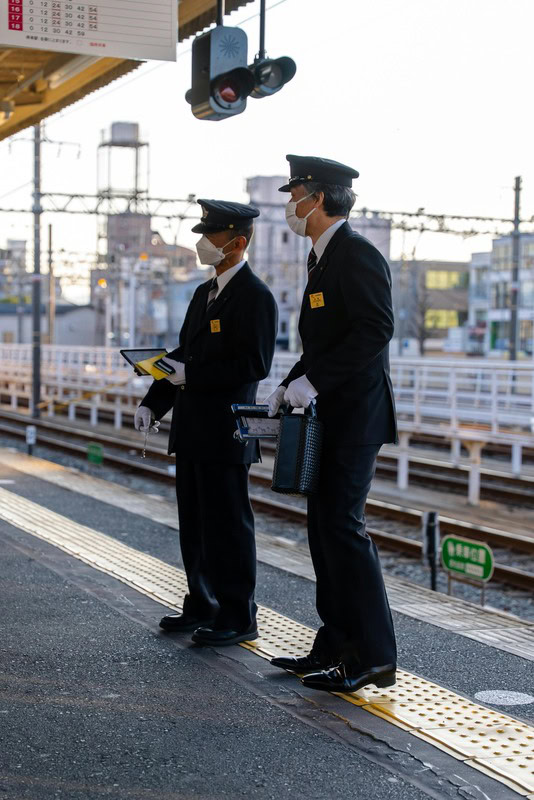
Choose Who to Ask for Directions in Japanese
Look for people who can actually help
When you need directions in Japan, think carefully about who you approach. Random commuters on crowded sidewalks or rushing through train stations may be too busy to stop and could ignore your question without meaning to be rude.
You’ll get the best results by asking station staff, store employees, or anyone whose job involves assisting the public, as they are accustomed to giving information and are more likely to respond.
Be Mindful of Where You Stop when Asking for Directions in Japanese
Don't Block the Flow of People
It’s important to be aware of your surroundings when you stop to check a map or ask for help. Avoid blocking the middle of busy sidewalks, train platforms, or escalators. Step off to the side or near a wall so you won’t disturb the flow of people moving past you.
Use Proper Etiquette When Asking for Directions in Japanese
Polite words and body languages matters
Good manners go a long way when approaching someone for help. Begin with a polite greeting such as “すみません” (sumimasen) before asking your question, and stand slightly to the side rather than directly in front of the person. Speak clearly but politely, and finish with a simple thank you “ありがとうございます” (arigatō gozaimasu) , which is both expected and appreciated.
Check out our Ultimate Guide to Easy Japanese for simple tips and tricks to start speaking Japanese with confidence!
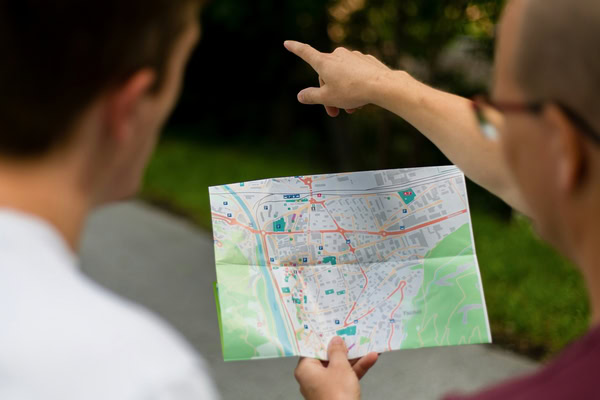
Online Japanese Lessons That Actually Work.
Our affordable online Japanese lessons are built for busy learners with small groups, real conversations, and flexible schedules that work for you.
Online Japanese Lessons That Actually Work.
Our affordable online Japanese lessons are built for busy learners with small groups, real conversations, and flexible schedules that work for you.
Directions in Japanese: Map-Following Game!
Learning directions in Japanese is much more fun when you can play a game!
Below is a town map. The buildings don’t have names, your job is to read the directions in Japanese, follow them carefully, and guess which building is the correct answer.
Click or tap on the building you think is correct to reveal the answer!
How to Play!
- Look at the “START” point on the map. It's the house in the bottom left-corner!
- Read the Japanese directions.
- Follow the streets step by step.
- Guess the building!
- Click to check if you were right

Start!
Distractor. House
公園 Park!
学校 School!
カフェ Café (distraction)
病院 Hospital!
家 A house! (distraction)
交番 Police Box!
家 A house! (distraction)
スーパー Super Market!
駅 Station!
コンビニ Convenience Store!
Example Round
Direction:
「建物を出てまっすぐ行って、学校で左に曲がってください。
まっすぐ行ったら、右に何がありますか?」
(tatemono wo dete massugu itte, gakkou de hidari ni magatte kudasai.massugu ittara, migi ni nani ga arimasuka?)
“Go straight after leaving the building, and turn left at the school.When you go straight, what is on the right?”
Answer: 交番!
Practice Round 1
Direction:
「建物を出て、まっすぐ行ってください。学校を右に曲がって、しばらく行くと左に何がありますか?」
(Tatemono wo dete, massugu ittekudasai. Gakkou wo migi ni magatte, shibaraku ikuto hidari ni naniga arimasuka?)
"Leave the building and go straight. Turn right at the school, and after walking for a while, what is on the left?"Practice Round 2
Direction:
「建物を出て、まっすぐ行ってください。学校で左に曲がって、次の角を右に曲がったら、前に何がありますか?」
(Tatemono wo dete, massugu ittekudasai. Gakkou de hidari ni magatte, tsugi no kado wo migi ni magattara, mae ni nani ga arimasuka?)
"Leave the building and go straight. Turn left at the school, then turn right at the next corner, what's in front of you?"Practice Round 3
Direction:
「建物を出て、まっすぐ行ってください。学校を右に曲がって、さらにまっすぐ行ったら、右に何がありますか?」
(Tatemono wo dete, massugu ittekudasai. Gakkou wo migi ni magatte, sarani massugu ittara, migi ni nani ga arimasuka?)
"Leave the building and go straight. Turn right at the school, and if you continue straight ahead, what is on the right?"Practice Round 4
Direction:
「建物を出て、まっすぐ行ってください。学校を左に曲がって、駅を通りすぎたら、前に何がありますか?」
(Tatemono wo dete, massugu ittekudasai. Gakkou wo hidari ni magatte, eki wo tōrisugitara, mae ni nani ga arimasuka?)
"Leave the building and go straight. Turn left at the school, and after you pass the station, what is in front of you?"
Top 1,000 Japanese Words You Need to Know
Want to build a strong Japanese vocabulary fast? Check out this Ultimate Guide to Top 1,000 Japanese Words You Need to Know and get ready to speak and understand more confidently.
Final Takeaways!
Learning how to ask and give directions in Japanese not only helps you navigate easily but also deepens your connection with locals. Remember to master key direction words, use polite greetings, and rely on landmarks rather than compass points. Always approach the right person politely and keep a quick reference or phrase list handy. With a bit of practice and confidence, you’ll find your way,and great conversations,anywhere in Japan!
The post How to Ask and Give Directions in Japanese appeared first on Japan Switch.
]]>The post Ultimate Guide to Japanese Medicine appeared first on Japan Switch.
]]>Ultimate Guide to Japanese Medicine
By Kah Mun Fu | November 10th, 2025
Have you caught a cold? Are your allergies acting up? Need to refill your prescription medication soon? Don’t worry, we’ve got you covered.
Choosing the right Japanese medicine can seem daunting at first; you probably don’t know which medication to get for what symptom or condition, or you’re worried about how to express your symptoms to a pharmacist or chemist. In this guide, we’ll show you where to find a pharmacy in Japan, how to get a prescription filled out, and what Over the counter, or OTC medications are available to treat which symptom.
Disclaimer: This article is not intended as medical advice. While this may be a guide on how to get medicine in Japan, readers should always consult a medical professional for advice on treatment.
This article is a part of our extensive series on Learning about Japan through Online Japanese Lessons at Japan Switch.
Is Japanese Medicine less effective?

There is some debate on the effectiveness of Japanese medicine as compared to medicine from abroad. Some may say that Japanese medicine is not as effective in alleviating their symptoms while others might say the opposite. The main difference between Japanese and Western medication is that Japanese medicine dosages tend to contain less than what you’re used to; for example, Tylenol in Japan comes in 300mg tablets, as compared to your usual 500mg outside of Japan. This could explain why some Japanese medications might not work for some people.
Pro Tip: Just like any medication, take it according to the package instructions. If symptoms do not improve or worsen after taking OTC medication, see a doctor. They might be able to prescribe you some stronger prescription medication.
Types of Japanese Medicine: What are Class 1, 2 and 3 drugs?
For Japanese medicine which is sold over-the-counter, they are classified according to risk levels, such as how likely a medication’s side effects can interfere with daily life. Risk level is classified on a scale of 1 to 3, with 1 being the most risky to 3 being the least risky.
Class 1 Japanese medicine
Class 1 drugs are OTC medications that are very effective, but are most likely to interfere with daily life due to their potential side effects. Examples of Class 1 Drugs include some painkillers and stomach medicine. These medications are not accessible to customers as they are usually stored in a cabinet behind the counter, and must be sold by a licensed pharmacist. In order to buy this type of medication, you have to consult with an on-site pharmacist. If you are able to buy Class 1 OTC medication, you will always receive an explanation in-person and in writing on how to use the medication from the pharmacist.
Class 2 Japanese medicine
Class 2 drugs are OTC medications that rarely cause side effects, and therefore don’t really interfere with day to day life that often. Examples of Class 2 drugs include cold medicines. While medication that falls under this category is accessible to customers (meaning they’re not locked behind the counter), you will often receive an explanation from the pharmacist or registered seller on their proper use.
There are also Designated Class 2 drugs, which have a slightly higher risk of potential side effects, which depends on the user. These medications require more attention as they are more likely than Class 2 drugs to cause side effects. To tell whether a medication is a Class 2 drug or Designated Class 2 drug, check whether the number 2 in 第2類医薬品 (Dai-ni rui iyakuhin) is enclosed in a circle or square.
Class 3 Japanese medicine
Class 3 drugs are OTC medications that have very few side effects, so they will not cause a hindrance to your daily life. However, Class 3 OTC drugs might cause changes to your body or discomfort when taken. Examples of Class 3 drugs include vitamin supplements. Medications that fall under this category do not require consultation by a pharmacist and are directly accessible to customers.
Check out our Ultimate Guide to Japanese Kanji to learn how to read and understand Japanese Kanji!
No More Cookie-Cutter Japanese Lessons!
At Japan Switch, we teach the Japanese you’ll actually hear, actually use, and actually need and not just textbook sentences you’ll never say.
Over the Counter Japanese Medicine by Symptoms
Japanese Medicine for Common Colds
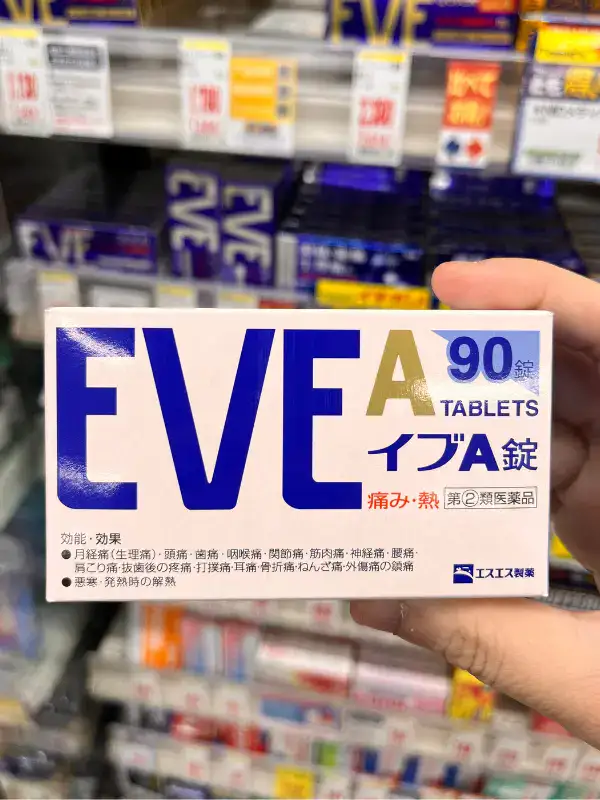
Eve A (Ibuprofen)
Eve A is a Designated Class 2 Drug that is used to treat common cold symptoms such as fever and headaches. The main ingredient, Ibuprofen, helps to reduce fevers and pain symptoms.
Dosage: Take 2 tablets with cold or lukewarm water up to 3 times a day with 4 hour intervals in between.
Side Effects: May include rashes, nausea, vomiting, loss of appetite, dizziness, shortness of breath or blurred vision. Rare side effects such as anaphylaxis or liver dysfunction may occur.
Considerations: Children under the age of 15 should not take this medication. Like most medications, do not drink alcohol before and after taking this medication. Do not drive or operate any heavy machinery after taking this medication. Do not take other cold or pain medications along with this medication.
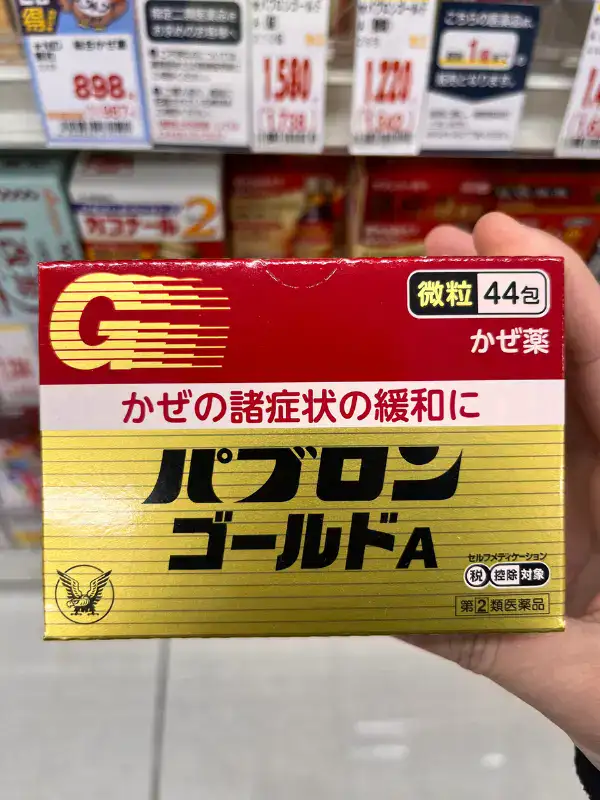
Pabron Gold A
Pabron Gold A is a Designated Class 2 OTC medication that relieves common cold symptoms such as fever, headache and coughs. You can find them in either granule or tablet form.
Dosage: For granules, take 1 packet per dose with cold or lukewarm water, up to 3 times per day.
For tablets, take 3 tablets with cold or lukewarm water up to 3 times per day.
Children between the ages of 12 to 14 must take two-thirds of the packet (in granule form) or 2 tablets (in tablet form) three times a day.
Side Effects: May cause nausea, vomiting, rashes, itchy skin, loss of appetite, difficulty urinating, excessive decrease in temperature.
Considerations: Aside from the standard warnings (no drinking alcohol, don’t drive after taking this medication, etc.) if you are breastfeeding, do not use this medicine.
Lulu Attack EX
Lulu Attack EX is a Designated Class 2 drug that is used to treat cough and cold symptoms. It contains ingredients that reduce symptoms associated with the common cold, such as fevers and sore throats.
Dosage: Take 2 tablets 3 times a day with water, ideally within 30 minutes after eating a meal.
Side Effects: May cause nausea, vomiting, rashes, dizziness, shortness of breath, difficulty urinating, blurred vision, etc. In rare cases, anaphylaxis, blood disorders, etc. may occur.
Considerations: People who have had allergic reactions to similar medication, children under the age of 15, pregnant women whose due date is in 12 weeks or less, and those who have developed asthma from similar products should not take this medicine. In addition, women who are breastfeeding should not take this medicine. Otherwise, standard warnings apply.
Japanese Medicine for Coughs
Contac EX
Contac EX is a Designated Class 2 OTC drug that is used to treat both cold symptoms and coughs, though it is mainly used as a cough medicine. Although the main ingredient of this medication is ibuprofen, it contains dextromethorphan, which suppresses cough symptoms. This medicine comes in capsule form.
Dosage: Take 2 capsules 2 times a day; in the morning and in the evening with warm water, ideally within 30 minutes after eating a meal.
Side Effects: May cause nausea, vomiting, loss of appetite, stomach pain, heartburn, abdominal pain, shortness of breath, etc. In rare cases, conditions such as anaphylaxis may occur.
Considerations: Children under the age of 15 should not take this medication. Do not take other gastrointestinal drugs whilst taking this medication. Do not drive or operate any heavy machinery after taking this medication.
Stona EX
This is a Designated Class 2 OTC drug that is highly effective in treating coughs. Some of its ingredients are mainly used to treat cold symptoms as well. It usually comes in tablet form, though other variations of this medication exist in different colored boxes and in capsule form.
Dosage: For tablets, take 2 tablets 3 times a day within 30 minutes after eating a meal. Always follow the package instructions.
Side Effects: May cause symptoms such as nausea, vomiting, rashes, dizziness, difficulty urinating, shortness of breath, blurred vision, etc. Rare side effects such as anaphylaxis may occur.
Considerations: Children under the age of 15 should not take this medication. Standard warnings apply (don’t drink alcohol, don’t drive or operate any machinery, etc.).
Medicon Cough Suppressant Tablets Pro
This is a Designated Class 2 drug which contains ingredients that are highly effective in relieving coughs. It usually comes in tablet form and is easy to take.
Dosage: Take 2 tablets 3 times a day with cold or lukewarm water, with intervals of at least 4 hours between doses.
Side Effects: Nausea, vomiting, loss of appetite, dizziness, breathlessness, shortness of breath, anaphylaxis in extremely rare cases.
Considerations: Children under the age of 15 should not take this medication. Do not take this medication if you have experienced allergic reactions to its ingredients. Do not take this medication along with other cold medicines, antihistamines, etc.
Learn Japanese for Free
Our newsletter for beginner to low intermediate Japanese students will get you on the right track to learning Japanese and saving money.

Japanese Medicine for Stomach Aches
Stoppa EX (ストッパEX)
This is a Class 2 Drug that is used to treat diarrhea symptoms. It is easy to carry around, and doesn’t contain ingredients that make you drowsy.
Dosage: Take 1 tablet 3 times a day, with 4 hour intervals between doses.
Side Effects: May cause rashes, itchiness, headaches, difficulty urinating, flushed face, increased sensitivity to light. In rare cases, blurred vision and dry eyes may occur, in that case stop taking this medication.
Considerations: Although this medication doesn’t contain drowsy ingredients, do not drive or operate any heavy machinery after taking it. Children under the age of 15 should not take this medicine. Otherwise, standard warnings apply.
Buscopan A
Buscopan A is a Class 2 OTC drug that is used to treat stomach aches, abdominal pain and stomach cramps. This medication contains butylscopolamine bromide, which relieves gastrointestinal tension and spasms.
Dosage: Take 1 tablet 3 times a day with cold or lukewarm water, with 4 hour intervals in between doses.
Side Effects: May cause rashes, itchy skin, headaches, difficulty urinating, anaphylaxis in extremely rare cases.
Considerations: Children under the age of 15 should not take this medicine. Otherwise, standard warnings apply.
Gaster 10
Gaster 10 is a Class 1 Drug that is used to treat stomach aches. The main ingredient, Famotidine, relieves stomach ache symptoms, heartburn, and nausea, as well as suppresses excessive gastric acid.
Dosage: Take 1 tablet up to 2 times a day, with cold or lukewarm water.
Side Effects: May cause rashes, itchiness, irregular heart beat, lightheadedness, convulsions, lethargy, fever with sore throat. In rare cases, anaphylaxis, liver or kidney dysfunction, may occur.
Considerations: This medication is meant for those over the age of 15 years old, though those over the age of 80 should not take Gaster 10.
Japanese Medicine for Hay Fever and Dust allergies
Allegra FX
This is a Class 2 drug that treats nasal symptoms caused by pollen and dust. It is an antihistamine that relieves nasal congestion, sneezes and runny noses. A child-friendly version, Allegra FX Junior, is also available.
Dosage: Take 1 tablet 2 times a day; 1 in the morning, 1 in the evening, on an empty stomach. For Allegra FX Junior, children between the ages of 7 to 11 must take 1 tablet 2 times a day, while children between the ages of 12 to 14 must take 2 tablets 2 times a day.
Side Effects: May cause nausea, headaches, drowsiness, abdominal pain, etc. In rare cases, conditions such as anaphylaxis and liver dysfunction may occur.
Considerations: If you are breastfeeding or allergic to similar medicines (or the ingredients of Allegra FX), do not take this medication. Otherwise, standard warnings apply.
Claritin EX
Claritin EX is a Class 2 drug that treats mainly nasal symptoms caused by hay fever or dust such as stuffy or runny nose, as well as sneezes. This medicine doesn’t contain ingredients that make the user drowsy.
Dosage: 1 tablet once a day, after eating a meal. Take this medicine at the same time daily.
Side Effects: May cause rashes, hair loss, sore throat, headaches, nausea, cardiovascular problems, etc. In rare cases, anaphylaxis, epilepsy, and liver dysfunction may occur.
Considerations: Children under the age of 15 should not take this medicine. If you are breastfeeding, or have experienced allergic reactions to similar medicines, do not take this medication. Otherwise, standard warnings apply.
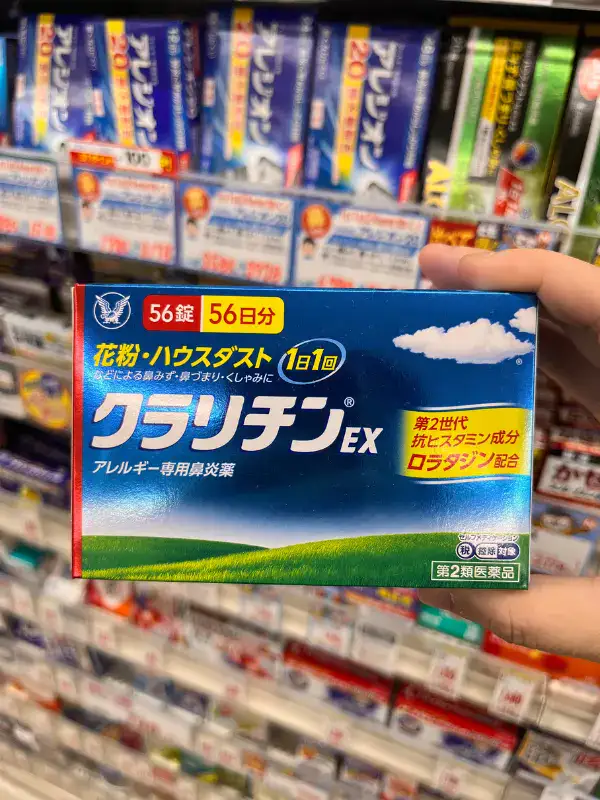
Contac Z
Contac Z is a Class 2 Drug that is used to treat allergy symptoms caused by indoor and outdoor allergies such as dust and pollen. It mainly relieves nasal symptoms such as sneezing, runny nose, and congestion. Luckily, this medication won’t make you drowsy.
Dosage: Take 1 tablet once per day with cold or warm water.
Side Effects: May cause symptoms such as headache, dizziness, nausea, vomiting, shortness of breath, etc. In rare cases, anaphylaxis or liver dysfunction may occur.
Considerations: Children under the age of 15 should not take this medicine. Otherwise, standard warnings apply.

Japanese Medicine for Headaches and Migraines
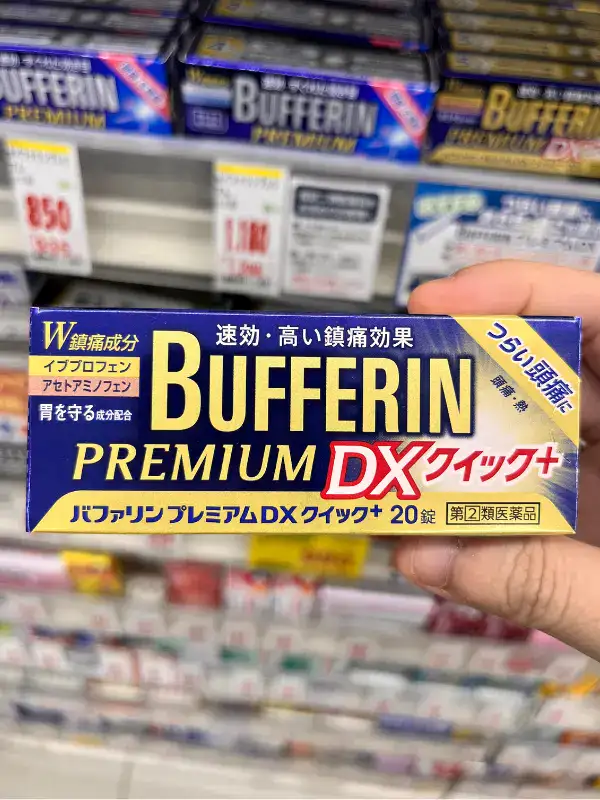
Bufferin Premium DX Quick Plus
This is a Class 2 OTC Drug that is used for pain relief and treating fevers. It is a fast-acting medication that uses ibuprofen and acetaminophen-based relief.
Dosage: Take 2 tablets, up to 2 times a day, with cold or lukewarm water.
Side Effects: May cause symptoms such as rashes, nausea, loss of appetite, dizziness, drowsiness, heart palpitations, shortness of breath, or blurred vision. In rare cases, conditions such as anaphylaxis, kidney disorder, or asthma may occur.
Considerations: Children under the age of 15 should not take this medicine. Otherwise, standard warnings apply.
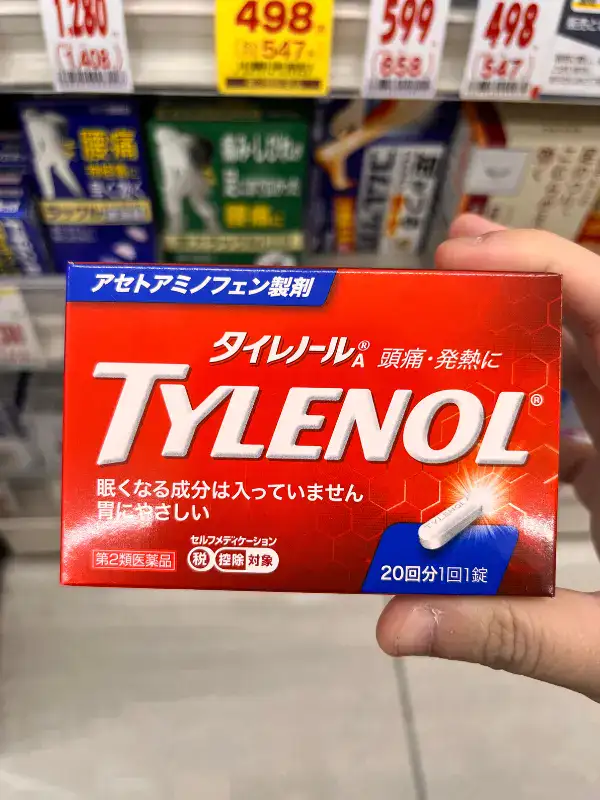
Tylenol A
Surprisingly, you can get Tylenol in Japan. Tylenol is a Class 2 OTC Drug used to treat headaches and fevers. The main ingredient in Tylenol, acetaminophen, helps to reduce chills caused by fevers and relieve pain.
Dosage: Take 1 tablet with water, up to 3 times per day with 4 hour intervals in between doses.
Side Effects: May cause symptoms such as rashes, itchy skin, nausea, vomiting, loss of appetite, dizziness, or excessive decrease in body temperature. In rare cases, conditions such as anaphylaxis may occur.
Considerations: This medication is meant to be taken for those above the age of 15 years old. Avoid taking this medication on an empty stomach if you are experiencing common cold symptoms.
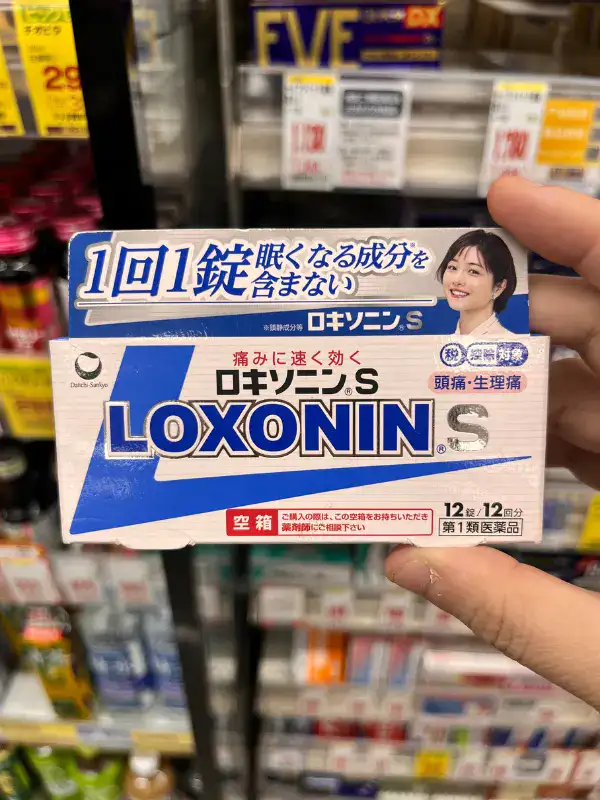
Loxonin S
Loxonin S is a Class 1 drug used to treat headaches, menstrual cramps, and even toothaches. In addition to reducing pain symptoms, this medication can also be used to treat fevers. It has a fast acting nature, which makes it perfect for immediate pain relief.
Dosage: Take 1 tablet per dose with water. Take 2 doses per day, with a 4 hour interval in between.
Side Effects: May cause nausea, loss of appetite, or drowsiness. In rare cases, anaphylaxis, kidney dysfunction or liver dysfunction may occur.
Considerations: Children under the age of 15, those who have experienced allergic reactions to this medication or its ingredients, those with blood disorders, and those who are pregnant and are due to give birth in less than 12 weeks should not take this medication. Avoid taking this medication on an empty stomach. Otherwise, standard warnings apply.
What to do when experiencing certain side effects
In the event that you do experience certain side effects, such as shortness of breath, rashes, or increased blood pressure, stop taking the medication and consult a doctor immediately.
If needed, check your city or ward’s medical association, or ishikai (医師会), to find the nearest emergency clinic or hospital. Do keep in mind that most ishikai websites have little to no English support (though the ishikai for Shibuya Ward has English support). For more severe side effects such as anaphylactic shock, call 119 for an ambulance immediately.
Popular Pharmacists and Drug Stores to Buy Japanese Medicine
There are many drugstores and pharmacies in Japan, with each having their own opening hours and product availability. One thing to keep in mind is that pharmacists' opening hours will differ from drugstore opening hours, as they tend to close earlier. Opening times might differ on the weekends as well, since some pharmacies are either closed on the weekends or have shorter hours.
In addition, product availability will depend from branch to branch; some stores might only sell Class 2 and 3 drugs whilst others will have Class 1, 2 and 3 drugs available. In terms of price, there is relatively no difference in pricing when it comes to OTC medication, so just go to the pharmacy or drugstore that’s the most convenient for you.
Matsumoto Kiyoshi
Matsumoto Kiyoshi, often shortened to MatsuKiyo, is the most well known drugstore chain in Japan, with over 3400 stores across the country. You can find a range of OTC medications at MatsuKiyo stores, as well as skincare, cosmetic items, shampoo, and snacks.
Opening hours: Opens 10:00am to 09:00pm; varies from branch to branch, check website for more details.
Is there a pharmacist’s office?: Varies from branch to branch, check website for more details. Look for the words chouzai-uketsuke (調剤受付).
English support: Some stores might offer English support, primarily in the major cities such as Tokyo and Osaka.
Welcia
Welcia is another big pharmacy and drugstore chain with over 2000 stores open throughout Japan. This drugstore chain is known for having integrated pharmacies within their stores.
Opening hours: Opens 09:00am to 09:00pm; varies from branch to branch, check Welcia’s website for more details.
Is there a pharmacist on-site?: Open from 09:00am to 09:00pm; varies from branch to branch, check website for more details. Look for the words chouzai heisetsu-ten (調剤併設店).
English support: Some stores might offer English support, primarily in the major cities such as Tokyo and Osaka.
Tomods
Tomods is one of the lesser known pharmacy and drugstore chains, as their stores are mostly found in the Kanto area of Japan. However, the majority of their stores can be found close to many train stations. Like most drugstores, you can find OTC medication for sale, as well as cosmetics, and daily necessities.
Opening hours: Opens from 10:00 to 09:00pm; varies from branch to branch, check website for more details.
Is there a pharmacist on-site?: Open from 09:00am to 07:00pm; varies from branch to branch, check website for more details. Look for the words shohousen uketsuke (処方せん受付).
English support: Some stores might offer English support, primarily in the major cities such as Tokyo and Osaka.
How to get a prescription filled in Japan
How to get a prescription
You will need a prescription from your doctor in order to get prescription medication. You can get your prescription from any doctor in Japan, but if you’re looking for a clinic with English support, we have provided a list of English-speaking doctors in Japan, specifically in the Tokyo area.
At the Pharmacy
Before you go to the pharmacy, make sure to bring important documents such as your National Health Insurance Card or your My Number Card (if applicable). You’ll save a lot of money that way; if you have health insurance, you only have to pay 20 percent of the full cost of your Japanese medication.
When you arrive at the pharmacy, the process to get your prescription fulfilled is simple:
- Go to the counter and show your prescription given to you by your doctor.
- The pharmacist will ask if you have health insurance or a My Number card. Give the respective documents to the pharmacist.
- The pharmacist will then give you a numbered ticket. Wait until they call your number. Wait times can vary by how busy the pharmacy is on that day.
- When the pharmacist calls your number, go to the counter. The pharmacist will show you the prescribed medication and explain how to take them, though written instructions in Japanese or English will be provided as well.
- Pay for your medication and you are done!
Useful phrases at a Japanese drug store/pharmacy
Symptoms
| 熱があります。 | netsu ga arimasu. | I have a fever. |
| 喉が痛いです。 | nodo ga itai desu. | My throat hurts. |
| お腹が痛いです。 | onaka ga itai desu. | My stomach hurts. |
| 咳が出ます。 | seki ga demasu. | I have a cough. |
| 痰が出ます。 | tan ga demasu. | I'm coughing up phlegm. |
| 鼻水が出ます。 | hanamizu ga demasu. | I have a runny nose. |
| 花粉症です。 | kafunshou desu. | I have hay fever. |
| アレルギーがあります。 | arerugi ga arimasu. | I have allergies. |
| 頭が痛いです。 | atama ga itai desu. | My head hurts. |
| 便秘しています。 | benpi shiteimasu. | I am constipated. |
| 下痢をしています。 | geri shiteimasu. | I have diarrhea. |
| 乳糖不耐症です。 | nyuutou futaishou desu. | I am lactose intolerant. |
Specific Medications
| 痛み止め | itami-dome | Painkillers |
| 風邪薬 | kaze-gusuri | Cold medicine |
| 胃薬 | igusuri | Stomach Medicine |
| 抗ヒスタミン薬 | kouhisutaminyaku | Antihistemines |
| 目薬 | megusuri | Eyedrops |
| 咳止め | seki-dome | Cough medicine |
| 〜がありますか? | ~ga arimasu ka? | Do you have (name of medication)? |
| 薬は何かおすすめますか? | kusuri wa nani ka osusume masu ka? | What medications do you recommend? |
| この薬を飲んだら、症状がありますか? | kono kusuri wo nondara, shoujou ga arimasu ka? | If I drink this medicine, will there be any side effects? |
| この薬は眠くなりますか? | kono kusuri wa nemuku narimasu ka? | Will this medication make me sleepy? |
| この薬を飲むとき、運転できますか? | kono kusuri wo nomu toki, unten dekimasu ka? | Can I drive while on this medication? |
| 〜を飲んでいますし、この薬も飲めますか? | ~nondeimasu shi, kono kusuri mo nomemasu ka? | I am taking (name of medication), is it okay to take this medication? |
| この薬はどれぐらい効きますか? | kono kusuri wa dore gurai kikimasu ka? | How long does this medication last for? |
Bringing medication to Japan
Of course, you have the option of bringing your medication from your home country to Japan. However, there are a list of rules and regulations that you need to follow before you can bring your medication into Japan. In general, it’s okay to bring in medication from abroad as long as:
- It is for personal use.
- You bring in no more than 1 month (for prescription drugs) or 2 months (non-prescription drugs) supply of medication. This also includes disposable contact lenses.
If you are carrying more than 1 or 2 months supply of prescription medication and OTC medication respectively, then you will have to apply for an Import Confirmation Certificate, or Yunyu Kakunin-sho (輸入確認書). You can now apply for a Yunyu Kakunin-sho online or by submitting an email. You will usually receive the Yunyu Kakunin-sho in a few business days. If approved, make sure to present the Yunyu Kakunin-sho to customs when you arrive in Japan.
It is prohibited to bring in controlled substances or medication with certain ingredients, such as cannabis, amphetamine, and opium. Always check the Ministry Of Health, Labor and Welfare’s website as well as the Narcotics Control Department to see whether your medication might contain these ingredients. In addition, if your medication does contain controlled substances, you must apply for permission by email, mail or FAX to the Narcotics Control Department.
Kampo: Traditional Japanese Medicine
What is Kampo?
Kampo, or traditional Japanese medicine, is a system of traditional medicine based on the theories of traditional Chinese medicine. The origin of Kampo can be pinpointed to the 5th and 6th centuries, where traditional Chinese medicinal practices came to Japan. Although the practice was nearly wiped out in the 19th century, the 20th century saw a resurgence in the practice, and in 1967, Kampo medicines were finally included under public insurance coverage.
Kampo medicine is always made out of natural ingredients such as medicinal herbs, animal products and minerals. It can be used to treat a variety of illnesses, such as colds, stomach problems, and headaches.
Where can I get traditional Japanese medicine?
If you prefer traditional medicine over conventional medicine, some pharmacies and drugstores might offer OTC Kampo medicine, though keep in mind, they tend to be more pricey than conventional medication. You might end up paying more than if you were to buy its modern counterpart.
There are also Kampo practitioners in Japan; look for the characters 漢方 (Kampo) outside of their offices. Ask your doctor if they are able to prescribe Kampo medicine for you, otherwise they will just prescribe standard medication. Although Kampo medicine is entirely natural, always check to see if there are any potential side effects when taking them, and always follow the instructions from your doctor or pharmacist. Lucky, Kampo medications can be covered under health insurance, so you don’t have to worry about paying the full cost.
Final thoughts
And there you have it! Now you know that getting your Japanese medicine and going to the pharmacy does not have to be a daunting experience. It’s all a matter of who to ask, what to ask for, and how to get your medicine.
Hope you get well soon! お大事にどうぞ!(O-daiji ni douzo!)
Related Articles:
Ultimate Guide to Japanese Language Exchange
Top 15 Japanese Vocabulary Tips
Top 15 Japanese Conversation Tips
Ultimate Guide to Seasons in Japan
Ultimate Guide to Japanese Tea


The post Ultimate Guide to Japanese Medicine appeared first on Japan Switch.
]]>The post Ultimate Guide to the Japanese Business Card appeared first on Japan Switch.
]]>Ultimate Guide to the Japanese Business Card
By Katie Huynh | September 29th, 2025
If you are from the West, business cards may seem like no big deal to you. There are no proper rules around exchanging them, nor is there a guide on how to treat them. However, business card exchange practices and etiquette is like second nature in Japanese business culture. The exchange is a ritual that signals respect, hierarchy, and connection. Even though it may seem confusing or intimidating at first, it is crucial to understand the significance behind business cards in Japan.
We’re going to cover everything you need to know about the Japanese business card, and how to master it.
This article is a part of our extensive series on Learning about Japan through Online Japanese Lessons at Japan Switch.
No More Cookie-Cutter Japanese Lessons!
At Japan Switch, we teach the Japanese you’ll actually hear, actually use, and actually need and not just textbook sentences you’ll never say.
Why Japanese Business Cards Matter
In Japan, business cards embody a person’s identity. The card details personal information, such as the person’s name, contact, and company. You must treat the card as you would treat the person, which is with respect.
This dates back to the 1600s, when samurai and high-ranking officials carried personal introduction cards to formally announce themselves when visiting another household. Over time, this custom spread to merchants, who began using cards to identify themselves and legitimize trade relationships. This tradition has carried on through many generations, and is a staple for doing business in Japan.
Overall, actions say a lot. If you are careful with the card, it shows that you will treat the person the same way. If you just throw it around, it shows how detrimental you can be to the relationship.
Ultimate Guide to Japanese Customs
Customs are important in both day-to-day life in Japan and in Japanese business. Read more about our Ultimate Guide to Japanese Customs.

Business Cards Affect Trust
How you handle business cards speaks to your professionalism. It is not solely about politeness, it is also a reflection of your brand. If you mistreat business cards, you may lose the trust of other businesses and people. They will view you as reckless, which is not a desirable trait of a business partner. In general, people want to do business with those who are diligent and trustworthy. Be gentle, and show that you are worth doing business with.
Showing Respect to Your Seniors
When introducing yourself to a senior figure in business, you should always present your business card. By doing this, you acknowledge and respect their authority. Within those first few minutes of meeting, the senior figure can gauge what kind of person you are. A business card helps build your credibility by demonstrating your commitment to professionalism.
Building Long-Lasting Connections
Japanese business cards are more than just swapping contact details. It’s a way to build long-term and valuable relationships. Sharing your business card demonstrates a genuine openness to connect. You show that you’re serious about the connection, not just meeting at hand.
Top 15 Japanese Conversations Tips
A crucial step to building strong business relationships is having great conversations. If you're looking to connect with a Japanese professional, check out Top 15 Japanese Conversations Tips.
How you Treat the Card Matters
Please be gentle with Japanese business cards. Shoving a person’s business card into your pockets or purse is like pushing a person to the side and completely disregarding them. It’s not something you’d do to a business professional, so don’t do it to the card.
Japanese Business Card Etiquette
In Japan, you don’t just hand someone a business card like it’s nothing. You must do it in a specific manner.

When to Present Japanese Business Cards
Timing matters. Be prepared to exchange business cards before a meeting, as it is considered to be a crucial step in relationship-building. It sets the tone for the meeting and establishes roles. In Japan, it serves as a proper introduction.
The Hierarchy in Japanese Business Cards
The person of lower status, such as an intern, will typically present their business card first. If visitors from another company are coming to present or meet, they would also present their business cards first, starting with the highest-ranking person. Again, it is the proper way to introduce yourself in a business setting.
How to Present Japanese Business Cards
- Be ready to pull out your cards at any moment. They should be stored in an accessible place, such as a business card holder. This is also great to ensure that they do not get damaged in storage.
- When it’s time to present your business card, stand in front of the recipient with straight posture and ensure that the card is facing them.
- Use both hands to present the card, holding it by the top corners so that you are not covering any information.
- Slightly bow as a symbol of respect.
How to Receive Japanese Business Cards
- Gently accept the card with both hands by the bottom corners.
- Mirror their gesture and bow slightly.
- Read the card carefully. Acknowledge the company and the person’s position. Small and respectful comments are acceptable.
- If seated at a table, place the card on the table in front of you, aligned with the seating arrangement. This helps you remember names and positions during the discussion.
- At the end of the meeting, store the business card in a card holder.
Ultimate Guide to Japanese Culture
Japanese culture may look different from your own. Check out our Ultimate Guide to Japanese Culture to learn more!
Exchanging Japanese Business Cards in Special Situations
If you catch yourself in a specific situation, such as being in a group meeting, networking event, or casual settings, a standard guide on exchanging Japanese business cards may not suffice. You have to be flexible, as each situation has its own expectations.
Exchanging Japanese Business Cards in Group Meetings
In group meetings, the exchange is carried out one-by-one. Each person has to stand up, move around the table, and exchange cards individually. It might take some time, but it sets the tone for the meeting and ensures that everyone is properly introduced. Compared to the West, this practice is more genuine and intimate, making it a stronger way to form relationships.

Director to President
The Director from Company A initiates the exchange with the President of Company B.

Manager to President
Next, the Manager from Company A shares their card with the President.

Intern to President
The Intern follows up by presenting their card to the President of Company B.

Director to Sales Rep
The Director then exchanges cards with the Sales Rep from Company B.
Exchanging Japanese Business Cards at Networking Events
If you are at a large gathering, the exchange is a bit less formal, but still follows the same etiquette. You exchange cards the same way, but since there are so many people, hierarchy likely won’t matter. Plus, you’ll learn exactly who the person is just by talking to them. Remember to take some time to acknowledge their position, even if the interaction is brief.
What to Absolutely Avoid When Exchanging Japanese Business Cards
One-handed exchange
Always use both hands when giving or receiving. Offering or grabbing a card with one hand appears careless.
Shoving the card into your pocket or wallet
This signals disrespect. Always use a business card holder and handle the card carefully.
Writing on the card
It’s considered rude to do so, as you wouldn’t treat a person like that.
Failing to acknowledge the card
Before putting the card down, please take the time to read the person's name, title, and company.
Placing the card down casually
Never leave the business card under your phone or scatter it on the table. Be neat and cordial.
Failing to offer your own card
You should always reciprocate the action. This shows that you value both the relationship you are building and the exchange itself.
Check out our Top Tips to Improve Bad Japanese if you are interested in making a strong impression in Japanese business.
Must-Know Tips for Using Business Cards in Japan
Some people overlook these tips because they seem like common sense, but don’t let it get over your head! Here’s some actionable and practical advice that will ensure you are well-prepared.
Always carry extra cards
Meetings often involve more people than expected, so running out looks unprepared. You don’t want to miss out on connections and damage your image.
Use cards in pristine condition
Don't hand over a bent or dirty card. That's not a good look. This is easily preventable by storing your business cards in a card holder. Card holders can be found at an affordable price at 100-yen stores such as Daiso or Seria.
Add a personal touch to your card
This is a unique addition to traditional meishi, but adding your LinkedIn, personal website, or a QR code can make you stand out, as long as you keep it subtle and professional. This shows your personal brand
If you run out of cards, be polite about it
Apologize and show an effort to follow up. If possible, reach out by email or any other communication platform. This keeps the recipient in mind and shows deep consideration.
Placing the card down casually
Never leave the business card under your phone or scatter it on the table. Be neat and cordial.
Tip for students and/or interns
Even students or short-term workers benefit from having a simple meishi. Especially so early on in your career, it makes you memorable and demonstrates your commitment to professionalism and learning.
Ultimate Guide to Japanese Business
Interested in learning more about business in Japan? Check out our Ultimate Guide to Japanese Business!
How to Design a Japanese Business Card
There’s no harm in using your preexisting business card in Japan, but you can absolutely create a new one, too! Below is a simple guide on how to design a Japanese business card.

What Goes on a Japanese Business Card?
A Japanese business card won’t look too different from a Western business card, other than it being a bit larger in size. The essential information for any business card includes your organization, full name, position, company information (address, operating hours if necessary, etc), phone number, and social media handles and/or email address.
A Japanese business card will feature these same elements, but there are specific formatting rules you should follow. To emphasize hierarchy and company importance, the company’s name and logo will typically lie at the top of the business card, followed by your name and position. An important and small detail to note is how names are written. In Japan, your surname precedes your first name.
Can I Use English?
In international business, it is common to use double-sided cards with contents being in Japanese on one side, and English on the other. It is highly recommended to follow this style because it shows respect to Japanese business culture and ensures readability. Consider writing your name in katakana so people know how to pronounce your name properly.
Want to read someone's business card in Japanese? Be sure to brush up on your comprehension skills with Top 15 Tips to Improve Japanese Reading.
How Can I Translate My Current Business Card?
There are a few options to select from if you want to translate your current business card. The best way to go about this is to hire a professional translator. Business cards are taken very seriously in Japan, so you want to make sure that your business card is accurately translated. A recommended translation service is Linguistic Systems, Inc, with prices starting at $135. They are fully human-based, so you can be sure that you are getting the most accurate translation possible.
A cheaper alternative to a professional translator is AI. I don’t recommend this entirely because machine translation can sound awkward, however, it can definitely reduce costs. If you have Canva pro and your business card design is on Canva, you should try their online translator. It automatically translates your entire design in just the click of a button. This is convenient because you don’t have to redesign your entire business card, and you don’t have to manually translate everything.
Feeling confident and want to translate your business card on your own? Check out Top 15 Japanese Kanji Tips.
Where Can I Find Free Templates?
If you’re looking to revamp your current business card or create an entirely new one, there are many free templates you can find online. Canva, Microsoft, and Adobe all offer a wide variety of business card templates, from abstract to minimalistic designs.
Where to Print Japanese Business Cards (with English Support)
Mojoprint
Mojoprint is known to be Japan’s number one English-language printing service. They only offer online printing, so if you are in a rush this may not be the most convenient option. However, if you have time, Mojoprint is a reliable choice. They are highly accessible, with delivery options all throughout Japan, even on the tropical island of Okinawa. Delivery can be as quick as two days. Additional fees apply depending on your location.
Mojoprint provides a wide variety of finishes, including uncoated, matte, semi-gloss, smooth matte, gloss, matte-laminated, and gloss-laminated business cards. Printing prices start at ¥2,900.
They also offer a design service if you don’t already have a business card prepared. This service starts at ¥8,000, and you don’t need to be a design professional to use it. All you need to do is provide examples of what you like, dislike, or even a rough sketch of your vision. Mojoprint’s team will create a draft and allow up to two rounds of revisions. If you need additional changes beyond that, extra charges apply.
Website: mojoprint.jp
Pricing: From ¥2,900 (printing), from ¥8,000 (design service)
Delivery Time: 1–3 days
Delivery Method: Nationwide delivery across Japan (fees vary by location)
Printshop GRAP
If you are in Tokyo, Printshop GRAP is an excellent option for quick and professional business card printing. The shop is located at 1-29-9 Hamamatsucho, Minato-ku, Tokyo 105-0013, on the 7th floor. It’s very accessible, only a one-minute walk from both Hamamatsucho Station and Daimon Station.
Printshop GRAP offers services in both English and Japanese, making it foreigner-friendly. Appointments are currently required for in-store orders, but they also have a fully functional online ordering system. You can choose to have your order delivered (fees apply) or arrange for pickup.
A notable feature that Printshop GRAP offers is their “SONOBA MEISHI” service, which is an express service that offers 10-minute business card printing. You can design your own business card through their website, or attach a PDF/JPEG file of your preexisting business card. Prices start as low as ¥2,990.
Website: printshopgrap.com
Pricing: From ¥2,990
Delivery Time: Same-day (10-minute express option available)
Delivery Method: Pickup or nationwide shipping (fees vary)
Convenience Stores (Konbini)
Did you know that your local konbini offers printing at a low cost? If you’re looking to print small quantities, a konbini may be the way to go. You will likely find one within a five-minute walk from your accommodation in Japan. Common konbinis include 7-Eleven, FamilyMart, and Lawson.
At these chains, you can upload your business card design from your smartphone or laptop, print out your business cards, then pay directly at the machine. While the machine technically cannot print out pre-cut business cards, you can print out your template and cut it on your own. Konbinis offer various types of paper, most commonly standard copy paper and glossy/photo paper. They also sometimes offer matte high-quality paper, but it will depend on the store. This method is the most cost-effective, with prints starting around ¥20 per sheet. As a bonus, this is all self-service. If you cannot speak Japanese, no worries! You can change the machine’s language to English for easier usability. It should all be straightforward.
Curious about Konbini vs. Supermarket?
Check out our Ultimate Guide to Shopping in a Japanese Supermarket!
Step-By-Step Guide on Printing Business Cards at the Konbini
Make sure that your business card design is formatted properly.
Use A4 or A5 paper.
Save your designs as a PDF or JPEG.
PDF is recommended.
Upload your file to the printing service.
For 7-Eleven, use Netprint or the Netprint App. For Lawson and FamilyMart, use Network Print.
Choose your paper size and color setting.
While A5 paper may work, typical paper size is A4. You can pick between black and white or colored printing.
Once you’re finished uploading your file, you will receive a reservation code.
Keep this code safe, as you’ll need this at the machine.
Head to the multi-copy machines, typically located by the ATM.
You can switch the language to English to make it more accessible. From there, select the Netprint/Network Print option and enter your reservation code.
Your file should appear on the screen.
Double-check to make sure it looks good to print.
You can print on standard or glossy paper.
The choice is yours. It depends on your preference!
Once you’re ready, you can pay directly at the machine.
You can pay with cash, IC card, or store specific cards (nanaco at 7-Eleven, WAON at Lawson, Rakuten Edy or FamiPay at FamilyMart).
When finished paying and printing, cut the papers into individual cards.
The neatest way to do this is with a paper cutter, which can be purchased from affordable shops like Daiso and Don Quijote. Additionally, if you are a student in Japan, your school might provide cutters in the art department or library.
Check out our Ultimate Guide to Living in Tokyo on a Budget for more affordable tips and tricks.
Speaking English and Asking for Help at the Konbini
If you run into issues even with the English setting on, no worries! It’s understandable that printing at a Japanese convenience store can be confusing and intimidating, especially if it’s your first time and there’s a strong language barrier. Luckily, konbini clerks are usually polite and happy to help. They will likely know a little bit of English, but if they don’t, knowing some simple phrases will go a long way. Here are some phrases you should know before printing at a konbini.
Phrases to Say When Printing at a Konbini
Can you help me use the printer?
プリンターの使い方を手伝っていただけますか?
(Purintā no tsukaikata o tetsudatte itadakemasu ka?)
Can I print X amount of copies?
X部印刷してもいいですか?
(X-bu insatsu shite mo ii desu ka?)
What paper can I print on? A4 or glossy?
どの用紙に印刷できますか?A4か光沢紙ですか?
(Dono yōshi ni insatsu dekimasu ka? A4 ka kōtaku-shi desu ka?)
How can I pay?
支払いはどうすればいいですか?
(Shiharai wa dō sureba ii desu ka?)
Can I print in color?
カラー印刷はできますか?
(Karā insatsu wa dekimasu ka?)
If you are nervous about messing up some words, check out the Top 1000 Japanese Words You Need to Know. This should help with communication.
If you still have trouble speaking, body language also helps. If you point or use gestures, the konbini clerks will likely understand what you are trying to convey.
Final Takeaways
Whether you’re doing business in Japan or simply researching, there’s no need to overthink it. This guide is all-encompassing, and you will surely make a wonderful impression with your knowledge on Japanese business cards. Remember: business cards are not just little pieces of paper. They are an embodiment of trust, respect, and identity in Japan. Your effort alone speaks volumes. You don’t have to be perfect as long as you’re trying your best!
Related Articles
The post Ultimate Guide to the Japanese Business Card appeared first on Japan Switch.
]]>The post How to Use a Japanese Toilet: A Complete Guide appeared first on Japan Switch.
]]>How to Use a Japanese Toilet: A Complete Guide
By Giorgi Gokieli & Shawn Zhu | Sep 7th, 2025
You did it! You're in Japan, but now you're in a public bathroom and you realize that you have no idea how to use a Japanese toilet. There's a control panel that looks like the cockpit of a spaceship, buttons labeled only in Japanese, and sounds coming from the stall next to you that are both confusing and oddly comforting. Whether you're facing a high-tech Japanese toilet with bidet functions or a traditional fixture, this guide will help you navigate the experience with confidence, dignity, and maybe even a bit of enjoyment.
This article is a part of our extensive series on Learning about Japan through Online Japanese Lessons at Japan Switch.
No More Cookie-Cutter Japanese Lessons!
At Japan Switch, we teach the Japanese you’ll actually hear, actually use, and actually need and not just textbook sentences you’ll never say.
Getting Started With a Japanese Toilet
Understanding the Symbols
Before diving into all the high-tech features and functions, it’s important to get familiar with some common kanji (Japanese characters). Knowing these will make navigating the toilet controls way easier and save you from a few awkward surprises.
水 (mizu) - water (used to indicate water for washing or flushing water)
温 (atatakai) - warm (usually used to heat water flow or seat)
冷 (tsumetai) - cold (“cold water” option in water temperature adjustment)
止 (tomaru) - stop (stop all operations)
座 (suwaru) - seat (related to seat heating)
ビデ (bide) - bidet (for ladies) (female washing nozzle)
音 (oto) - sound (playing the sound of running water to cover the sound of going to the toilet)
おしり (oshiri) - butt (rear) (main nozzle function)
大 (ookii) - big (a large amount of water flush)
小 (chiisai) - small (a small amount of water flush)
These symbols appear on just about every Japanese toilet, whether it’s a basic model or a high-end one. Once you’re familiar with them, you’ll be able to use all the essential features without stress or second-guessing.
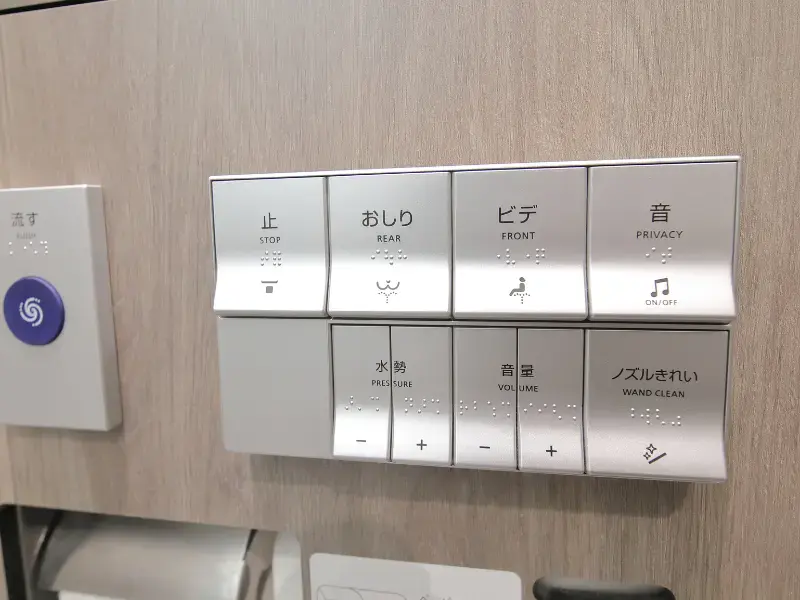
Understanding the Layout
Almost every Japanese toilet you’ll come across, about 99% of them will be made by either TOTO or INAX, the two biggest names in the game. A Japanese toilet typically includes a remote control panel (sometimes wall-mounted), a sensor-equipped toilet seat, automated lids, and adjustable washing nozzles.
If you want to get more out of your daily experiences in Japan, the Ultimate Guide to Hiragana and Katakana is an essential starting point. Learning to recognize these basic scripts will make signs, labels, and even toilet instructions far easier to understand, helping you feel more confident as you navigate daily life.
How to Use a Japanese Toilet: The Basics
Automatic Lead and Seat Functions
Some Japanese toilets have motion sensors that make the lid open automatically, which adds some extra convenience. For example, certain INAX models have a sensor that detects when someone walks up and automatically opens the lid for them. The Toto Washlet SB lacks this feature unless you’re using one of their more advanced models. Still, both brands allow manual control of the lid using the remote. These smart features are all about making things more hygienic and easier to use, showing how technology and comfort come together in Japanese toilet design.
DISCOVER JAPANESE CUSTOMS
Our Guide to Japanese Customs will help you understand the traditions and manners that shape daily life in Japan.
Using the Bidet and Rear Wash Features
Modern Japanese washlets typically include advanced cleaning features, such as a rear wash for general cleaning and a bidet (or front wash) for feminine hygiene.
There are often additional modes like soft wash, massage spray, or oscillating spray, all delivered through a retractable nozzle that can move to cover a wider area. Users can usually adjust the water pressure, nozzle position, and sometimes even water temperature, depending on the model.
Washlets are designed for individual customization, so it's worth taking a moment to familiarize yourself with the settings. They might feel high-tech at first, but the experience quickly becomes intuitive. For many users, it’s hard to go back to a regular toilet afterward.
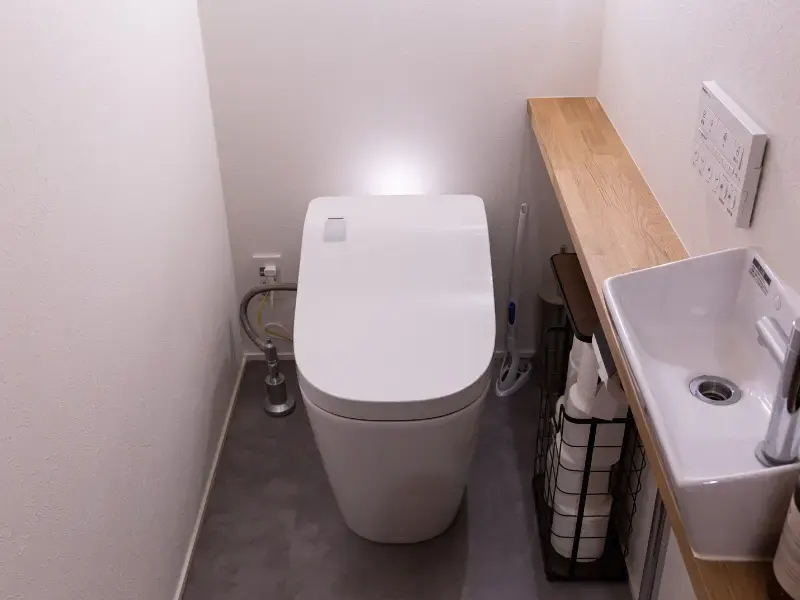
Temperature and Pressure Control
Japanese Washlets are designed with comfort and seasonal changes in mind. In colder months, many models automatically heat the seat or slightly increase the water temperature. In the summer, they may lower the setting to stay cool. Some Washlets even fine-tune the drying air volume based on seasonal changes.
For example, some models offer up to six levels of heat adjustment for both the seat and water, allowing you to find just the right setting in small, one-level steps. Some washlets, like those from Toto, offer four water pressure levels: OFF, LOW, MEDIUM, and HIGH. These let you control how strong the spray feels, which is especially helpful if you’re new to washlets and worried about getting blasted with too much pressure. Starting on Low is a good idea until you get used to the sensation, then you can adjust to a stronger setting if you want a more thorough clean. These settings are easy to tweak and can be adjusted with the seasons too, warmer water (温水) and a heated seat (便座) feel great in winter, while lower settings might be more comfortable in summer. The whole idea is to make your bathroom experience customizable and never overwhelming.
SPEAK LIKE A LOCAL
Check out our Top 40 Japanese Slang to Know and sound more natural when chatting with locals.
Drying Function
After the cleaning cycle, most washlets include a warm air dryer to help you dry off without using toilet paper. Typically, you can choose between multiple air strength settings, usually LOW, MEDIUM, or HIGH, so you can pick whatever feels most comfortable. These options are often labeled on the control panel with words like “弱” for low, “中” for medium, and “強” for high. Some models also use wave-like icons, such as one wave for low, two for medium, and three for high. This makes it easier for new users to identify the levels and avoid confusion during their first use.
The Low setting is especially good for kids, older adults, or anyone with sensitive skin. Some washlets can even activate the dryer automatically after a wash cycle, while others let you start it manually by pressing a "DRYER" (乾燥) button. You can stop it at any time with a "STOP" (止) button. The warm air isn’t harsh or intense, it’s designed to be gentle, hygienic, and hands-free, adding to the overall clean, modern, and user-friendly experience that makes washlets so popular.
Technology in Japan often combines practicality with comfort, and language study can follow the same approach. The Top 15 Tips to Improve Japanese Reading offers practical strategies to read faster and understand better, making it easier to enjoy everything from manuals and menus to everyday instructions.
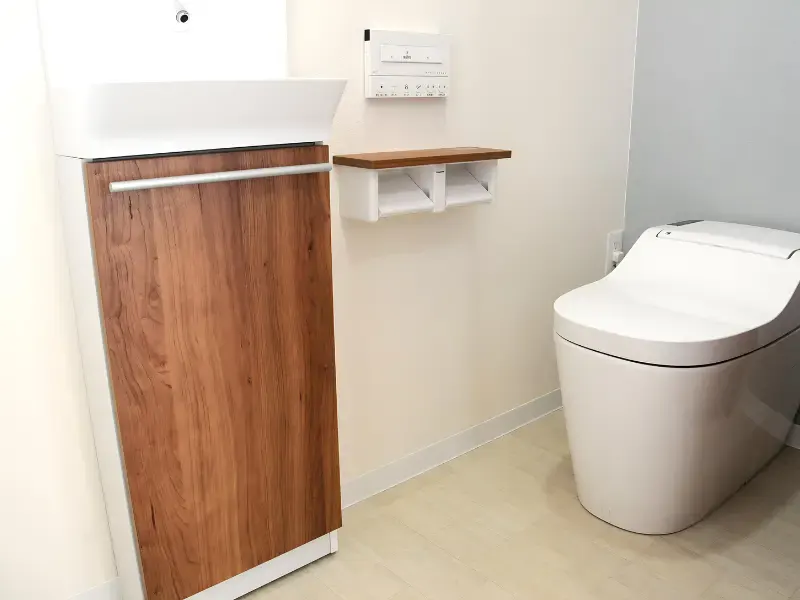
Deodorization and Plasmacluster Technology
Japanese toilets are also great at getting rid of bad smells. Some toilets use Plasmacluster ion technology to clean the bowl and kill bacteria, helping everything stay fresh. You can turn on features like ‘Bowl Sterilization’ or ‘Room Refresh’ using the remote, which activates built-in air purifiers and fans. Other toilets have something called a Power Deodorizer that turns on automatically when someone sits down, and it gets even stronger during the cleaning cycle.
These features keep the bathroom smelling clean and show how focused Japanese toilet designs are on hygiene and comfort. In contrast, toilets in many other countries often rely on large amounts of air fresheners or exhaust fans to mask odors. Japanese washlets take a different approach, removing odors at the source and creating a fresh environment without artificial fragrances.
What’s worth noting is that these deodorizers aren’t heavily scented, they’re designed to neutralize odors, not mask them. So you won’t get that overwhelming “floral cover-up” smell you’d find with cheap air fresheners. In line with Japan’s cultural preference that no smell is the best smell, the goal is a clean, fresh environment that simply doesn’t smell like anything at all.
Extra Features: Music, Night Lights, and Comfort Add-ons
Smart toilets come with some pretty fancy features that make using them even more enjoyable. They have built-in speakers that play 30 different classical and relaxing songs, a glowing base light to help you see at night, and a lid that closes by itself. You can choose how the music plays: random, repeat, or pick the song yourself for a calming vibe. The Night Light is super useful for late-night trips, so you don’t have to turn on bright lights. While Toto’s simpler models focus more on the basics like cleanliness, they still have important features like heated seats, automatic wand cleaning, and deodorizing. All of this shows how Japanese toilets combine luxury and practicality in one smart design.
Japanese Toilet Etiquette: Do’s and Don’ts
In Japan, you’ll find free restrooms conveniently available in parks, train stations, hotels, and other public spaces. To make the most of these facilities, follow a few simple tips. These will help ensure a smooth and stress-free experience.
EXPLORE JAPANESE CULTURE
Toilet etiquette is just the beginning. Read our Guide to Japanese Culture to learn more about festivals, food, and traditions.
Line Etiquette and Helpful Tips for Visitors
If the restroom is crowded, form a single, orderly line, usually just outside the entrance or along the wall. Unlike in some countries where people hover near the stalls or casually stake claims, Japan values clear, quiet order. There’s no need to knock, pace, or peer under doors. Just stand in line and wait your turn. Cutting the line isn’t just rude, it’s seen as a serious breach of etiquette that can really offend locals. In Japan, how you wait matters as much as what you’re waiting for.
Public bathrooms in Japan highlight the country’s sense of order and respect. If you want to see how this respect extends into other areas of life, the Ultimate Guide to Recycling and Garbage Disposal in Japan explains the strict but fascinating system for separating waste. It’s an essential read for anyone living in or visiting Japan.
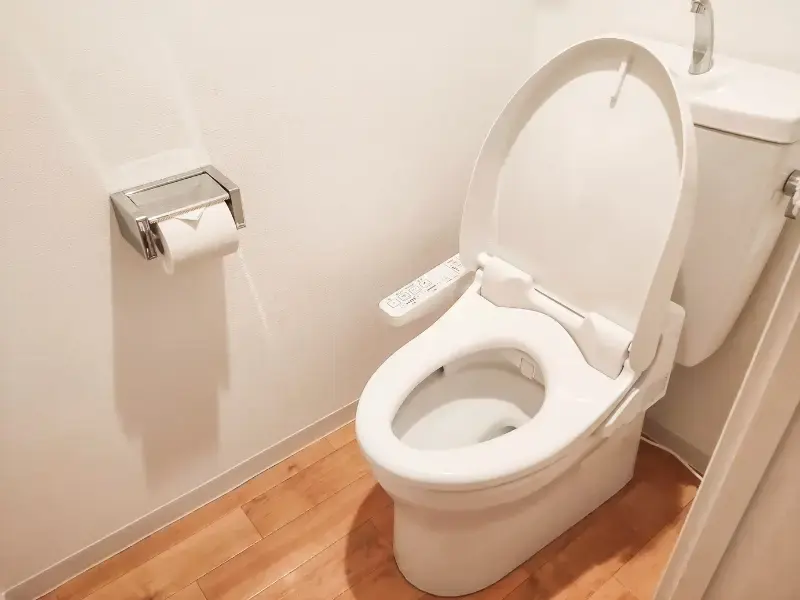
Navigating Through the Toilet
Sit Properly on the Toilet
Lift the hinged lid and sit on the seat as you would on a regular toilet after removing your undergarments. Please do not squat or stand on the seat, as this can damage the toilet and pose safety risks. In case of the squat pan, squat over the toilet with your back to the stall door and your face toward the raised dome or hooded end of the toilet.
Flush Used Toilet Paper
In Japan, toilet paper is designed to be flushed, so you can dispose of it directly in the toilet. However, do not flush anything else, including sanitary products, paper diapers, or non-toilet paper items. Women’s restrooms often have a small trash bin for sanitary items only.
Flush and Leave It Clean
Always flush after use and take a moment to leave the area tidy for the next person by wiping away any water stains or splashes and closing the lid if needed. Toilets may flush in different ways: Most commonly, there’s a lever on the side of the tank. Some modern toilets feature buttons, motion sensors, or remote controls on the wall near the toilet paper holder. Take a moment to locate the flush mechanism before or after use.
Installation, Maintenance and Cleaning
Initial Setup and Power Connection
Before you can enjoy a Japanese toilet, you’ll need to make sure it’s properly set up. That starts with removing your old toilet seat, usually a simple process with a screwdriver, and giving the area a good clean before installing anything new.
Japanese toilets require both electricity and a water connection. In Japan, bathrooms are typically designed with these in mind, but in other countries, things can get tricky. If your washlet doesn’t have a nearby power outlet or accessible water line, especially if the pipe is hidden behind tiles, you may need to call a professional. Otherwise, many models are fairly DIY-friendly and come with everything you need. Don’t forget to shut off the water before installation, and once everything is connected, you’ll know the washlet is working when the control panel lights up. Some even detect when you sit down and turn on automatically.
If in doubt, especially with hidden plumbing or electrical work, hiring a pro is worth it for peace of mind.
EXPERIENCE JAPANESE TEA
Discover the elegance of Japanese tea culture with our Ultimate Guide to Japanese Tea, from matcha ceremonies to daily green tea.
Nozzle Cleaning and Hygiene
Hygiene is a top priority when it comes to Japanese toilets, and all washlet brands make sure their nozzles stay clean by using sterilized water to wash them automatically. Some brands even have a button you can press to extend the nozzle for manual cleaning, which can be especially helpful after long periods of non-use or when dirt builds up. To keep everything working well, it’s best to skip harsh cleaners and use gentle ones that are safe for plastic. Some washlets take things a step further by cleaning the nozzle before and after every use. These features ensure thorough cleanliness and demonstrate the high hygiene standards of Japanese toilet design.
Manual Flushing and Emergency Use
Even if the power goes out, Japanese toilets are built to still work without any trouble. Some models have a red manual flush lever hidden behind a side panel, you just pull and hold it for five seconds to flush. Other washlets that aren’t hooked up to an automatic tank, you might need to lift the lid and use a regular flush button. These backup options make sure you can always use the toilet easily, showing how Japanese toilets are designed to be both high-tech and dependable.
Living in Japan often means adapting to unexpected situations, whether it’s power outages or unfamiliar systems. The Ultimate Guide to Banking in Japan provides everything you need to know about opening an account, transferring money, and navigating a system that can feel complex to newcomers.
Energy Saving Functions
Energy-saving features are another key advantage of Japanese smart toilets. Some toilet brands offer two main energy-saving options. One-Touch Power Save cuts down energy use for up to eight hours, while Advanced Power Save automatically lowers the seat and water temperature when no one is using the toilet. Some washlet brands are even smarter; they learn when you usually use the toilet and lower the heat during times you don’t. You can also set timers, like from 1 AM to 7 AM, to save power while still staying comfortable. These features show how Japanese toilets are designed to be both convenient and eco-friendly
Japan is famous for blending modern technology with sustainable practices. If you’re interested in the cultural side of these innovations, the Ultimate Guide to Seasons in Japan shows how seasonal changes influence daily habits, food, and traditions. It’s a great way to understand why Japanese products and lifestyles adapt so seamlessly throughout the year.
Safety Precautions
To ensure long-term performance and safety, it’s important to follow the instructions in the user manual. Don’t unplug the toilet with wet hands or let the plugs get wet, and avoid plugging too many things into one outlet. Check the hoses and power cords regularly for any damage or wear. Never use cleaners with chlorine because they can damage the inside parts. Also, avoid pressing too hard on the lid. If you won’t be using the toilet for a while, drain the water and unplug it. Following these easy steps helps keep your toilet safe and operate reliably.
ENJOY JAPANESE SWEETS
Looking for something sweet after your trip to the bathroom? Our Ultimate Guide to Japanese Sweets covers wagashi, mochi, and more.
Final Thoughts
Using a Japanese toilet might feel like stepping into the future at first, but once you get the hang of it, it becomes a smooth and even enjoyable part of your daily routine. From moving water sprays and heated seats to relaxing music and automatic features, everything is designed to make your bathroom experience more comfortable. Just take some time to read the manual for your specific model, and soon using a Japanese toilet will feel more like a relaxing spa visit than a regular chore.
Technology in Japan often reflects a balance between modern convenience and tradition. For a cultural experience that combines both, the Guide to the Japanese Tea Ceremony in Tokyo walks you through the meaning, rituals, and etiquette of this iconic tradition. It’s a perfect next step after exploring daily habits like toilets.
Related Articles:
Ultimate Guide to Japanese Road Signs
Ultimate Guide to Japanese Superstitions
Ultimate Guide to Improving Your Japanese Vocabulary
Ultimate Guide to Japanese Learning Apps
Guide to Japan Consumption Tax
Ultimate Guide to Health Insurance in Japan
The post How to Use a Japanese Toilet: A Complete Guide appeared first on Japan Switch.
]]>The post Ultimate Guide to the Top Japanese Clothing Brands appeared first on Japan Switch.
]]>Ultimate Guide to the Top Japanese Clothing Brands
By Christina Economos | August 30th, 2025
Top Japanese clothing brands are globally recognized for their innovation, craftsmanship, and unique aesthetic that blends tradition with modern style. From world-famous streetwear labels to minimalist everyday essentials and high-end runway designers, Japan has built a fashion scene that continues to influence global trends.
While some top Japanese clothing brands like BAPE or Onitsuka Tiger are hyped internationally, not all are everyday staples in Japan, many locals prefer subtler labels like MUJI, United Arrows, or Beams.
Whether you're shopping for quality basics, looking to elevate your wardrobe, or exploring what makes top Japanese clothing brands truly popular in Japan versus just overseas hype, this guide will walk you through the best names to know, how to shop them, and how to style them confidently. If you're searching for authentic, stylish, and culturally rich fashion, top Japanese clothing brands offer something for every style and budget.
This article is a part of our extensive series on Learning about Japan through Online Japanese Lessons at Japan Switch.
No More Cookie-Cutter Japanese Lessons!
At Japan Switch, we teach the Japanese you’ll actually hear, actually use, and actually need and not just textbook sentences you’ll never say.
What Makes Japanese Clothing Brands Unique?
Craftsmanship and Detail
Whether it’s a hand-dyed kimono, indigo-dyed denim from Okayama, or loopwheeled cotton sweatshirts, some of the top Japanese clothing brands are renowned for obsessive attention to material, design, and detail. This tradition stems from centuries of artisanal craft culture, such as kimono weaving in Kyoto or indigo dyeing in Tokushima, that continues to influence modern fashion. Many Japanese brands still partner with regional workshops and mills, ensuring that even casual clothing reflects a legacy of precision and pride in craftsmanship.
Innovation and Design
Designers like Issey Miyake (Pleats Please, Bao Bao) and Yohji Yamamoto (Y’s, Y-3 with Adidas) revolutionized global fashion by pushing boundaries in both form and fabric. Miyake pioneered pleating techniques that created garments which hold their shape over decades, while Yamamoto challenged Western silhouettes with oversized, deconstructed tailoring. Japanese innovation often blends cutting-edge textile technology with traditional practices, producing clothing that is both futuristic and timeless.
Subcultural Influence
Top Japanese clothing brands and the fashion scene thrive on subcultures, each generating distinctive aesthetics that ripple through the global industry. Harajuku popularized playful, layered streetwear and colorful experimentation, while Shibuya nurtured gyaru and casual American-inspired looks. Ura-Harajuku gave rise to brands like BAPE and Neighborhood, defining Japanese streetwear in the 1990s. Meanwhile, Tokyo’s business districts lean toward clean, minimalist styling seen in brands like United Arrows and Beams. These subcultural forces make Japanese fashion not a single style, but a spectrum of niche movements that brands continually draw inspiration from.
Experience Japanese by learning Japanese with our Ultimate Guide to Beginner Japanese!

Top Japanese Clothing Brands: Streetwear
BAPE (A Bathing Ape)
BAPE is one of the most iconic top Japanese clothing brands, known for its bold camouflage prints, shark hoodies, and playful collaborations with global labels. Founded in Harajuku in 1993, BAPE has grown into an international streetwear powerhouse. While BAPE is now a global name, it remains deeply rooted in Tokyo street culture through limited drops, Harajuku exclusives, and a culture of scarcity that makes each piece highly collectible. The BAPE Store Harajuku remains a pilgrimage spot for fans worldwide, offering a shopping experience that caters to both locals and international visitors, with English-friendly service and tax-free shopping.
Website: www.bape.jp
Main Store: Harajuku
Price Range: ¥8,000 - 60,000¥
WTAPS (Double Taps)
WTAPS represents the rugged, military-inspired side of top Japanese clothing brands, blending utilitarian aesthetics with streetwear sensibility. Founded by Tetsu Nishiyama in 1996, WTAPS became known for its tactical designs, oversized silhouettes, and subtle cultural references. The brand’s flagship HOODS store in Harajuku also stocks collaborative releases with its sister label, Neighborhood, making it a must-visit for serious streetwear fans. While English support is more limited here than at global-facing stores like BAPE, the brand’s reputation and distinct style attract a steady stream of international shoppers.
Website: www.wtaps.com
Main Store: GIP-Store Harajuku
Price Range: ¥15,000- ¥60,000
UNDERCOVER
UNDERCOVER, founded by Jun Takahashi, is another heavyweight among top Japanese clothing brands, bridging the gap between streetwear and high fashion. Known for its rebellious graphics, punk-inspired themes, and innovative collaborations, UNDERCOVER has built a cult following worldwide. Its flagship store in Aoyama, Tokyo, is designed as an immersive fashion environment, reflecting Takahashi’s avant-garde vision. While the atmosphere leans more conceptual than tourist-focused, English signage and international payment options make it accessible to foreign visitors looking for a unique experience in Japanese streetwear.
Website: www.undercoverism.com
Main Store: Aoyama
Price Range: ¥15,000- ¥120,000
Online Japanese Lessons That Actually Work.
Our affordable online Japanese lessons are built for busy learners with small groups, real conversations, and flexible schedules that work for you.
Online Japanese Lessons That Actually Work.
Our affordable online Japanese lessons are built for busy learners with small groups, real conversations, and flexible schedules that work for you.
Top Japanese Clothing Brands: Luxury & High Fashion Labels
Comme des Garçons
Comme des Garçons, founded by Rei Kawakubo in 1969, is celebrated for pushing boundaries with deconstructed silhouettes and bold, often provocative concepts. Its flagship Dover Street Market Ginza is a must-visit for anyone interested in top Japanese clothing brands, offering exclusive releases and collaborations in a gallery-like shopping experience. English-speaking staff are often available, and the store caters to international shoppers with tax-free options.
Website: www.comme-des-garcons.com
Main Store: Aoyama
Price Range: ¥10,000- ¥200,000
Youji Yamamoto
Yohji Yamamoto, equally legendary, is renowned for his mastery of draping, oversized tailoring, and monochrome palettes that challenge Western ideas of proportion. His flagship boutique in Aoyama, Tokyo provides a sleek, minimalist setting that reflects the designer’s aesthetic. While not every staff member speaks fluent English, the boutique is foreigner-friendly, and Yamamoto’s collections are also widely available through international luxury retailers.
Website: www.yohjiyamamoto.co.jp
Main Store: Aoyama
Price Range: ¥20,000- ¥300,000
Top Japanese Clothing Brands: Minimalist & Everyday Wear
Uniqlo
Uniqlo is perhaps the most famous top Japanese clothing brand worldwide, known for innovations like HeatTech, AIRism, and Ultra Light Down. While Uniqlo stores exist globally, its flagship in Ginza, Tokyo spans 12 floors and showcases exclusive Japan-only collections and designer collaborations. The staff are accustomed to international visitors, with English signage and tax-free shopping for tourists.
Website: www.uniqlo.com/jp
Main Store: Ginza
Price Range: ¥1,000- ¥15,000
MUJI
MUJI goes beyond clothing with its minimalist lifestyle concept, but its apparel line is a cornerstone of Japanese everyday wear. Simple cuts, neutral tones, and natural fabrics make MUJI clothing popular among those seeking understated elegance. Its MUJI Ginza flagship store in Tokyo is the largest in the world, offering clothing alongside furniture, food, and home goods, and is very foreigner-friendly with multilingual support.
Website: www.muji.com/jp
Main Store: Ginza
Price Range: ¥1,000- ¥15,000
Auralee
For those who want a more refined, boutique-level minimalist label, Auralee has become one of the rising stars among top Japanese clothing brands. Known for premium fabrics and sophisticated basics, Auralee offers elevated wardrobe staples that appeal to fashion-conscious consumers. The brand’s Aoyama store provides an intimate shopping experience, though English support can be limited, so it’s best suited for those with a bit of fashion knowledge
Website: www.auralee.jp
Main Store: Aoyama
Price Range: ¥15,000- ¥120,000
Top Japanese Clothing Brands: Affordable and Accessible Brands

GU
As the sister company of Uniqlo, GU is one of the most popular top Japanese clothing brands for budget-friendly yet stylish fashion. Known for fast trends and low prices, GU appeals especially to younger shoppers who want the look of designer-inspired pieces without the high cost. Its stores are everywhere in Japan, and the Shinjuku flagship offers a massive selection. English self-checkout kiosks and tax-free options make GU very tourist-friendly
Website: www.gu-global.com/jp
Main Store: Ginza
Price Range: ¥500- ¥5,000
Does GU have the Basics for Cheap?
GU is also considered an everyday wear brand, as they also sell plain colored everyday items, however they also have a few more accessories and certain articles that they switch out according to the season etc. Items such as cardigans or certain types of T-shirts are not so minimal and are not always stocked up but they offer both everyday wear and more seasonal items for a very good price.
WEGO
WEGO is a staple among Japanese youth culture, particularly in Harajuku, offering quirky, colorful, and trend-driven styles at very affordable prices. As one of the most playful top Japanese clothing brands, WEGO often collaborates with anime, pop culture icons, and local artists, making it popular among students and tourists alike. The WEGO Harajuku store is especially foreigner-friendly, with lots of signage in English and staff accustomed to international shoppers.
Website: www.wego.jp
Main Store: Harajuku
Price Range: ¥1,000- ¥8,000
Uniqlo (Budget Basics)
While already covered as a minimalist staple, Uniqlo also belongs here as one of the most accessible top Japanese clothing brands for everyday basics. Its price point is lower than most international brands of similar quality, making it a go-to for tourists stocking up on affordable wardrobe essentials. The brand’s countless locations across Japan, combined with easy tax-free shopping and English-friendly service, make Uniqlo a must-visit for any traveler.
Check out more of Uniqlo's Brand here.
Nano Universe
Nano Universe strikes a balance between affordability and sophistication, offering modern, urban-inspired clothing at mid-range prices. As one of the younger top Japanese clothing brands, it has become popular with both students and young professionals who want refined looks without the luxury price tag. Its flagship store in Shibuya provides a polished shopping experience, though English support is more limited compared to Uniqlo or GU.
Website: www.nanouniverse.jp
Main Store: Shibuya
Price Range: ¥5,000- ¥40,000
Top Japanese Clothing Brands: Emerging & Designer-Led Labels
Children of the Discordance
Children of the Discordance is one of the most exciting top Japanese clothing brands redefining streetwear through cultural references, vintage fabrics, and intricate patchwork designs. Founded by Shikama Hideaki, the label is rooted in themes of identity and rebellion, often repurposing vintage bandanas and fabrics into fresh, high-end creations. While not as widely available as bigger streetwear labels, the brand has gained global attention through fashion weeks and exclusive stockists in Tokyo and abroad.
Website: www.childrenofthediscordance.com
Main Store: No standalone flagship — stocked in select boutiques (e.g., GR8 Harajuku, United Arrows, international retailers)
Price Range: ¥20,000- ¥150,000
MeansWhile
Meanswhile is a rising Japanese clothing brand that blends functional design with elevated aesthetics. Known for modular outerwear, technical fabrics, and utilitarian details, the brand caters to those who value both practicality and refined style. Its philosophy of “design is not for design’s sake” emphasizes wearability, making it stand out in Japan’s fashion scene. While its presence is still niche, select Tokyo boutiques and online retailers stock Meanswhile, making it accessible to fashion-forward travelers who seek something unique.
Website: www.meanswhile.net
Main Store: Shibuya
Price Range: ¥15,000- ¥100,000
Hender Scheme
Hender Scheme has carved out a reputation as one of the most original top Japanese clothing brands, blending artisanal craftsmanship with playful reinterpretations of classic footwear and accessories. Famous for its “Hommage” line, where luxury sneakers are reimagined in natural leather, Hender Scheme bridges the gap between art, design, and fashion. The brand’s flagship store in Asakusa, Tokyo, reflects its artisanal spirit, offering a curated experience for visitors. Though not mass-market, its international recognition makes it a must-visit for those exploring Japan’s emerging fashion scene.
Website: www.henderscheme.com
Main Store: Sukiya-bashi showroom (Near Ginza)
Price Range: ¥10,000- ¥150,000
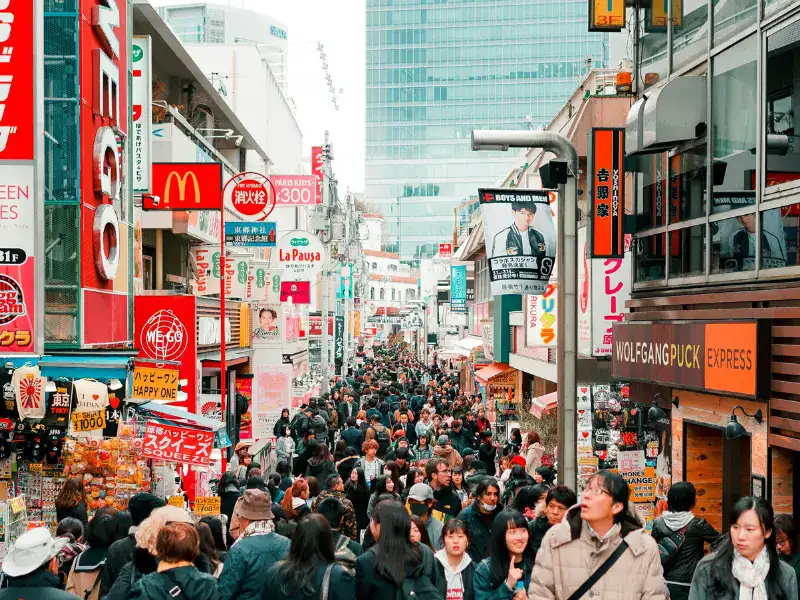
What Japanese People Actually Wear vs. International Hype
Tourist Favorites vs. Local Staples
Many travelers come to Japan eager to shop iconic top Japanese clothing brands like Onitsuka Tiger sneakers, BAPE streetwear, or cult denim labels such as Momotaro and Samurai Jeans. These names are popularized internationally and often top “must-buy” lists. However, Japanese locals usually prefer more subtle, versatile labels like United Arrows, MUJI, GU, or Beams, which better suit everyday life in Japan. While Uniqlo is still heavily shopped by both groups, it’s worth noting that for locals, Uniqlo is a routine stop, whereas for foreigners, flagship stores like Uniqlo Ginza are often a sightseeing destination in themselves.
Make friends with locals with our Top 15 Tips to Make Japanese Friends!
Quiet Luxury and Understatement
One defining characteristic of top Japanese clothing brands is their focus on subtlety and refinement rather than logos or loud statements. Unlike many Western fashion trends, which lean toward bold branding, Japanese fashion often embraces muted colors, minimal silhouettes, and a concept of understated elegance. This approach reflects cultural values of modesty and attention to detail, where the quality of materials and the way garments are worn matter more than overt status signaling.
Fast Fashion with a Twist
Fast fashion in Japan looks different from its Western counterparts. Brands like GU and Uniqlo are prime examples of top Japanese clothing brands that balance affordability with thoughtful design tailored to the Japanese lifestyle. Clothing is cut to match local sizing standards, engineered for seasonal comfort (such as Uniqlo’s HEATTECH for winters or AIRism for hot summers), and designed to be layered or mixed with both casual and formal wardrobes. This blend of accessibility and practicality makes Japanese fast fashion a distinct part of the country’s clothing culture.
How to Shop Japanese Brands (Locally & Abroad)
Explore Tokyo Neighborhoods
Tokyo is the heart of shopping for top Japanese clothing brands, offering everything from luxury boutiques to underground streetwear. In Harajuku, you’ll find flagship stores for cult streetwear brands like BAPE alongside quirky independent shops. Shibuya offers trend-driven fashion with major department stores and accessible labels like GU and Uniqlo, while Daikanyama caters to a more refined crowd with high-end boutiques, lifestyle stores, and minimalist designers. Each neighborhood highlights a different side of Japan’s diverse fashion culture, making them essential stops for both tourists and locals.
Online Stores That Ship Worldwide
If you can’t make it to Japan, several online platforms carry top Japanese clothing brands and ship internationally. Rakuten and Mercari are great for scoring deals and rare finds, while Zozotown is Japan’s largest fashion marketplace with a wide variety of labels. For curated selections, platforms like SSENSE and Grailed often stock Japanese designers, including Comme des Garçons, WTAPS, and Auralee, sometimes with global shipping options. These sites make it possible to access authentic Japanese fashion no matter where you live.
Understanding Japanese Sizing
Sizing is one of the biggest hurdles when shopping for top Japanese clothing brands. Generally, Japanese sizes run smaller than Western equivalents, so what’s labeled as “L” in Japan might fit more like an “M” elsewhere. Many brands and online shops provide conversion charts, but when possible, it’s best to try clothing on in person. This is especially true for tailored pieces or denim, where fit is a core part of the design.
Avoiding Fakes and Replicas
Because of their global reputation, top Japanese clothing brands like BAPE and Comme des Garçons are frequently counterfeited. To avoid knockoffs, it’s important to buy directly from flagship stores, official retailers, or trusted resale platforms that offer authentication. Shops in Harajuku and Shibuya, as well as online sites like Grailed and StockX (for sneakers and streetwear), are safer bets. Being cautious not only ensures quality but also supports the designers who built these brands’ reputations.
Buy Japanese omiyage while shopping in Japan with our Ultimate Guide to Japanese Omiyage!
Is It Worth It? Price, Quality, and Style Fit
When to Splurge vs. Save
Not every purchase from top Japanese clothing brands needs to break the bank. It's about knowing when to splurge and when to save. Investing in a Youji Yamamoto coat or a piece from Comme des Garçons can be worthwhile thanks to timeless design, impeccable tailoring, and materials that last decades. On the other hand, basics from Uniqlo or GU serve perfectly for daily wear, offering functionality and comfort at a fraction of the cost.
Japan Exclusive Items that are Worth Considering
Certain global brands release Japan-exclusive items that are highly sought after, like The North Face Purple Label. These pieces often use upgraded fabrics or construction techniques that aren’t available in overseas versions, making them a smart splurge if you’re looking for something unique that reflects Japanese design sensibilities, and totally worth splurging for.
Check out more about Japan's North Face Purple Label Store here.

Materials and Durability
A major reason people seek out top Japanese clothing brands is the reputation for premium materials and durability. From loopwheeled cotton sweatshirts that retain their shape after years of wear to selvedge denim crafted in Okayama that can last decades, Japanese designers take fabric selection seriously. Brands also incorporate plant-dyed wools, natural indigo, and hand-finished textiles, making their garments not just clothes but long-term investments.
Ethical and Sustainable Options
In recent years, sustainability has become more central in the world of top Japanese clothing brands. Emerging designers and even established houses are exploring natural dyeing techniques, upcycling vintage materials, and slow fashion manufacturing practices that reduce environmental impact. Brands like Children of the Discordance and Kapital have experimented with upcycled textiles, while smaller ateliers focus on hand-dyeing and artisanal production. For conscious consumers, this makes Japanese fashion a way to invest in both style and sustainability.
Hidden Gems: Underrated Japanese Brands Worth Discovering
Cult-Favorite Indie Labels
Some of the most intriguing top Japanese clothing brands aren’t the ones you see in every tourist guide. Labels like Kapital, Kijima Takayuki, and Evisen Skateboards have quietly gained cult followings for their originality, exceptional craftsmanship, and unique approach to design. Kapital, for example, is known for inventive denim and patchwork, while Kijima Takayuki elevates classic hats and accessories into statement pieces. Evisen Skateboards blends streetwear with skate culture, producing apparel that resonates with insiders and collectors alike.
Genderless and Experimental Brands
Japan’s fashion scene is increasingly embracing genderless and experimental designs. Brands such as FUMITO GANRYU and Auralee push boundaries by challenging traditional fashion categories, creating clothing that emphasizes form, texture, and movement over conventional gender norms. These labels represent a growing movement within top Japanese clothing brands toward inclusivity, avant-garde aesthetics, and versatile pieces that can be styled in multiple ways.
Where to Find These Hidden Brands
Discovering these hidden top Japanese clothing brands requires looking beyond mainstream chain stores. Secondhand shops and boutiques in Koenji often carry rare finds, while Nakameguro hosts carefully curated stores that highlight emerging designers. Online platforms like Rakuten and Zozotown also feature niche labels that are hard to find elsewhere. And of course, classic fashion hubs like Harajuku and Shibuya can still yield unexpected treasures if you know where to look. For fashion explorers, seeking out these hidden gems can lead to unique pieces that set your wardrobe apart.
Final Thoughts
Top Japanese clothing brands offer so much more than just stylish garments, they reflect a deep cultural philosophy, a dedication to craftsmanship, and a unique fusion of tradition and innovation. Whether you're drawn to bold streetwear icons like BAPE, refined minimalism from brands like Auralee, or hidden gems tucked away in Tokyo’s backstreets, there’s something in top Japanese clothing brands for every kind of style explorer. By understanding what locals actually wear, how to shop smartly (both online and in Japan), and how to incorporate these pieces into your own wardrobe with confidence, you not only elevate your fashion sense, you can also connect with a culture that values intention, individuality, and subtle expression. So whether you're starting small with Uniqlo basics or diving into avant-garde runway pieces, Top Japanese clothing brands have something to offer anyone ready to look deeper.
Related Articles:
Ultimate Guide to Japanese Culture
Ultimate Guide to Japanese Customs
Ultimate Guide to Fashion in Japan
Ultimate Guide to Getting a Tattoo in Japan
Ultimate Guide to Japanese Pop Culture
The post Ultimate Guide to the Top Japanese Clothing Brands appeared first on Japan Switch.
]]>